Part 1 of 7 · JLPT N2
土神ときつね Dojin to Kitsune, part 1: A Birch Tree and Her Two Friends
In this part
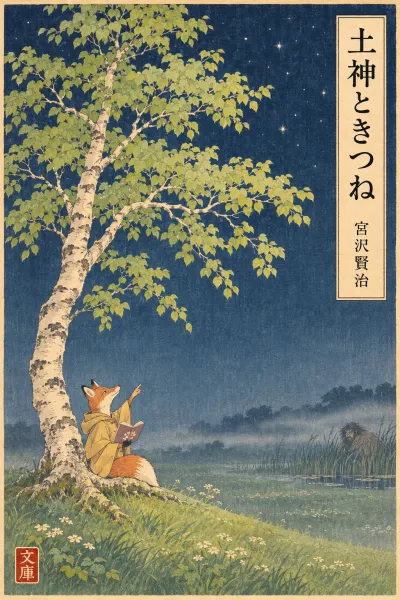
On a small hill at the northern edge of Ippongi meadow stands a lovely birch tree. She has two friends: a rough, shabby Earth God who lives in a nearby marsh, and a refined, well-dressed fox, whom she prefers. On an early-summer night the fox visits her with a book of poems and shows off his knowledge of the stars.
AI translation · independently checked
(一)(One)
一本木の野原の、北のはずれに、少し小高く盛りあがった所がありました。At the northern edge of the meadow of Ippongi there was a place where the ground rose up into a low mound.
いのころぐさがいっぱいに生え、そのまん中には一本の奇麗な女の樺の木がありました。Foxtail grass grew thickly all over it, and right in the middle stood a single beautiful female birch tree.
それはそんなに大きくはありませんでしたが幹はてかてか黒く光り、枝は美しく伸びて、五月には白い花を雲のようにつけ、秋は黄金や紅やいろいろの葉を降らせました。She was not very big, but her trunk shone a glossy black, her branches spread out gracefully, in May she put out white blossoms like clouds, and in autumn she let fall leaves of gold and crimson and many other colours.
ですから渡り鳥のかっこうや百舌も、又小さなみそさざいや目白もみんなこの木に停まりました。So migratory birds such as cuckoos and shrikes, and also little wrens and white-eyes, all perched in this tree.
ただもしも若い鷹などが来ているときは小さな鳥は遠くからそれを見付けて決して近くへ寄りませんでした。Only, if a young hawk or some such bird was there, the small birds spotted it from far away and would never come near.
この木に二人の友達がありました。This tree had two friends.
一人は丁度、五百歩ばかり離れたぐちゃぐちゃの谷地の中に住んでいる土神で一人はいつも野原の南の方からやって来る茶いろの狐だったのです。One was the Earth God, who lived in a soggy marsh just about five hundred paces away, and the other was a brown fox who always came over from the southern side of the meadow.
樺の木はどちらかと云えば狐の方がすきでした。If anything, the birch tree liked the fox better.
なぜなら土神の方は神という名こそついてはいましたがごく乱暴で髪もぼろぼろの木綿糸の束のよう眼も赤くきものだってまるでわかめに似、いつもはだしで爪も黒く長いのでした。For though the Earth God did bear the name of a god, he was very rough, his hair was like a bundle of frayed cotton thread, his eyes were red, his clothes looked just like seaweed, and he always went barefoot, with long black nails.
ところが狐の方は大へんに上品な風で滅多に人を怒らせたり気にさわるようなことをしなかったのです。The fox, on the other hand, had very refined manners and hardly ever did anything to anger or offend anyone.
ただもしよくよくこの二人をくらべて見たら土神の方は正直で狐は少し不正直だったかも知れません。Still, if you had compared the two of them very carefully, you might have found that the Earth God was honest and the fox a little dishonest.
(二)(Two)
夏のはじめのある晩でした。It was an evening at the beginning of summer.
樺には新らしい柔らかな葉がいっぱいについていいかおりがそこら中いっぱい、空にはもう天の川がしらしらと渡り星はいちめんふるえたりゆれたり灯ったり消えたりしていました。The birch was covered with new, soft leaves, and a sweet scent filled the air all around; in the sky the Milky Way already stretched pale and white, and the stars everywhere were trembling and swaying, lighting up and going out.
その下を狐が詩集をもって遊びに行ったのでした。It was beneath this sky that the fox went to visit her, carrying a book of poems.
仕立おろしの紺の背広を着、赤革の靴もキッキッと鳴ったのです。He wore a brand-new navy-blue suit, and his red leather shoes squeaked as he walked.
「実にしずかな晩ですねえ。」"What a truly quiet evening it is."
「ええ。」樺の木はそっと返事をしました。"Yes," the birch tree answered softly.
「蝎ぼしが向うを這っていますね。あの赤い大きなやつを昔は支那では火と云ったんですよ。」"The Scorpion is crawling along over there, isn't it? Long ago in China they called that big red one 'Fire'."
「火星とはちがうんでしょうか。」"Isn't that different from Mars?"
「火星とはちがいますよ。火星は惑星ですね、ところがあいつは立派な恒星なんです。」"Oh, it's quite different from Mars. Mars is a planet, you see, whereas that one is a proper fixed star."
「惑星、恒星ってどういうんですの。」"What do you mean by a planet and a fixed star?"
「惑星というのはですね、自分で光らないやつです。つまりほかから光を受けてやっと光るように見えるんです。恒星の方は自分で光るやつなんです。お日さまなんかは勿論恒星ですね。あんなに大きくてまぶしいんですがもし途方もない遠くから見たらやっぱり小さな星に見えるんでしょうね。」"A planet, you see, is a thing that doesn't shine by itself. In other words, it only seems to shine because it receives light from something else. A fixed star, on the other hand, shines by itself. The sun, of course, is a fixed star. It's so big and dazzling, but if you looked at it from an enormous distance, I expect it would look like a little star after all."
「まあ、お日さまも星のうちだったんですわね。そうして見ると空にはずいぶん沢山のお日さまが、あら、お星さまが、あらやっぱり変だわ、お日さまがあるんですね。」"Goodness, so the sun is one of the stars too. Seen that way, there are ever so many suns in the sky—oh, I mean stars—no, it still sounds odd—suns, aren't there?"
狐は鷹揚に笑いました。The fox gave a generous laugh.
「まあそうです。」"Well, yes, that's about it."
「お星さまにはどうしてああ赤いのや黄のや緑のやあるんでしょうね。」"I wonder why some stars are red like that, and some yellow, and some green?"
狐は又鷹揚に笑って腕を高く組みました。The fox laughed magnanimously again and folded his arms high across his chest.
詩集はぷらぷらしましたがなかなかそれで落ちませんでした。The book of poems dangled, but it did not fall even so.
「星に橙や青やいろいろある訳ですか。それは斯うです。全体星というものははじめはぼんやりした雲のようなもんだったんです。"You mean why stars come in orange and blue and all sorts of colours? It's like this. To begin with, every star was at first something hazy, like a cloud.
いまの空にも沢山あります。たとえばアンドロメダにもオリオンにも猟犬座にもみんなあります。There are plenty in the sky even now. For example, there are some in Andromeda, in Orion and in the Hunting Dogs—in all of them.
猟犬座のは渦巻きです。それから環状星雲というのもあります。魚の口の形ですから魚口星雲とも云いますね。そんなのが今の空にも沢山あるんです。」The one in the Hunting Dogs is a spiral. Then there's also what they call the Ring Nebula. Because it's shaped like a fish's mouth, it's also called the Fish-Mouth Nebula. There are plenty of those in the sky even today."
Vocabulary
| Word | Meaning | JLPT |
|---|---|---|
| 小高くこだかい | slightly raised, forming a low risedictionary form: 小高い小 here means 'somewhat' rather than 'small'. | — |
| 幹みき | trunk (of a tree) | N1 |
| てかてかてかてか | glossy, shinyMimetic word for a smooth, slick shine. | — |
| 渡り鳥わたりどり | migratory birdFrom 渡る 'to cross over'; note rendaku とり → どり. | N1 |
| 谷地やち | marsh, boggy low groundMainly used in northeastern Japan and in place names. | — |
| 土神つちがみ | Earth God, local god of the land | — |
| 乱暴らんぼう | rough, violent, unruly | N2 |
| 上品じょうひん | refined, elegantOpposite: 下品 (げひん) 'vulgar'. | — |
| 滅多にめったに | rarely, hardly everAlways used with a negative verb. | N3 |
| 不正直ふしょうじき | dishonest不 + 正直 'honest'; 不 makes a negative. | — |
| 仕立おろししたておろし | newly tailored, worn for the first timedictionary form: 仕立て下ろし | — |
| 背広せびろ | (men's) suitSlightly old-fashioned; today スーツ is more common. | N5 |
| 恒星こうせい | fixed star (a star that shines by itself)Contrasted here with 惑星 (わくせい) 'planet'. | — |
| 鷹揚おうよう | magnanimous, generous and relaxedSuggests the calm, superior air of someone of high standing. | — |
Grammar
どちらかと云えば N3 if anything; if I had to choose
This sets up a mild preference between two options. It softens the statement, so the birch only slightly prefers the fox.
樺の木はどちらかと云えば狐の方がすきでした。
If anything, the birch tree liked the fox better.
〜こそ〜が N2 it is true that ..., but ...
こそ puts strong stress on the word before it, and the following が turns this into a concession. The god has the name of 'god', but his looks and behaviour do not match it.
神という名こそついてはいましたがごく乱暴で
though he did bear the name of a god, he was very rough
〜たり〜たり N4 doing things like ... and ...
This lists representative actions or states without giving a complete list. In this passage it joins 怒らせる and 気にさわる, and it also describes the stars trembling, swaying, lighting up and going out.
滅多に人を怒らせたり気にさわるようなことをしなかったのです
hardly ever did anything to anger or offend anyone
〜かも知れません N4 may, might
This expresses a possibility. The narrator gently hints at the fox's dishonesty without stating it as fact.
狐は少し不正直だったかも知れません。
the fox might have been a little dishonest.
〜というのは〜です N3 what is called ... is ...
This introduces a term in order to define it. The fox uses it to sound like a lecturer, and the added ですね makes him sound even more pompous.
惑星というのはですね、自分で光らないやつです。
A planet, you see, is a thing that doesn't shine by itself.
〜訳ですか N3 you mean the reason why ...?
訳 here means 'reason' or 'explanation'. The fox repeats her question as 'the reason the stars have various colours' before he answers it.
星に橙や青やいろいろある訳ですか。
You mean why stars come in orange and blue and all sorts of colours?