Intermediate · JLPT N3
伸び支度Nobijitaku — Getting Ready to Grow
- JLPT N3
- 6,093 characters
- 5 parts
- about 51 minutes
- 2 easier versions
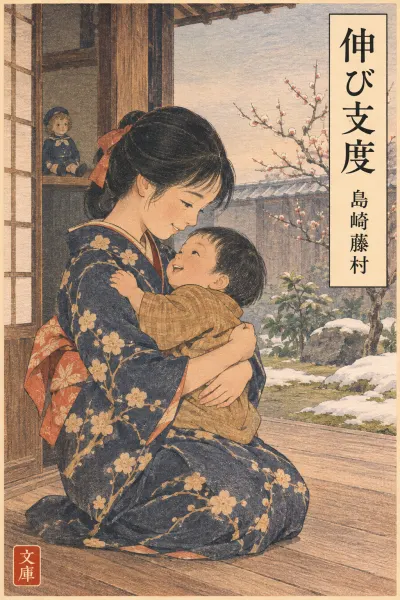
"Getting Ready to Grow" is a short, quiet story by Shimazaki Tōson about a girl on the edge of adulthood. Sodeko, fourteen or fifteen, lives with her widowed father, two elder brothers and their maid, O-Hatsu. She has put away the dolls she once loved and drifted apart from her old playmate Mitsuko. Now she dotes on Kinnosuke, a neighbour's toddler who can say only "chā-chan." Her father, who has raised her alone and dressed her to his own taste, would like her to stay his little doll-daughter forever. One morning a change in her body begins to alter how she sees herself and her family. The story treats this moment with great delicacy, mostly through what is left unsaid. The tone is gentle and reflective, and the narration moves between Sodeko's feelings and her father's. For learners, the story is short and carefully structured, and the dialogue clearly shows differences in speech by gender and status. The challenges are the literary narration, the long reflective sentences and some old-style kanji and spellings. Because the central event is described so indirectly, you will need to read closely and notice implication.
Contents
Easier versions
This story is also retold in simpler Japanese. Reading an easier version first makes the original much more approachable.
Before you read
- Track who is speaking by speech style. O-Hatsu and Mitsuko use soft, polite feminine forms (お遊びなさいな, ~んですよ). Father uses plain, warm masculine speech (俺, ~だなあ, ~ぜ). The elder brother is blunt and rough (オイ, 弱虫め). These differences often tell you the speaker even when no name is given.
- Learn the core vocabulary first: 人形 (doll), 女中 (maid), 学校, 弱虫 (weakling), 母親, and the toddler's word ちゃアちゃん, which he uses for both Sodeko and O-Hatsu. Older spellings also appear, such as 独逸 (Germany, ドイツ) and 遽かに (にわかに, suddenly). If a kanji looks unfamiliar, check whether it is an old form of a common word.
- The narration often looks back on habits and inner states. Expect patterns like ~たものだ (used to…), ~ずにはいられない / ~なしにはいられない (cannot help…), いくつ~か知れない (who knows how many…), and ~ねばならない (must). Recognising these will make the long reflective sentences much easier to parse.
- Watch for ~ときたら (as for…, often with mild exasperation), ~たり~たりする, ~だ~だと言って (saying this and that), and the honorific お~になる. These carry much of the story's characterisation and tone.
- Sodeko's first period is never named directly. It is conveyed through O-Hatsu's care, Father's confusion and Sodeko's feelings. Read parts 3–5 slowly, and don't expect a single explicit sentence to explain what has happened.
Words to know
The most useful words from the notes across the story.
| Word | Meaning | JLPT |
|---|---|---|
| 見立てみたてる | to choose, to pick out (with a discerning eye)dictionary form: 見立てるTypically used for choosing clothes or goods for someone. | — |
| 畠はたけ | field; (figuratively) area of expertise畑 is the usual kanji; 〜の畑 means 'one's specialty'. | N3 |
| 恢復かいふく | recovery; to recover (health)dictionary form: 回復恢復 is the older spelling of 回復. | N3 |
| 護らまもる | to protect, to guarddictionary form: 護る護 is a literary spelling of 守る, suggesting defence or shelter. | N3 |
| 欠けたりかける | to wane (of the moon); to be chipped or missingdictionary form: 欠ける満ちる (wax) and 欠ける (wane) are the standard pair for the moon. | N3 |
| 漸くようやく | only just, barelyHere it stresses how young she still is, not 'finally'. | N2 |
| 派手はで | showy, bright, flashyOpposite of 地味 (じみ, plain, sober). | N2 |
| 曖昧あいまい | vague, unclear | N2 |
| 兼ねてかねる | to serve also as, to combine (roles)dictionary form: 兼ねる | N2 |
| 口実こうじつ | excuse, pretext | N2 |
| 遽かににわか | suddenlydictionary form: 俄か遽 is an old-style kanji; the usual modern spelling is 俄かに or にわかに. | N2 |
| 相違そうい | difference, disparityA more formal word than 違い. | N2 |
| 覗いてのぞく | to peep into, to glimpsedictionary form: 覗くSeeing only part of something, as through a gap. | N2 |
| 大概たいがい | most, the majority ofAlso used as an adverb meaning 'usually' or 'probably'. | N1 |
| 風俗なり | dress, appearance (dictionary reading ふうぞく, 'customs; manners; style of dress'; the author glosses it here as なり)Normally read ふうぞく ('customs, manners'); the author glosses it with なり, i.e. 'how one is dressed'. | N1 |
Plot summary
Show the full summary (contains spoilers)
Sodeko has outgrown her dolls, including a foreign boy doll her father bought at Maruzen before the earthquake. She no longer plays with lively Mitsuko next door and instead fusses over little Kinnosuke. Her father jokes that the toddler is her doll, though he knows he has treated Sodeko herself as his own doll-daughter. One morning Sodeko has her first period. O-Hatsu quietly looks after her, while Father, unsure what has happened, makes excuses for her absence from school. One brother scolds her as a weakling, and O-Hatsu defends her. Father senses that her childhood has ended. Sodeko returns to school feeling shy and alone and longs for her dead mother. She recovers feeling healthier than ever, but sad. She now sees how she differs from her carefree brothers and thinks of her mother, who died of bleeding after giving birth to her. Caught between childhood and womanhood, she finds she can no longer hold Kinnosuke as she once did.
About the author
Shimazaki Tōson was a Japanese poet and novelist, born in Magome in the old Shinano region. He first became known as a poet of the new-style verse movement with the collection Wakanashū. He then turned to prose. His novel Hakai (The Broken Commandment) is regarded as a landmark of Japanese naturalist fiction, and he went on to write autobiographical novels. His late historical novel Yoake mae (Before the Dawn) is set in his home region during the Meiji Restoration.