 N3 · easy
Simplified retelling · JLPT N3
花のき村と盗人たち Hana Noki Mura to Nusubitotachi in easy Japanese (N3)
This is our own simplified retelling of Five Thieves Come to Hananoki Village, written for N3 learners and checked word by word against the N3 vocabulary list. A few story words and grammar patterns go beyond N3; the notes below give each one's level. It keeps the characters, events and ending of the original. When it feels easy, move on to the original text.
The story in brief
Five thieves arrive in peaceful Hananoki Village, but the four new apprentices keep forgetting they are thieves. A little boy trusts the chief with his calf, and being trusted for the first time melts the chief's heart. He confesses to a kind village official, sends his apprentices away to live honestly, and the villagers decide the boy was probably the stone Jizō by the bridge.
AI translation · independently checked
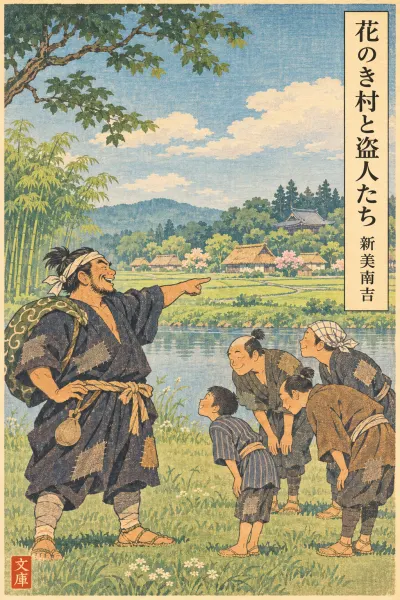
むかし、花のきむらに、五人のどろぼうがやって来ました。Long ago, five thieves came to Hananoki Village.
夏の初めの昼でした。It was midday at the start of summer.
むらの入口では、子供や牛が遊んでいました。At the entrance to the village, children and cows were playing.
平和なむらです。It was a peaceful village.
どろぼうたちは「このむらには、お金持ちの家があるだろう」と喜びました。The thieves were delighted. "There must be some rich houses in this village," they said.
どろぼうのかしらが言いました。The chief of the thieves spoke up.
「わしはここで待っている。おまえたちはむらに入って、様子を見て来い。」四人の弟子は、昨日どろぼうになったばかりでした。"I'll wait here. You lot go into the village and see how things look." The four apprentices had only become thieves the day before.
一人はかまを作る職人、一人はかぎ屋、一人はふえをふいて遊びを見せる少年、一人は大工の息子でした。One was a craftsman who made kettles, one was a locksmith, one was a boy who played the flute and put on shows, and one was a carpenter's son.
最初に、かま職人が戻って来ました。The kettle-maker came back first.
「大きいかまと、おてらの大きいかねがありました。」手には、あなのあいたなべを持っています。"There were big kettles, and a big bell at the temple." In his hand he was holding a pot with a hole in it.
「このなべを直しましょうと、つい言ってしまいました。」かしらは「おまえはどろぼうだぞ」としかりました。"I couldn't help it, I went and said, 'Let me mend this pot for you.'" The chief scolded him: "You're a thief, remember!"
次に、かぎ屋が戻って来ました。Next, the locksmith came back.
「このむらのかぎは弱くて、仕事になりません。」かしらは「それこそ、どろぼうにはいいむらじゃないか」と言いました。"The locks in this village are so weak there's no work to be had." The chief said, "Well, that's exactly what makes it a good village for thieves, isn't it?"
少年は、ふえをふきながら帰って来ました。The boy came back playing his flute.
「白いひげのおじいさんが、美しい曲をふいてくれました。お礼に、とんぼがえりを見せました。」大工の息子は、「お金持ちの家のてんじょうが、すばらしい一まいのいたでした」と言いました。"An old man with a white beard played a beautiful tune for me. To thank him, I showed him my somersaults." The carpenter's son said, "The ceiling in the rich man's house was one single, splendid board."
かしらはあきれて、四人をもう一度むらへ行かせました。The chief was dumbfounded, and he sent the four of them back into the village once more.
かしらが一人で休んでいると、七さいぐらいのかわいい男の子が、子牛をつれて来ました。While the chief was resting alone, a sweet little boy of about seven came along, leading a calf.
小さいわらじをはいています。He was wearing tiny straw sandals.
「おじさん、この牛、持っていてね。」男の子はそう言うと、友達のほうへ走って行ってしまいました。"Mister, hold this calf for me, will you?" With that, the boy ran off toward his friends.
かしらは笑いました。The chief laughed.
「どろぼうが、子牛をあずかったぞ。」でも、笑っているうちに、なみだが止まらなくなりました。"Well, now! A thief's been left to mind a calf!" But as he laughed, his tears began to flow and would not stop.
かしらは今まで、みんなにきらわれてきました。All his life until then, the chief had been disliked by everyone.
かしらが通ると、人々は窓を閉めました。When he passed by, people shut their windows.
池の魚もにげました。Even the fish in the ponds swam away.
でも、この子供はかしらを信じて、子牛をあずけてくれました。But this child had trusted him and left his calf in his care.
子牛も、おとなしくそばに立っています。The calf, too, stood quietly by his side.
人に信じてもらったのは、初めてでした。It was the first time anyone had ever trusted him.
かしらは、久しぶりに美しい心になりました。For the first time in a long while, the chief's heart became beautiful.
夕方になりました。Evening came.
月が出ても、男の子は帰って来ません。Even after the moon came out, the boy did not come back.
そこへ、四人の弟子が戻って来ました。Just then, the four apprentices returned.
「かしら、今度はしっかり調べて来ました。」でも、かしらは言いました。"Chief, this time we've looked into everything properly." But the chief said:
「この子牛を、あの子に返したいのだ。いっしょに探してくれ。」わけを聞いて、弟子たちもかしらの気持ちが分かりました。"I want to give this calf back to that boy. Help me look for him." When they heard the reason, the apprentices understood how their chief felt.
五人は、夜のむらを探して歩きました。The five of them walked through the village at night, searching.
木の上も、物置の中も見ました。They looked up in the trees and inside the storage sheds.
でも、子供は見つかりません。But the child was nowhere to be found.
むらの人も、この子牛を知りませんでした。The villagers did not know the calf either.
「あとは、役人のところへ行くしかありません。」かしらは少し考えて、「じゃ、行こう」と言いました。"All that's left is to go to the village official." The chief thought for a moment and said, "All right, let's go."
役人は、めがねをかけた優しい老人でした。The official was a kind old man who wore spectacles.
「どろぼうなら、物を返しに来るはずがない。うたがって悪かった。」老人は子牛をあずかり、五人に酒を出してくれました。"If you were thieves, you'd hardly come to return something. I was wrong to doubt you." The old man took charge of the calf and served the five of them sake.
みんなで楽しく話しました。They all talked together happily.
かしらは、また、なみだが出ました。Once again, tears came to the chief's eyes.
家を出たあと、かしらは立ち止まりました。After they had left the house, the chief stopped in his tracks.
「忘れ物がある。」かしらは戻って、老人に言いました。"I've forgotten something." The chief went back and spoke to the old man.
「じつは、わしらはどろぼうです。あなたがわしらを信じてくれるので、もううそはつけません。」そして、今までの悪いことを全部話しました。"The truth is, we're thieves. You trust us so, I can't go on lying to you." And he told him about all the bad things he had done until then.
「でも、弟子たちはまだ何もしていません。どうか許してやってください。」"But my apprentices haven't done anything yet. Please, I beg you, forgive them."
次の朝、四人の弟子は、それぞれ別の方へむらを出て行きました。The next morning, the four apprentices left the village, each going his own way.
かしらは最後に「もう決してどろぼうになるな」と言いました。At the very end, the chief told them, "Don't you ever become thieves again."
四人は、その言葉を守ろうと思いました。The four of them made up their minds to keep his word.
少年は、草の中からふえをひろって、ふきながら歩いて行きました。The boy picked up his flute from the grass and walked off, playing it.
あの男の子は、だれだったのでしょう。Now, who could that little boy have been?
むらの人々は、はしのそばのおじぞうさんだろうと考えました。The villagers thought he must have been the stone Jizō by the bridge.
その日、おじぞうさんの足もとには、新しい小さいわらじがあったからです。For on that day, there was a new pair of tiny straw sandals at the Jizō's feet.
むらの人々の心がよかったので、おじぞうさんがむらを守ってくれたのかもしれません。Perhaps, because the villagers had such good hearts, the Jizō had been watching over their village.
Vocabulary
| Word | Meaning | JLPT |
|---|---|---|
| どろぼうどろぼう | thief, burglardictionary form: 泥棒Usually written in kana in children's stories. | N4 |
| かしらかしら | chief, boss (of a gang)dictionary form: 頭An old-fashioned reading of 頭 used for the leader of a group. | N5 |
| 弟子でし | apprentice, disciple | — |
| 様子ようす | the state of things, how things look様子を見る = to check out the situation. | N3 |
| 職人しょくにん | craftsman, artisan | N2 |
| とんぼがえりとんぼがえり | somersaultdictionary form: とんぼ返りLiterally 'dragonfly turn'; it also means a quick round trip. | — |
| あきれてあきれる | to be dumbfounded, to be appalleddictionary form: 呆れるShock mixed with disbelief at someone's foolishness. | N2 |
| わらじわらじ | straw sandalsdictionary form: 草鞋Traditional woven-straw footwear, often offered to Jizō statues. | — |
| あずかったあずかる | to take into one's care, to look afterdictionary form: 預かるCompare 預ける (to leave something in someone's care) in the passage. | N2 |
| 信じてしんじる | to trust, to believe indictionary form: 信じる | N3 |
| 役人やくにん | official, government officer | N2 |
| うたがってうたがう | to doubt, to suspectdictionary form: 疑う | N3 |
| 許してゆるす | to forgive, to let offdictionary form: 許す | N3 |
| おじぞうさんおじぞうさん | Jizō (a stone statue of a Buddhist guardian)dictionary form: お地蔵さんJizō is a Buddhist guardian of children and travellers. English has no equivalent, so the name is kept. His small stone statues stand by roads and bridges, and people affectionately call him お地蔵さん. | — |
Grammar
〜たばかり N4 have just done
The past form of a verb + ばかり shows that something happened only a short time ago. Here it stresses that the apprentices are complete beginners at thieving.
四人の弟子は、昨日どろぼうになったばかりでした。
The four apprentices had only become thieves the day before.
つい〜てしまう N3 do something without meaning to
つい with 〜てしまう expresses an action someone did out of habit or impulse and now regrets. The kettle-maker's old trade slips out despite himself.
このなべを直しましょうと、つい言ってしまいました。
I couldn't help it, I went and said, 'Let me mend this pot for you.'
〜うちに N3 while ~ (and before one knew it)
〜ているうちに shows that a change happens during an ongoing action, often without the person noticing. While the chief is laughing, he begins to cry.
笑っているうちに、なみだが止まらなくなりました。
As he laughed, his tears began to flow and would not stop.
〜てもらう N4 to have someone do something (for one's benefit)
The person who receives the favour is the subject, and the giver is marked with に. 信じてもらった shows the chief experiencing someone's trust as a gift.
人に信じてもらったのは、初めてでした。
It was the first time anyone had ever trusted him.
〜しかない N3 there is no choice but to ~
The dictionary form of a verb + しかない (here politely しかありません) means that this is the only remaining option.
あとは、役人のところへ行くしかありません。
All that's left is to go to the village official.
〜はずがない N3 there's no way that ~
This pattern expresses strong certainty, based on reasoning, that something cannot be true. The official reasons that real thieves would never return stolen goods.
どろぼうなら、物を返しに来るはずがない。
If you were thieves, you'd hardly come to return something.