Upper intermediate · JLPT N2
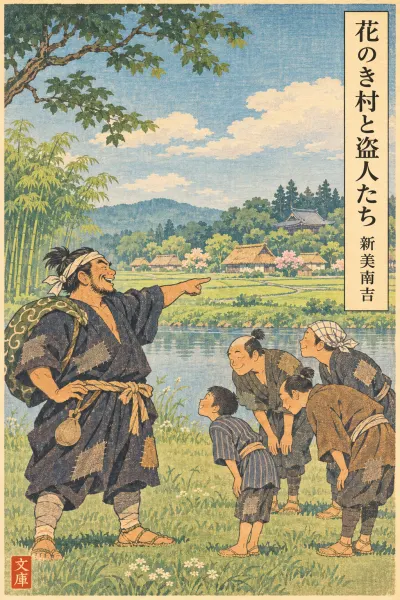
花のき村と盗人たちHana Noki Mura to Nusubitotachi — Five Thieves Come to Hananoki Village
- JLPT N2
- 9,652 characters
- 8 parts
- about 80 minutes
- 3 easier versions
Five Thieves Come to Hananoki Village is a gently comic tale about a band of thieves who arrive to rob a peaceful farming village. Their chief is a real criminal who has only just become a boss, and his four apprentices were, until yesterday, a kettle-maker, a locksmith, a boy street acrobat and a carpenter's son. Sent out to scout rich houses, they keep slipping back into their old trades, and much of the humour comes from the chief's exasperated reactions. The middle of the story turns on a small act of trust: a child hands the chief a calf to hold. From there the story becomes quietly moving. It ends on a reflection about goodness and what makes a village. The narrator speaks kindly and directly to the reader in polite です/ます form, with literary であります endings. The dialogue contrasts the chief's rough speech with his apprentices' humble replies and the old-fashioned speech of an elderly village official. For a learner, the challenge is this mix of registers and some period vocabulary. The reward is a clear, episodic plot, much of it in dialogue, in which each scene builds on the one before.
Contents
- Five Thieves Arrive in Hananoki (一)
- The Apprentices Report Back (一(つづき))
- A Flute, Sweet Tea and a Cedar Ceiling (一(つづき))
- A Little Boy Trusts the Thief (二)
- A Calf Left Waiting at Dusk (二(つづき))
- The Thieves Search for the Child (三)
- A Kind Old Official and a Confession (三(つづき))
- The Mystery of the Little Jizō (四)
Easier versions
This story is also retold in simpler Japanese. Reading an easier version first makes the original much more approachable.
Before you read
- Learn the word かしら (頭, 'chief/head') before you start. The apprentices address the chief this way throughout, and their respectful address startles him in Part 1. When the chief speaks to them, he calls them おまえら.
- Expect the narrator's literary 〜のであります and 〜であります endings. Read them as a storyteller's polite 'it was that…' (explanatory のだ in a formal register) rather than as anything difficult.
- Watch for 〜たばかり ('just did') and 〜たて ('freshly…'). They stress how new everyone is to the job: the chief has only just become a boss, and the apprentices have only just become thieves. Much of the humour depends on this.
- The apprentices' reports in Parts 2–3 follow a repeated pattern: an apprentice returns, gives a report, is scolded and is sent back. Use that structure to predict what comes next. Notice 〜のふりをする ('pretend to be'), because each apprentice is disguised as his old trade.
- In the second half, look for 〜に違いない ('must be') and 〜かどうか ('whether or not') as the thieves and villagers try to work out who the boy was. Also look for 〜こそ, which the narrator uses for emphasis in the closing reflection.
Words to know
The most useful words from the notes across the story.
| Word | Meaning | JLPT |
|---|---|---|
| 草鞋わらじ | straw sandalsWorn tied to the feet for travel; hence the idea of a long journey. | — |
| 自慢じまん | boasting, bragging自慢ができる = to have something to brag about. | N3 |
| 盗人ぬすびと | thiefOld-fashioned word; modern Japanese usually says 泥棒 (どろぼう). | — |
| とんぼがえりとんぼがえり | somersaultdictionary form: とんぼ返りAlso means a quick round trip. とんぼがえりをうつ = to turn a somersault. | — |
| 小判こばん | koban, an oval gold coinA high-value Edo-period gold coin; a classic symbol of hidden treasure. | — |
| 袂たもと | the hanging pouch of a kimono sleeveSmall items were often carried in it. | — |
| 仔牛こうし | calfAlso written 子牛; 仔 is used for young animals. | — |
| かしらかしら | chief, leader (of a gang)dictionary form: 頭Literally 'head'. お頭 (おかしら) sounds like 尾頭 (おかしら), a whole fish served with head and tail, hence the chief's complaint. | N5 |
| 都合つごう | convenience, suitability都合のよい = convenient, just right for one's purposes. | N4 |
| 久しぶりひさしぶり | for the first time in a long while久しぶりで is an older variant of the more common 久しぶりに. | N4 |
| 様子ようす | state of things, how things look様子を見る = to see how things stand, to scout. | N3 |
| 肚はら | belly; one's heart or mind肚にいれる means to take something firmly to heart; usually written 腹. | N3 |
| しょうばいしょうばい | trade, line of workdictionary form: 商売Used humorously here for the work of a thieves' boss. | N3 |
| あずけましたあずける | to leave in someone's care, to entrustdictionary form: 預けるA key word here: entrusting something implies trust in the person. | N3 |
| やっかいやっかい | troublesome, a nuisancedictionary form: 厄介 | N3 |
Plot summary
Show the full summary (contains spoilers)
On an early-summer afternoon, a newly made chief of thieves sends his four new apprentices into Hananoki to find rich houses. They return one by one with useless reports. The kettle-maker admired pots, the locksmith complained about flimsy locks, the boy Kakubē listened to an old man's flute and joined a flower festival, and Kannatarō admired a cedar ceiling. The chief scolds each of them and sends them back. While he is alone, a little boy in straw sandals hands him a calf and never returns. Trusted for the first time, the chief weeps. That night the apprentices return with plans for robbery but help him search instead. At last they take the calf to the kindly village official. The chief confesses and asks forgiveness for his apprentices, who have done nothing wrong yet. The next morning the four leave, vowing never to become thieves. The villagers decide the child was the stone Jizō by the bridge, which had been given new sandals that day.
About the author
Niimi Nankichi was a Japanese writer of children's stories, poems and songs from Handa in Aichi Prefecture. The countryside of that area is widely thought to lie behind the village and hills of Gongitsune. He began writing as a young man. Gongitsune appeared in the children's magazine Akai Tori (The Red Bird), edited by Suzuki Miekichi. Niimi later worked as a teacher at a girls' school while continuing to write. His health was poor, and he died of tuberculosis while still in his twenties. Many of his works were published and became widely known only after his death. Besides Gongitsune, he is especially remembered for Tebukuro wo Kai ni (Buying Mittens).