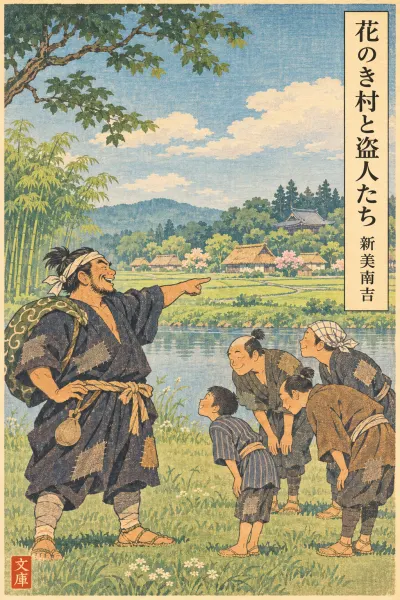
Part 1 of 8 · JLPT N2
花のき村と盗人たち(一) Hana Noki Mura to Nusubitotachi, part 1: Five Thieves Arrive in Hananoki
In this part
On an early-summer afternoon, a band of five thieves comes to the peaceful village of Hananoki. Their chief, a real criminal who has just become a boss for the first time, sends his four brand-new apprentices into the village to look for rich houses, each disguised in his old trade. While he lazes by the river and talks to himself, the first apprentice comes back and startles him by calling him 'Honourable Head'.
AI translation · independently checked
むかし、花のき村に、五人組の盗人がやって来ました。Long ago, a gang of five thieves came to Hananoki Village.
それは、若竹が、あちこちの空に、かぼそく、ういういしい緑色の芽をのばしている初夏のひるで、松林では松蝉が、ジイジイジイイと鳴いていました。It was an early-summer afternoon. Everywhere the young bamboo was stretching slender, fresh green shoots up into the sky, and in the pine woods the pine cicadas were singing, "Jee-jee-jeeee."
盗人たちは、北から川に沿ってやって来ました。The thieves came from the north, following the river.
花のき村の入り口のあたりは、すかんぽやうまごやしの生えた緑の野原で、子供や牛が遊んでおりました。Around the entrance to Hananoki Village lay a green meadow full of sorrel and clover, where children and cows were playing.
これだけを見ても、この村が平和な村であることが、盗人たちにはわかりました。From this alone, the thieves could tell that this was a peaceful village.
そして、こんな村には、お金やいい着物を持った家があるに違いないと、もう喜んだのでありました。And they were already delighted, thinking that a village like this was sure to have houses with money and fine clothes in them.
川は藪の下を流れ、そこにかかっている一つの水車をゴトンゴトンとまわして、村の奥深くはいっていきました。The river flowed beneath a bamboo thicket, turned a single waterwheel that stood over it with a clunk, clunk, and went on deep into the village.
藪のところまで来ると、盗人のうちのかしらが、いいました。When they reached the thicket, the chief of the thieves spoke.
「それでは、わしはこの藪のかげで待っているから、おまえらは、村のなかへはいっていって様子を見て来い。なにぶん、おまえらは盗人になったばかりだから、へまをしないように気をつけるんだぞ。金のありそうな家を見たら、そこの家のどの窓がやぶれそうか、そこの家に犬がいるかどうか、よっくしらべるのだぞ。いいか釜右ヱ門。」"Right then, I'll wait here in the shade of this thicket, and you lot go into the village and see how things stand. Mind you, you've only just become thieves, so take care you don't make a mess of it. When you see a house that looks like it's got money, check good and proper which of its windows looks easy to break and whether there's a dog in the place. Got that, Kamaemon?"
「へえ。」"Yes, sir."
と釜右ヱ門が答えました。answered Kamaemon.
これは昨日まで旅あるきの釜師で、釜や茶釜をつくっていたのでありました。Until yesterday he had been a travelling kettle-maker who made pots and tea kettles.
「いいか、海老之丞。」"Got that, Ebinojō?"
「へえ。」"Yes, sir."
と海老之丞が答えました。answered Ebinojō.
これは昨日まで錠前屋で、家々の倉や長持などの錠をつくっていたのでありました。Until yesterday he had been a locksmith who made locks for people's storehouses, clothes chests and the like.
「いいか角兵ヱ。」"Got that, Kakubē?"
「へえ。」"Yes, sir."
とまだ少年の角兵ヱが答えました。answered Kakubē, who was still only a boy.
これは越後から来た角兵ヱ獅子で、昨日までは、家々の閾の外で、逆立ちしたり、とんぼがえりをうったりして、一文二文の銭を貰っていたのでありました。He was a little lion-dance acrobat from Echigo, and until yesterday he had been doing handstands and somersaults outside people's doorways for a coin or two.
「いいか鉋太郎。」"Got that, Kannatarō?"
「へえ。」"Yes, sir."
と鉋太郎が答えました。answered Kannatarō.
これは、江戸から来た大工の息子で、昨日までは諸国のお寺や神社の門などのつくりを見て廻り、大工の修業していたのでありました。He was a carpenter's son from Edo, and until yesterday he had been travelling from province to province, studying how the gates of temples and shrines were built, as part of his training as a carpenter.
「さあ、みんな、いけ。わしは親方だから、ここで一服すいながらまっている。」"Off you go, all of you. I'm the boss, so I'll wait here and have myself a smoke."
そこで盗人の弟子たちが、釜右ヱ門は釜師のふりをし、海老之丞は錠前屋のふりをし、角兵ヱは獅子まいのように笛をヒャラヒャラ鳴らし、鉋太郎は大工のふりをして、花のき村にはいりこんでいきました。So the thieves' apprentices slipped into Hananoki Village: Kamaemon pretending to be a kettle-maker, Ebinojō pretending to be a locksmith, Kakubē tootling away on his flute like a lion dancer, and Kannatarō pretending to be a carpenter.
かしらは弟子どもがいってしまうと、どっかと川ばたの草の上に腰をおろし、弟子どもに話したとおり、たばこをスッパ、スッパとすいながら、盗人のような顔つきをしていました。Once his apprentices had gone, the chief plumped himself down on the grass by the river and, just as he had told them, puffed away at his pipe, wearing a proper thief's face.
これは、ずっとまえから火つけや盗人をして来たほんとうの盗人でありました。For he was a real thief, who had been setting fires and stealing for a long, long time.
「わしも昨日までは、ひとりぼっちの盗人であったが、今日は、はじめて盗人の親方というものになってしまった。だが、親方になって見ると、これはなかなかいいもんだわい。仕事は弟子どもがして来てくれるから、こうして寝ころんで待っておればいいわけである。」"Till yesterday I was a thief all on my own, but today, for the first time, I've gone and become what they call a boss of thieves. And now I'm a boss, I find it's not half bad. The apprentices go and do the work for me, so all I need do is lie about like this and wait."
とかしらは、することがないので、そんなつまらないひとりごとをいってみたりしていました。Having nothing to do, the chief amused himself by muttering such idle things to himself.
やがて弟子の釜右ヱ門が戻って来ました。Before long, his apprentice Kamaemon came back.
「おかしら、おかしら。」"Honourable Head! Honourable Head!"
かしらは、ぴょこんとあざみの花のそばから体を起こしました。The chief popped up from beside the thistle flowers.
「えいくそッ、びっくりした。おかしらなどと呼ぶんじゃねえ、魚の頭のように聞こえるじゃねえか。ただかしらといえ。」"Blast it, you gave me a fright! Don't go calling me 'Honourable Head' — it sounds like the head of a fish, don't it? Just say 'Head'."
Vocabulary
| Word | Meaning | JLPT |
|---|---|---|
| 盗人ぬすびと | thiefOld-fashioned word; modern Japanese usually says 泥棒 (どろぼう). | — |
| かしらかしら | chief, leader (of a gang)dictionary form: 頭Literally 'head'. お頭 (おかしら) sounds like 尾頭 (おかしら), a whole fish served with head and tail, hence the chief's complaint. | N5 |
| へまへま | blunder, bungleColloquial; へまをする = to mess up. | — |
| 様子ようす | state of things, how things look様子を見る = to see how things stand, to scout. | N3 |
| 釜師かまし | maker of iron pots and tea kettles | — |
| 錠前屋じょうまえや | locksmith錠前 = lock; 〜屋 marks a trade or shop. | — |
| 長持ながもち | long wooden chest for storing clothes and goods | — |
| 閾しきい | threshold, doorsillUsually written 敷居 today. | — |
| とんぼがえりとんぼがえり | somersaultdictionary form: とんぼ返りAlso means a quick round trip. とんぼがえりをうつ = to turn a somersault. | — |
| 修業しゅぎょう | training, apprenticeship in a craft | — |
| 一服いっぷく | a smoke, a short break一服すう = to have a puff of tobacco. | — |
| ふりふり | pretencedictionary form: 振りNoun + のふりをする = to pretend to be. | N1 |
| ひとりぼっちひとりぼっち | all alone, on one's owndictionary form: 独りぼっち | — |
| ひとりごとひとりごと | talking to oneselfdictionary form: 独り言 | N2 |
Grammar
〜に違いない N3 must be, surely
Expresses a strong conviction. Here the thieves feel certain that a village this peaceful has rich houses.
こんな村には、お金やいい着物を持った家があるに違いないと、もう喜んだのでありました。
And they were already delighted, thinking that a village like this was sure to have houses with money and fine clothes in them.
〜たばかり N4 have just done
The past form plus ばかり means that the action happened very recently. The chief is reminding the apprentices that they are brand-new thieves.
おまえらは盗人になったばかりだから
you've only just become thieves, so
〜かどうか N4 whether or not
This turns a yes/no question into part of a larger sentence. Here it states what the apprentices must check.
そこの家に犬がいるかどうか、よっくしらべるのだぞ。
Check good and proper whether there's a dog in the place.
〜のふりをする N3 pretend to be / pretend to do
A noun with の, or a verb, followed by ふりをする means acting as if something were true. Each apprentice disguises himself in the trade he really practised until yesterday.
釜右ヱ門は釜師のふりをし
Kamaemon pretending to be a kettle-maker
〜たとおり N3 just as (someone did / said)
とおり after a past verb means 'in the same way as'. The chief does exactly what he told his apprentices he would do.
弟子どもに話したとおり、たばこをスッパ、スッパとすいながら
just as he had told his apprentices, puffing away at his pipe
〜のであります N1 it was that… (formal, explanatory narration)
An old-fashioned, speech-like form of のです. It gives the narrator's explanations a solemn yet friendly storytelling tone.
これは昨日まで旅あるきの釜師で、釜や茶釜をつくっていたのでありました。
Until yesterday he had been a travelling kettle-maker who made pots and tea kettles.