Part 7 of 7 · JLPT N2
走れメロス Hashire Merosu, part 7: Melos Arrives as the Sun Sets
In this part
Melos arrives at the place of execution with his last strength just as the sun goes down, and he grabs his friend as Selinuntius is being raised onto the cross. Each friend confesses a moment of weakness: Melos admits a bad dream of giving up on the way, and Selinuntius admits he once doubted Melos. They strike each other and then embrace, and the moved king asks to be made one of their companions. The crowd cheers the king, and a young girl gives the naked Melos a scarlet cloak, which makes him blush deeply.
AI translation · independently checked
「それだから、走るのだ。信じられているから走るのだ。間に合う、間に合わぬは問題でないのだ。人の命も問題でないのだ。私は、なんだか、もっと恐ろしく大きいものの為に走っているのだ。ついて来い! フィロストラトス。」"That is exactly why I run. I run because I am trusted. Whether I am in time or not is not the question. A man's life is not the question either. I am running, somehow, for something far greater and more terrible. Follow me, Philostratus!"
「ああ、あなたは気が狂ったか。それでは、うんと走るがいい。ひょっとしたら、間に合わぬものでもない。走るがいい。」"Ah, you have gone mad. Then run, run with all your might. It may just be that you will be in time after all. Run!"
言うにや及ぶ。He hardly needed telling.
まだ陽は沈まぬ。The sun had not yet set.
最後の死力を尽して、メロスは走った。Spending the very last of his strength, Melos ran.
メロスの頭は、からっぽだ。Melos's head was empty.
何一つ考えていない。He thought of nothing at all.
ただ、わけのわからぬ大きな力にひきずられて走った。He simply ran, dragged along by some great power he could not understand.
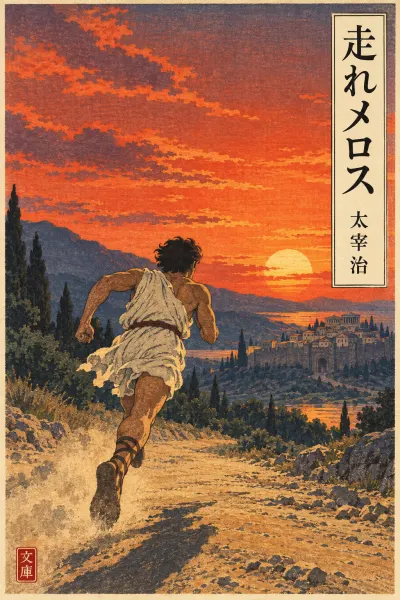
陽は、ゆらゆら地平線に没し、まさに最後の一片の残光も、消えようとした時、メロスは疾風の如く刑場に突入した。The sun sank, wavering, below the horizon, and just as the very last sliver of its afterglow was about to vanish, Melos burst into the place of execution like a gale.
間に合った。He was in time.
「待て。その人を殺してはならぬ。メロスが帰って来た。約束のとおり、いま、帰って来た。」と大声で刑場の群衆にむかって叫んだつもりであったが、喉がつぶれて嗄れた声が幽かに出たばかり、群衆は、ひとりとして彼の到着に気がつかない。"Stop! You must not kill that man! Melos has come back. As promised, he has come back, now!" He meant to shout this loudly to the crowd at the place of execution, but his throat had given out, and only a faint, hoarse voice came from it; not a single person in the crowd noticed that he had arrived.
すでに磔の柱が高々と立てられ、縄を打たれたセリヌンティウスは、徐々に釣り上げられてゆく。The pole of the cross had already been raised high, and Selinuntius, bound with ropes, was being slowly hoisted up.
メロスはそれを目撃して最後の勇、先刻、濁流を泳いだように群衆を掻きわけ、掻きわけ、When Melos saw this, with the last of his courage he pushed his way through the crowd, just as he had swum the muddy torrent earlier, pushing and pushing,
「私だ、刑吏! 殺されるのは、私だ。メロスだ。彼を人質にした私は、ここにいる!」と、かすれた声で精一ぱいに叫びながら、ついに磔台に昇り、釣り上げられてゆく友の両足に、齧りついた。and crying out as loud as he could in his rasping voice, "It is I, executioner! I am the one to be killed. It is Melos. I, who left him here as hostage, am here!", he at last climbed onto the scaffold and clung to the legs of his friend as he was being hoisted up.
群衆は、どよめいた。A roar went up from the crowd.
あっぱれ。Bravo!
ゆるせ、と口々にわめいた。Spare him! they shouted, one voice after another.
セリヌンティウスの縄は、ほどかれたのである。And so the ropes that bound Selinuntius were untied.
「セリヌンティウス。」メロスは眼に涙を浮べて言った。"Selinuntius," said Melos, with tears in his eyes.
「私を殴れ。ちから一ぱいに頬を殴れ。私は、途中で一度、悪い夢を見た。君が若し私を殴ってくれなかったら、私は君と抱擁する資格さえ無いのだ。殴れ。」"Strike me. Strike me on the cheek with all your strength. Once, on the way here, I dreamed an evil dream. If you do not strike me, I am not even worthy to embrace you. Strike me."
セリヌンティウスは、すべてを察した様子で首肯き、刑場一ぱいに鳴り響くほど音高くメロスの右頬を殴った。Selinuntius nodded as though he understood everything, and struck Melos on the right cheek so loudly that the sound rang through the whole place of execution.
殴ってから優しく微笑み、Having struck him, he smiled gently,
「メロス、私を殴れ。同じくらい音高く私の頬を殴れ。私はこの三日の間、たった一度だけ、ちらと君を疑った。生れて、はじめて君を疑った。君が私を殴ってくれなければ、私は君と抱擁できない。」"Melos, strike me. Strike me on the cheek just as loudly. In these three days, only once, just for a moment, I doubted you. For the first time in my life, I doubted you. If you do not strike me, I cannot embrace you."
メロスは腕に唸りをつけてセリヌンティウスの頬を殴った。Melos swung his arm so hard it whistled through the air and struck Selinuntius on the cheek.
「ありがとう、友よ。」二人同時に言い、ひしと抱き合い、それから嬉し泣きにおいおい声を放って泣いた。"Thank you, my friend." The two said it at the same moment, held each other tightly, and then wept aloud with tears of joy.
群衆の中からも、歔欷の声が聞えた。From within the crowd, too, came the sound of sobbing.
暴君ディオニスは、群衆の背後から二人の様を、まじまじと見つめていたが、やがて静かに二人に近づき、顔をあからめて、こう言った。Dionis the tyrant had been staring hard at the two of them from behind the crowd, but at length he quietly approached them, his face flushed, and spoke thus:
「おまえらの望みは叶ったぞ。おまえらは、わしの心に勝ったのだ。信実とは、決して空虚な妄想ではなかった。どうか、わしをも仲間に入れてくれまいか。どうか、わしの願いを聞き入れて、おまえらの仲間の一人にしてほしい。」"Your wish has been granted. You have conquered my heart. Faithfulness was never an empty delusion after all. Will you not, I beg you, take me too into your company? I beg you, hear my wish and make me one of your companions."
どっと群衆の間に、歓声が起った。A great cheer burst out among the crowd.
「万歳、王様万歳。」"Hurrah! Long live the King!"
ひとりの少女が、緋のマントをメロスに捧げた。A young girl offered Melos a scarlet cloak.
メロスは、まごついた。Melos did not know what to do.
佳き友は、気をきかせて教えてやった。His good friend kindly let him know.
「メロス、君は、まっぱだかじゃないか。早くそのマントを着るがいい。この可愛い娘さんは、メロスの裸体を、皆に見られるのが、たまらなく口惜しいのだ。」"Melos, you are stark naked, you know. Put that cloak on, quickly. This sweet girl cannot bear to have everyone see Melos's naked body."
勇者は、ひどく赤面した。The hero blushed a deep red.
(古伝説と、シルレルの詩から。)(From an old legend and a poem by Schiller.)
Vocabulary
| Word | Meaning | JLPT |
|---|---|---|
| 死力しりょく | desperate effort; the last of one's strengthUsually in the set phrase 死力を尽くす, to give everything one has. | — |
| 没しぼっする | to sink, to set (of the sun)dictionary form: 没するLiterary. Also used to mean 'to die'. Compare 日没, sunset. | — |
| 疾風しっぷう | a gale; a swift wind疾風の如く means 'like the wind', that is, extremely fast. | — |
| 刑場けいじょう | place of execution刑 = punishment, 場 = place. | — |
| 嗄れたしわがれる | to become hoarse; to grow husky (also read しゃがれる; the same kanji 嗄れる can also be read かれる, with the same meaning)dictionary form: 嗄れるAlso written 嗄れる with the reading かれる. A rare kanji. | — |
| 磔はりつけ | crucifixion; execution by being bound to a cross or pole磔の柱 is the pole of the cross, and 磔台 is the scaffold. | — |
| 掻きわけかきわける | to push one's way through (a crowd, grass, water)dictionary form: 掻き分けるRepeating the verb (掻きわけ、掻きわけ) shows the action going on and on. | — |
| 人質ひとじち | hostageThe reading is irregular: it is not じんしつ. | N1 |
| 齧りついたかじりつく | to cling to; to hold on tightlydictionary form: 齧り付くLiterally 'to bite into'. Here it describes grabbing hold desperately. | — |
| 抱擁ほうよう | embrace, hugA formal word. In everyday speech, 抱き合う is more common. | — |
| 首肯きうなずく | to nod (in agreement)dictionary form: 首肯くAn old-fashioned spelling. The usual kanji is 頷く. As a noun, 首肯 is read しゅこう. | — |
| 歔欷きょき | sobbingA very literary word. Everyday Japanese would say すすり泣き. | — |
| 信実しんじつ | faithfulness, sincerity, true trustThis is the key theme of the story. Do not confuse it with 真実 (truth), which has the same reading. | — |
| 赤面せきめん | せきめんするdictionary form: 赤面する赤 = red, 面 = face. | — |
Grammar
〜がいい N2 you should / go ahead and ~
The plain form of a verb plus がいい gives advice or permission, often in a lordly or resigned tone. Here Philostratus gives up arguing and urges Melos on.
それでは、うんと走るがいい。
Then run, run with all your might.
〜ないものでもない N1 it is not impossible that ~
This is a double negative that expresses a cautious possibility. 間に合わぬものでもない means 'it is not the case that you won't be in time', so there is still a chance.
ひょっとしたら、間に合わぬものでもない。
It may just be that you will be in time after all.
〜ようとした時 N3 just as ~ was about to happen
The volitional form plus とする describes something on the point of happening. With まさに it stresses how close the moment was.
まさに最後の一片の残光も、消えようとした時
just as the very last sliver of afterglow was about to vanish
〜たつもりであったが N3 meant to / thought one had done ~, but
The past form plus つもり describes what someone believed they had done or meant to do, which differs from what actually happened. Melos thought he was shouting, but only a whisper came out.
大声で刑場の群衆にむかって叫んだつもりであったが
he meant to shout this loudly to the crowd at the place of execution, but
ひとりとして〜ない N1 not a single one ~
One of something plus として, followed by a negative, gives a complete negation: not even one person noticed.
群衆は、ひとりとして彼の到着に気がつかない。
not a single person in the crowd noticed that he had arrived.
〜てくれまいか N1 won't you (please) ~?
まい is the literary negative volitional ending. As a question, てくれまいか makes a humble, hesitant request, which is striking coming from a king.
どうか、わしをも仲間に入れてくれまいか。
Will you not, I beg you, take me too into your company?