Part 1 of 6 · JLPT N2
自殺を買う話 Jisatsu o Kau Hanashi, part 1: A Strange Advertisement in the Paper
In this part
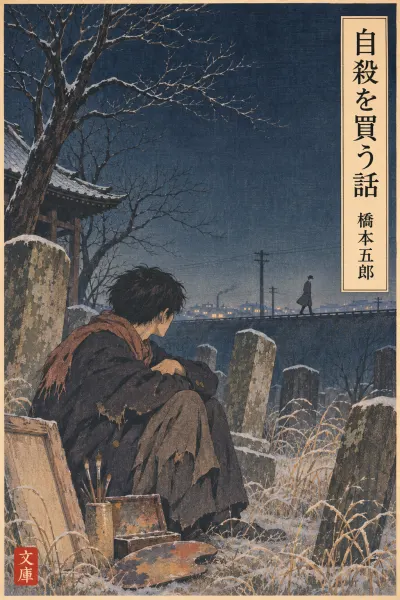
While reading the classified advertisements, the unemployed narrator finds a notice that says 'Suicide wanted.' It was placed by his friend Nonomura Shinji, a young painter. He visits Nonomura, who seems strangely weakened, and Nonomura begins to explain how he came to place the notice. The story goes back to a winter evening when Nonomura, starving and penniless, sat dozing on the veranda of a ruined temple beside a city cemetery.
AI translation · independently checked
1I
――妻らしき妻を求む。— A wife worthy of the name is sought.
十八歳以上二十七八歳までの、真面目にして且愛嬌あり、常識を有し、一生夫に忠実にして、血統正しく上品なる婦人ならば、貧富を問わず、妻として迎え優遇す。Any lady between eighteen and twenty-seven or twenty-eight years of age who is earnest and also charming, possessed of common sense, faithful to her husband all her life, and of sound lineage and refined manner, rich or poor, will be received as a wife and treated generously.
当方三十一歳、身長五尺三寸、体重十三貫二百匁、強健にして元気旺盛、職業薬業、趣味読書旅行観劇其他、新時代の流行物。The advertiser: thirty-one years of age, five feet three inches tall, thirteen kan two hundred monme in weight, robust and full of vigour; occupation, the pharmaceutical trade; interests, reading, travel, the theatre and other fashions of the new age.
禁酒禁煙。Abstains from drink and tobacco.
将来の目的、都会生活を営み外国取引開始。Future aim: to establish a life in the city and open trade with foreign countries.
保護者の許可を経て、最近の写真、履歴書、本人自筆の趣味希望等、親展書にて申込ありたし――。With the consent of a guardian, kindly apply by confidential letter, enclosing a recent photograph, a curriculum vitae, and a statement of interests and wishes in the applicant's own hand. —
そんな広告に微笑しながら、新聞の案内広告を見ていた私は、その雑件と云う条に至って、思わず新聞をとり直した。I was smiling at advertisements like that one as I looked through the classified columns of the newspaper, but when I reached the section headed 'Miscellaneous', I took a fresh grip on the paper without meaning to.
――自殺買いたし、委細面談。— Suicide wanted. Particulars at interview.
但し善良なる青年のものに限る。Only that of a young man of good character will be accepted.
××町野々村――。Nonomura, ×× Street. —
私が驚いたのは、その要件の奇抜よりも、該広告主の姓名に於てだ。What startled me was not so much the oddity of the request as the name of the person who had placed the advertisement.
××町と云えば、かの墓場と酒場の青年画家、私には親しい友人であるところの、野々村新二君より他にはない筈。If it was ×× Street, it could be no one else but Nonomura Shinji, that young painter of graveyards and taverns, who was a close friend of mine.
とまれ尋常の沙汰ではないぞ、と私が瞬間感じたのは、彼野々村君の平素と云うのが、こうした青年達のそれとはかけ離れて、至って平々凡々たるものであったからだ。At any rate, this is no ordinary business, I felt at once, because Nonomura's everyday life was far removed from that of such young men; it was utterly plain and unremarkable.
私はとにかく行って見ることにした。In any case, I decided to go and see.
勿論私が、常にもなくそう気軽に腰を上げることの出来たのは、一に友人を思う情の切なるものがあったからだが、そこにはまた、私として、新聞の広告欄にすがらねばならぬ程、それ程みじめな境遇に置かれていたからである。Of course, if I was able to stir myself so readily, quite unlike my usual habit, it was first of all because of my deep concern for my friend; but it was also because I myself had been put in such a miserable situation that I had to cling to the advertisement columns of the newspapers.
寒い朝だった。It was a cold morning.
古マントに風を除けながら、漸く私が訪れた時には、もう彼は起きていて、心からこの失業者を歓迎して呉れた。When at last I arrived, shielding myself from the wind with my old cape, he was already up, and he welcomed this unemployed man with all his heart.
火鉢にはカンカン火がおこっていたし、鉄瓶の湯は沸々と沸っていたのだが、何とはなく、私はこの、僅か二三カ月見なかった友の様子から、一種違った、妙な弱々しさと云ったものを感じた。A fire was burning briskly in the brazier, and the water in the iron kettle was bubbling at the boil; and yet, for no reason I could name, I sensed in my friend, whom I had not seen for a mere two or three months, a peculiar kind of feebleness quite different from anything before.
痩せていると云うのでもなく、また失望した時のそれとも違う。It was not that he had grown thin, nor was it like the feebleness of a man who has been disappointed.
どう云って慰めていいか、私には、その正体を見極めることが出来なかった。I could not make out what it really was, so I did not know what words of comfort to offer.
「妙な広告をしたじゃあないか」"That's a strange advertisement you've put in, isn't it?"
私は早速訊ねて見た。I asked him straight away.
「うむ」"Mm."
とそこで野々村君は、急に憂鬱な表情になって、やがて静かに、該広告をするようになったいんねんを話し始めたのである。At that, Nonomura's face suddenly clouded with gloom, and presently he began quietly to tell me the chain of events that had led him to place the advertisement.
聞けば聞く程痛ましい話だ。The more I heard, the more painful the story became.
私は、友がかく有名になった以前の、その奇怪な哀れな物語に引き込まれて、暫くは、私自身の現在をも忘れていた程だった。I was so drawn into that weird and pitiful tale from the time before my friend had become so famous that for a while I even forgot my own present circumstances.
でその話と云うのは、いったい芸術家と呼ばれる者の修行時代は、他から見るように呑気なものではなく、惨苦そのもののような、だから、時にはやり切れないで(勿論それには色々の意味があるが)あたら華かな青春を、猫いらずや噴火口に散らす者もあるのだが、その○○○○○○○○○○○○頃は、文字通りに喰うや喰わずの、カンヴァスも無ければチューブも持たない、至って風雅な生活をしていたのだが、どうかしたはずみに、その喰うや喰わずの生活も出来なくなって終にまる一日、何も口にしないような日が続いた、そのある日のこと……。And the story was this: the years of apprenticeship of those we call artists are not the carefree things they seem to others but are, as it were, hardship itself, and so at times there are some who cannot bear it (and of course there are many reasons for that) and who squander their bright youth on rat poison or in a volcano's crater; and in the days when ○○○○○○○○○○○○, he led a life that was, quite literally, hand to mouth, a most 'elegant' life with neither canvas nor tubes of paint, until, by some turn of chance, even that hand-to-mouth life became impossible, and at last there came a run of days on which he put nothing at all in his mouth for a whole day; and on one of those days……
2II
風はないが、寒い日の暮方だった。It was the dusk of a day that was cold, though without wind.
彼はさる荒れ寺の、半ば朽ち歪んだお堂の縁に腰を下して柱を背にうつつなく眠っていた彼自身を見出していた。He found himself sitting on the edge of the veranda of the half-rotted, warped hall of a certain ruined temple, his back against a pillar, sleeping obliviously.
このお寺は都会のそれで、庭から直ぐに墓地が拡がり、墓地を低い破れ塀が廻らし、その彼方を夕暮の中に丘陵が連り、丘陵には電柱の頭が見え、そこにはすでに灯が点ぜられていた。The temple was a city one: the cemetery spread out straight from the garden, a low, broken wall ran round the cemetery, beyond it a line of hills stretched away in the evening gloom, and on the hills the tops of telegraph poles could be seen, where lamps had already been lit.
丘陵を遠く、町の夜空が、ぼうっとうす明く照り淀んでいた。Far beyond the hills, the night sky over the town glowed dimly, a faint, still light.
Vocabulary
| Word | Meaning | JLPT |
|---|---|---|
| 求むもとむ | wanted; is soughtClassical form of 求める. It is still used in advertisements and job notices. | — |
| 愛嬌あいきょう | charm, likeabilityOften used in the phrase 愛嬌がある, 'charming, endearing'. | — |
| 優遇ゆうぐう | generous treatmentCommon in job advertisements: 経験者優遇 means 'experienced applicants preferred'. | — |
| 委細面談いさいめんだん | details at interviewA set phrase in advertisements. 委細 means 'particulars' and 面談 means 'face-to-face talk'. | — |
| 奇抜きばつ | eccentric, startlingly unusualA な-adjective. It describes something novel and surprising rather than something simply strange. | — |
| 該がい | the said, the aforementionedA formal, kanbun-style prefix. Compare the modern word 該当 (applicable). | — |
| 平々凡々へいへいぼんぼん | utterly ordinary, commonplaceAn emphatic doubled form of 平凡. Here it takes the literary attributive form たる. | — |
| 境遇きょうぐう | circumstances, situation in life | N1 |
| 火鉢ひばち | hibachi, a charcoal brazier for heating a roomA traditional Japanese heater: a bowl of burning charcoal, often with a kettle set over it. | — |
| 鉄瓶てつびん | cast-iron kettle | — |
| 正体しょうたい | true nature, what something really isAlso used in 正体を見極める, 'to see what something really is'. | — |
| いんねんいんねん | chain of circumstances; how something came aboutdictionary form: 因縁Originally a Buddhist term for 'cause and connection'. Here it is written in kana. | — |
| 猫いらずねこいらず | rat poison (originally a brand name of a phosphorus-based poison)Literally 'no cat needed'. It was a famous brand name and became a common word for arsenic-based rat poison, often mentioned in suicides of the period. | — |
| 荒れ寺あれでら | ruined, neglected templeThis compound shows rendaku: 寺 てら becomes でら. | — |
Grammar
〜にして N1 and (also); being … and …
This is a written form that links two descriptions, like 〜で. It gives the advertisement a stiff, formal tone, and 且 strengthens the meaning 'and moreover'.
真面目にして且愛嬌あり
earnest and also charming
〜たし N1 wish to; want to
This is the classical form of 〜たい and is used in notices and formal letters. 買いたし means 'wish to buy', and ありたし in the first advertisement means 'it is requested that…'.
自殺買いたし、委細面談。
Suicide wanted. Particulars at interview.
〜ところの N1 who/which (relative clause marker)
This is a translation-style literary device that marks a relative clause, modelled on European relative pronouns. It adds weight but no extra meaning: 友人であるところの野々村君 simply means 'Nonomura, who is my friend'.
私には親しい友人であるところの、野々村新二君より他にはない筈
it could be no one else but Nonomura Shinji, who was a close friend of mine
〜ねばならぬ N2 must, have to
Must, have to. This is the literary equivalent of 〜なければならない. ね is the realis (已然形) form of the classical negative auxiliary ず/ぬ (= ない). ね + ば gives 〜ねば ('if not…'). ならぬ means 'will not do', so the whole pattern means 'it won't do if not…', i.e. 'must'.
新聞の広告欄にすがらねばならぬ程
to the point of having to cling to the newspaper's advertisement columns
〜ば〜ほど N3 the more …, the more …
The same verb is repeated, first in the conditional and then before ほど, to show that one thing increases along with another.
聞けば聞く程痛ましい話だ。
The more I heard, the more painful the story became.
〜や〜ず N1 barely managing to …; whether or not …
In 喰うや喰わず, the plain verb plus や is followed by its own negative form. The idiom describes a life where one hardly knows whether one will eat, that is, living hand to mouth.
文字通りに喰うや喰わずの、カンヴァスも無ければチューブも持たない
quite literally hand to mouth, with neither canvas nor tubes of paint