Part 6 of 6 · JLPT N2
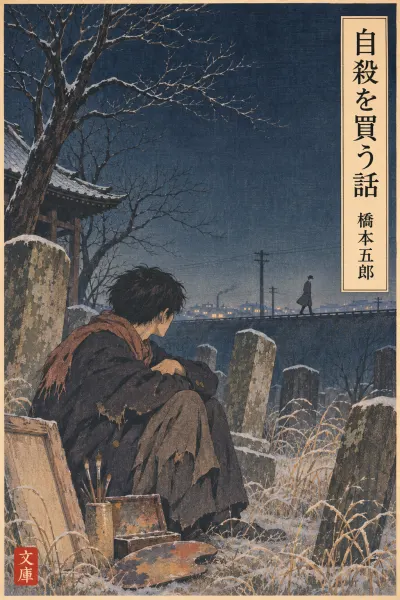
自殺を買う話 Jisatsu o Kau Hanashi, part 6: The Benefactor's Last Gift
In this part
Nonomura leaves the house with the money, half sensing what it means, and hurries back through the town toward Banda, whom he pictures anxiously waiting. In his account to the narrator, he found Banda dead, his throat cut with a razor. Banda's will had paid for Nonomura's studies and his life ever since, and Nonomura now says the same fate is coming for him. The narrator cannot bring himself to say 'buy a suicide'. He leaves, praying that no seller ever appears, or else that the borrower will turn out to be a good woman.
AI translation · independently checked
彼は一度頭を下げると、おずおずと、冷え切った手先にそれを受け取り、以前の女中に案内されて玄関に出た。He bowed his head once, timidly took it in his chilled fingers, and was shown out to the entrance by the same maid as before.
そしてすすめられる自動車を断り、駈けるような気持で町を電車通りへぬけた。Then, declining the motor-car that was offered him, he cut through the town to the tram street, feeling as though he were running.
彼にはおぼろながら、その金子の意味が解ったような気がした。He felt that he had grasped, if only dimly, what the money meant.
何か慌ただしい気持が腹の中で燃えた。Some restless agitation burned inside him.
あの婆やと二人切りの住居で、使いの安否を気づかいつつあろう青年伴田氏の、寂しい姿が想像された。He pictured the lonely figure of young Mr. Banda in that dwelling he shared only with his old housekeeper, no doubt anxiously wondering what had become of his messenger.
いかにすべてを与えると約束されたにしろ、彼にはそのまま、何処かへ行ってしまう気にはなれなかった。However much he had been promised everything, he could not bring himself simply to go off somewhere just like that.
それが最初からの考えでもあった。That had been his intention from the very start.
彼は漸く、ガランとした郊外電車に身を委すことが出来た。At last he was able to entrust himself to an all but empty suburban train.
55
「ところがねえ、僕が伴田氏の家に帰って見ると、君――」"But you see, when I got back to Mr. Banda's house, my dear fellow—"
野々村君は、もう声に涙を含め、そこで言葉を途切らしたのだった。Nonomura, his voice already thick with tears, broke off at that point.
「帰って見ると?」"When you got back?"
つり込まれて、私は思わずこう訊き返した。Drawn in, I found myself asking him this in return.
「――死んでいたんだ、恩人は死んでいたんだ、剃刀で咽喉を切って――。僕は、僕は身も世もなかった、死体に取りすがって埋もれる程泣きたかった――」"—He was dead. My benefactor was dead. He had cut his throat with a razor—. I, I was utterly beside myself. I wanted to cling to the body and weep until I was buried—"
ふたりの間には、ながい間言葉がなかった。For a long while no words passed between the two of us.
うそ寒いものが部屋に流れた。Something faintly chill flowed through the room.
「僕への遺書があってね、僕はそれで現在まで勉強することが出来た。今日こうして生活出来るのも、皆伴田氏のお蔭なんだ。それを思うと非常に心苦しいのだが、僕にもまた、伴田氏同様の運命が訪れている――」"There was a will left for me, you know, and thanks to it I have been able to go on studying until now. That I can live as I do today is all owing to Mr. Banda. It pains me terribly to think of it, but the same fate as Mr. Banda's has come to visit me too—"
流石に私も、自殺を買って呉れとは云い得なかった。Not even I could bring myself to say, "Please buy a suicide."
私は友の身を気づかいながら、永久にその売手の現れないことを祈りながら、若しくはその借用者の、善良な女性の中に現れることを祈りながら、この哀しい友の家を後にしたのであった。Fearing for my friend, praying that a seller would never appear, or else praying that a borrower would appear in the form of some good woman, I left the house of my sorrowful friend behind.
町々には、柔しい冬の陽が解けかけていた。Over the streets the gentle winter sun was beginning to melt.
(一九二七年五月号)(May issue, 1927)
Vocabulary
| Word | Meaning | JLPT |
|---|---|---|
| おずおずおずおず | timidly, hesitantlyUsually written in kana and often followed by と. | — |
| 金子きんす | money, a sum of moneyOld-fashioned, formal word. It is unrelated to the surname Kaneko. | — |
| 慌ただしいあわただしい | restless, agitated, hurriedUsually describes busy times, but here it describes an uneasy feeling. | N2 |
| 安否あんぴ | safety, how someone is faring安否を気づかう means to worry whether someone is safe. | — |
| 気づかいきづかう | to worry about, to be anxious fordictionary form: 気づかうAlso appears as 気づかいながら in the narrator's closing line. | — |
| 委すまかす | to entrust, to give oneself over toLiterary variant of 任せる. 身を委す means to let oneself be carried along. | N1 |
| 途切らしたとぎらす | to break off, to interrupt (speech)dictionary form: 途切らすThis is a transitive form of the more common 途切れる. | — |
| つり込まれてつりこむ | to draw in, to captivatedictionary form: つり込むThe passive つり込まれる means being drawn into someone's story. | — |
| 身も世もなかったみもよもない | utterly beside oneself (with grief)dictionary form: 身も世もないAn idiom for grief so great that one cares nothing for oneself or the world. | — |
| 取りすがってとりすがる | to cling todictionary form: 取りすがる | — |
| うそ寒いうそさむい | faintly chilly, somehow coldThe prefix うそ means 'slightly' and has nothing to do with lying. | — |
| 遺書いしょ | a will, a suicide note | — |
| 流石にさすがに | even (I), after all; understandablyHere it means that even the narrator could not go so far. | — |
| 柔しいやさしい | gentle, softAn old spelling. Today the word is written 優しい or 易しい. | — |
Grammar
〜ながら (concessive) N2 though, if only
Attached to an adjective stem such as おぼろ, ながら means 'though it is so'. It does not mean 'while doing' here. おぼろながら therefore means 'dimly, but still'.
彼にはおぼろながら、その金子の意味が解ったような気がした。
He felt that he had grasped, if only dimly, what the money meant.
〜つつある N2 be in the process of doing
The verb stem plus つつある describes an ongoing action in written style. Here it is combined with the conjectural あろう, giving 'must presumably be worrying'.
使いの安否を気づかいつつあろう青年伴田氏の、寂しい姿が想像された。
He pictured the lonely figure of young Mr. Banda, no doubt anxiously wondering what had become of his messenger.
いかに〜にしろ N2 no matter how much ~, even if ~
にしろ marks a concession, and いかに strengthens it to 'however much'. The main clause states what still holds true despite it.
いかにすべてを与えると約束されたにしろ、彼にはそのまま、何処かへ行ってしまう気にはなれなかった。
However much he had been promised everything, he could not bring himself simply to go off somewhere just like that.
〜て見ると N4 when (I) actually did ~, (I found that)
This is てみると, written here with the kanji 見. It introduces a discovery made after doing something, so the reader expects a surprising result to follow.
僕が伴田氏の家に帰って見ると、君――
When I got back to Mr. Banda's house, my dear fellow—
〜得ない N2 cannot (bring oneself to) ~
The verb stem plus 得ない (read えない in this sentence) means that something is impossible. In the past form 云い得なかった, it means the narrator could not bring himself to say it.
流石に私も、自殺を買って呉れとは云い得なかった。
Not even I could bring myself to say, "Please buy a suicide."
〜かける N3 to begin to ~, to be partway through ~
The verb stem plus かける marks an action that has started but is not finished. Here the sunlight is just beginning to melt.
町々には、柔しい冬の陽が解けかけていた。
Over the streets the gentle winter sun was beginning to melt.