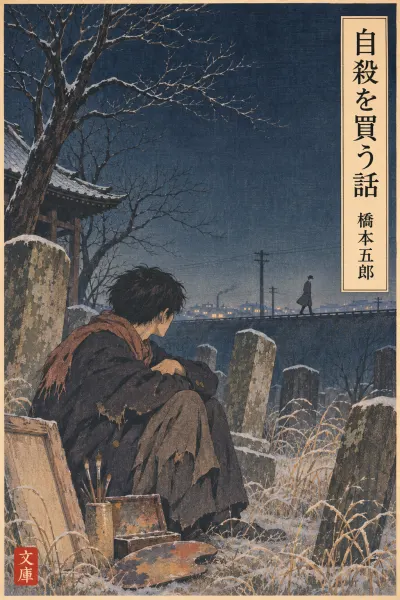
Part 2 of 6 · JLPT N2
自殺を買う話 Jisatsu o Kau Hanashi, part 2: Rescued from the Railway Line
In this part
Penniless and starving in a cemetery, he daydreams of warm rooms and lost comforts, then numbly follows a young man who slips out from among the gravestones. When he loses sight of the stranger beside a railway embankment, he goes down onto the tracks and listens, entranced, to an approaching train. At the last moment the same young man pulls him clear and offers him a cigarette, and he, in tears, admits he has eaten nothing.
AI translation · independently checked
彼の眼は涙を感じた。His eyes felt the tears.
心は温い家庭を思った。His heart thought of a warm home.
乃至は華かな酒場を偲んだ。Or else it yearned for some brilliant tavern.
あかあかと燃えているストオブや、ゆるやかに香りをたてた紅茶の皿や、暖気に重くなったカーテンの緑色や、談笑や、煙草や、そして一銭の財布も持たぬ彼は、真実よるどころない現在を哀れんだのであった。A stove burning bright red, a cup of tea on its saucer giving off a slow fragrance, the green of curtains grown heavy in the warmth, easy talk and laughter, tobacco: and he, who had not so much as a single sen in his purse, pitied his present state, truly without anything left to lean on.
○○○○○○○○○○○○○○○○○○○○○○○○○○○の一本も呑むことが出来た。○○○○○○○○○○○○○○○○○○○○○○○○○○○ he had even been able to smoke one.
が今日は?But today?
彼は四回目の空腹に襲われることを考えた。He thought of being seized by hunger for the fourth time.
此度は最後だと思った。This time, he thought, would be the last.
彼の脳裡は色んな想念に乱れた。His mind was thrown into confusion by all manner of thoughts.
秋の展覧会や、多くの紳士淑女や、かと思うと暗いしるこ屋の一隅や、鉄道の踏切やまた母の顔や見も知らぬ恋びとの姿や、ちぎれちぎれのそれ等の情景は、皆悲しい色彩をもって明滅した。The autumn exhibition and the many ladies and gentlemen there; then, all at once, a corner of a gloomy sweet-bean-soup shop; a railway crossing; and his mother's face, and the figure of a sweetheart he had never even met: these scenes, all in fragments, flickered on and off, every one of them in mournful colours.
とふと、彼の視界を黒い物が動いた。And then, suddenly, something black moved across his field of vision.
石塔の間を音もなく行く、それは確に人間の姿だ。Passing soundlessly between the gravestones, it was without doubt a human figure.
しかも若い男だ。A young man, moreover.
気が付かなかったが、それまで石塔のひとつに腰かけていたに違いない。He had not noticed him, but the man must have been sitting on one of the gravestones until then.
影はそろそろと歩いて行く。The shadow walked slowly on.
「飯を食わせろ」"Give me something to eat!"
そう云って飛び付き度いような親しさを彼は感じた。He felt such a sense of closeness that he wanted to rush up to him and say just that.
不思議に友人か何かのように考えられた。Strangely, he found himself thinking of the man as a friend or something of the kind.
彼の両足は何と云う意味もなく、相当の間隔を保ったまま、その青年と同じ歩調で同じ方向へ歩いて行った。Without any purpose at all, his two feet kept a fair distance behind and walked on in the same direction, at the same pace as the young man.
青年は墓場をぬけて、破れ塀に添うた小路を丘陵に向って歩いた。The young man passed out of the graveyard and walked along a lane that ran beside a broken-down wall, towards a low hill.
首を垂れて影のように歩いた。He walked with his head hanging, like a shadow.
幾時頃であったろうか、もうあたりはすっかり暗くなってともすれば視界が失われたりするのだった。What time could it have been? By now it had grown completely dark all around, and at moments everything was lost to sight.
彼が丘陵と見たのは鉄道の土手であった。What he had taken for a hill was a railway embankment.
○○○○○○○○○○○○○○ものを左下に見た時、彼は、何故か来てはならない処へ来たような気がした。When he saw ○○○○○○○○○○○○○○ below him to the left, he felt, for some reason, that he had come to a place where he must not come.
そして思わず足を止めた。And he stopped in his tracks without meaning to.
とその瞬間、何処にどう潜ったのか、彼は青年の姿を見失ってしまったのであった。And in that instant, he lost sight of the young man, who had slipped away he knew not where or how.
あてどない俄盲目にも似た彼は、突然底知れぬ暗闇の中にとり残されたのだ。Like a man suddenly struck blind with nowhere to go, he had been abruptly left behind in a darkness without bottom.
独りだ、と感じると、今更のような寒さと共に、かつて知らなかった生々しい恐怖が、しかも奇怪な落着きをもって、彼の皮膚の上を這い廻った。As he felt that he was alone, a cold that seemed to strike him only now, and with it a raw terror such as he had never known, crawled over his skin, and with an uncanny calm besides.
ぞろぞろと撫でさすって過ぎた。It passed over him in a slow, creeping caress.
静かに線路に下り立った彼は、身を踞めてレールに耳を当てた。Quietly he climbed down onto the line, crouched, and put his ear to the rail.
遠い黄泉の国からかでもあるように、不思議な濁音が響いて来る。A strange, muffled sound came echoing, as though from the distant Land of the Dead.
それは美しい韻律をもって、例えば夢のからくりのようにいとも快い刺激を鼓膜に与えた。It had a beautiful rhythm, and, like some mechanism in a dream, it gave his eardrums a most agreeable thrill.
彼は尻を立てた黒猫のような格好で、忘我の中に、そのまま凝乎と蹲っていた。Shaped like a black cat with its hindquarters raised, he stayed crouched there, perfectly still, lost to himself.
音響がひどく烈しく、段々近く聞えて来た。The sound grew terribly violent and came nearer and nearer.
と、Then—
「危い!」"Look out!"
誰かが彼の肩を掴んで引き戻した。Someone seized him by the shoulder and pulled him back.
とほとんど同時だった、彼の袂のすれすれを、ゴォーッと凄まじい唸りを残して真黒い列車が通り過ぎた。It was almost at the same moment that a pitch-black train went roaring past, a hair's breadth from his sleeve, leaving a fearful howl behind it.
彼の眼には列車の窓の、華かな明りだけが残った。In his eyes there remained only the brilliant lights of the train's windows.
「危なかったじゃあないか、いったいどうしたんだ?」"That was a near thing, wasn't it? What on earth were you doing?"
彼を救った人間は、こう云って闇の中で、彼の衣服の泥を払った。So said the man who had saved him, brushing the mud from his clothes in the dark.
彼は別に有難いとも悲しいとも感じなかった。He felt neither particularly grateful nor particularly sad.
ただ涙が、さんさんと止めどなく溢れ出した。Only the tears came streaming out, endlessly.
「まあ煙草でも呑み給え」"Come, have a cigarette, at least."
それを無意識に彼は受取った。He took it without thinking.
そしてこの青年が墓地からの同行者であったこと、善良な、富裕な、しかも教育のある人間であることを、彼は涙の中から一度に感じた。And through his tears he sensed, all at once, that this young man was the one who had walked with him from the cemetery, and that he was a good man, a wealthy one, and an educated one too.
「済みません、僕は、僕は何も喰っていないのです」"I'm sorry. I… I haven't eaten anything."
彼は、初めて感謝の念をもって答えた。He answered, for the first time with a feeling of gratitude.
恥しさもなかった。He felt no shame either.
Vocabulary
| Word | Meaning | JLPT |
|---|---|---|
| 乃至ないし | or; or elseFormal written conjunction; in modern use also 'from … to' between numbers. | N1 |
| 偲んだしのぶ | to think fondly of, to yearn for (something absent)dictionary form: 偲ぶUsed for remembering people or places with longing. | — |
| よるどころないよりどころない | having nothing to turn to or rely on; helpless (variant of よんどころない 拠ん所ない, from 拠り所なし)dictionary form: 拠り所ないFrom 拠り所 'support, basis'; here written in an older form よるどころ. | — |
| 脳裡のうり | the mind, the inside of one's headLiterary; common in 脳裏に浮かぶ 'come to mind'. Modern spelling 脳裏. | — |
| 明滅めいめつ | flickering on and off明 bright + 滅 go out. | — |
| 石塔せきとう | gravestone; stone monument | — |
| 土手どて | embankment, bank | N1 |
| 見失ってみうしなう | to lose sight ofdictionary form: 見失う | — |
| 底知れぬそこしれない | bottomless, unfathomabledictionary form: 底知れない〜ぬ is the literary form of 〜ない. | — |
| 黄泉よみ | the land of the dead, the underworldOld native Japanese word for the afterlife; 黄泉の国 = the Land of the Dead. | — |
| 蹲ってうずくまる | to crouch, to squat downdictionary form: 蹲る | — |
| 袂たもと | the hanging sleeve of a kimonoShows he is wearing Japanese dress. | — |
| 富裕ふゆう | wealthy, affluentWritten word; everyday equivalent is 金持ち. | — |
Grammar
〜に違いない N3 must be; surely
Expresses a strong conclusion drawn by the speaker. Here the narrator reasons that the young man had been sitting on a gravestone all along.
それまで石塔のひとつに腰かけていたに違いない。
he must have been sitting on one of the gravestones until then.
〜度い (=〜たい) N5 want to …
度い is an old-fashioned kanji spelling of the desire ending 〜たい. Here 飛び付き度いような modifies 親しさ: 'a closeness such that he wanted to rush up'.
そう云って飛び付き度いような親しさを彼は感じた。
He felt such a sense of closeness that he wanted to rush up to him and say just that.
〜たまま N4 while keeping (a state) unchanged
Attached to a past-tense verb, it shows a state continues while something else happens. His feet keep their distance as they follow the young man.
相当の間隔を保ったまま、その青年と同じ歩調で同じ方向へ歩いて行った。
keeping a fair distance, they walked on in the same direction at the same pace as the young man.
〜てはならない N3 must not …
A firm prohibition, more formal than 〜てはいけない. Used here inside a noun phrase: 'a place where one must not come'.
何故か来てはならない処へ来たような気がした。
for some reason he felt that he had come to a place where he must not come.
〜給え N1 do …; (mild command among equals or to juniors)
The imperative of 給う attached to the verb stem, typical of educated male speech of the period. It sounds friendly but a little lordly, like 'Do have…'.
「まあ煙草でも呑み給え」
"Come, have a cigarette, at least."