Upper intermediate · JLPT N2
自殺を買う話Jisatsu o Kau Hanashi — Buying a Suicide
- JLPT N2
- 7,579 characters
- 6 parts
- about 63 minutes
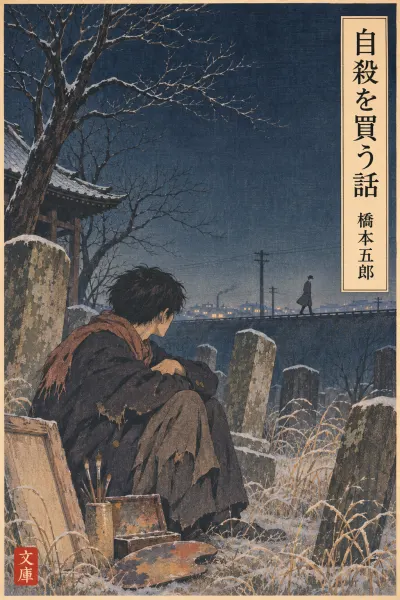
Buying a Suicide is a short, dark story told in a frame. An unemployed narrator, scanning the classified advertisements, finds a notice that reads 'Suicide wanted'. It was placed by his friend Nonomura Shinji, a young painter. The narrator goes to see him, and Nonomura, strangely weakened, explains how it came about. One winter night, starving and penniless in a run-down temple cemetery, he was saved on a railway line by a wealthy, weary young man named Banda. Banda then sent him on a puzzling errand to a mansion in the Yamanote district. The mood is quiet and melancholy, and the tension builds slowly as the reader comes to suspect what the errand really means. For learners the story is short, in six manageable parts, with a clear plot and only a few characters. It is also demanding. The narration uses a mannered literary style of the 1920s, with kanbun-flavoured written words, old spellings and long sentences. The dialogue mixes the students' 君/僕 speech with the stock speech of an old man. Several passages were blanked out by the censor (○○○), so you will sometimes have to infer meaning from context, as the original readers did.
Contents
Before you read
- Learn the written, kanbun-style connectives before you start. 且 (かつ, 'and moreover'), 該 (がい, 'the said / the aforementioned') and 乃至 (ないし, 'or / from … to') all appear in the narration. Also expect 〜ところの as a formal relative-clause marker, as in 〜するところの人.
- Expect older spellings and forms. 呉れ is くれ, 〜度い is 〜たい, and 〜ねばならぬ is a literary 〜なければならない. In dialogue between the two young men, 〜給え is a student-style command ('do …'), as in 行き給え.
- Onda speaks in an old man's stock speech: わし for 'I', 〜じゃ for 〜だ, and the sentence-final particle 喃 (のう). Read his lines as courtly and old-fashioned rather than as a regional dialect.
- Watch for literary grammar that carries the mood. 〜や〜ず means 'no sooner … than' or 'without even …'. Concessive 〜ながら means 'although'. 〜にして marks a time, place or state, and 〜に違いない marks the narrators' growing certainty.
- Keep track of the frame. Part 1 opens in the narrator's present and then moves back into Nonomura's account, and Part 6 returns to the present at the very end. When you meet a censored gap (○○○), read the surrounding sentences and guess what it hides. Don't try to reconstruct it word by word.
Words to know
The most useful words from the notes across the story.
| Word | Meaning | JLPT |
|---|---|---|
| 火鉢ひばち | hibachi, a charcoal brazier for heating a roomA traditional Japanese heater: a bowl of burning charcoal, often with a kettle set over it. | — |
| 富裕ふゆう | wealthy, affluentWritten word; everyday equivalent is 金持ち. | — |
| 呉れるくれる | to do (something) for oneOld kanji spelling of the auxiliary くれる; modern texts write it in kana. | N4 |
| 厄介やっかい | troublesome, bothersomeNa-adjective; 厄介な問題 = a troublesome problem. | N3 |
| 率直そっちょく | frank, candidUsed adverbially as 率直に. | N2 |
| 慌ただしいあわただしい | restless, agitated, hurriedUsually describes busy times, but here it describes an uneasy feeling. | N2 |
| 境遇きょうぐう | circumstances, situation in life | N1 |
| 乃至ないし | or; or elseFormal written conjunction; in modern use also 'from … to' between numbers. | N1 |
| 土手どて | embankment, bank | N1 |
| 甘えるあまえる | to accept (someone's kindness), to take advantage of (goodwill)好意に甘える is a fixed phrase for gratefully accepting an offer. | N1 |
| 辞退じたい | to decline (an offer)Polite, formal word for turning something down. | N1 |
| 体采ていさい | appearances, how things look to othersdictionary form: 体裁Normally written 体裁; 体裁のいいこと = something that sounds respectable or saves face. | N1 |
| 不審ふしん | doubt, suspicionSomething that seems strange or questionable; 不審者 = a suspicious person. | N1 |
| 煌々こうこう | brilliantly, blazingly (of lights)Literary; usually seen as 煌々と輝く. | N1 |
| 面目めんぼく | honour, face面目が立つ means 'one's honour is saved', and 面目ない means 'ashamed'. | N1 |
Plot summary
Show the full summary (contains spoilers)
The narrator spots a 'Suicide wanted' advertisement and visits Nonomura, who placed it. Nonomura tells his story. Starving in a cemetery, he followed a stranger and drifted onto the railway tracks, where the young man, Banda, pulled him clear. Banda took him home, fed him, let him bathe and put him up for the night. Banda then asked him to go the next evening to the Onda house, ask for Toshiko, and, when refused, request a hundred or two hundred yen to keep and use to rebuild his own life. Dressed in Banda's clothes, Nonomura went. Old Onda took him for Banda, would not let him see Toshiko and offered money to make him leave. Nonomura asked for two hundred yen and was given three hundred, the extra hundred being Onda's own gift. When he hurried back, he found Banda dead, his throat cut with a razor. Banda's will had paid for Nonomura's studies and his living ever since. Nonomura now says the same fate is coming for him. The narrator cannot bring himself to say 'buy a suicide'. He leaves, praying that no seller ever appears, or else that the borrower turns out to be a good woman.
About the author
Hashimoto Gorō (橋本五郎, 1903–1948) was a Japanese writer of detective and mystery fiction. He was active in the prewar years and was associated with Shinseinen (新青年), the magazine at the centre of Japanese detective fiction in the 1920s and 1930s. Buying a Suicide, dated May 1927, belongs to the early part of his career and shows his interest in poverty, desperation and dark irony.