Upper intermediate · JLPT N2
黄いろのトマトKiiro no Tomato — The Tomato That Shone Like Gold
- JLPT N2
- 7,847 characters
- 6 parts
- about 65 minutes
- 3 easier versions
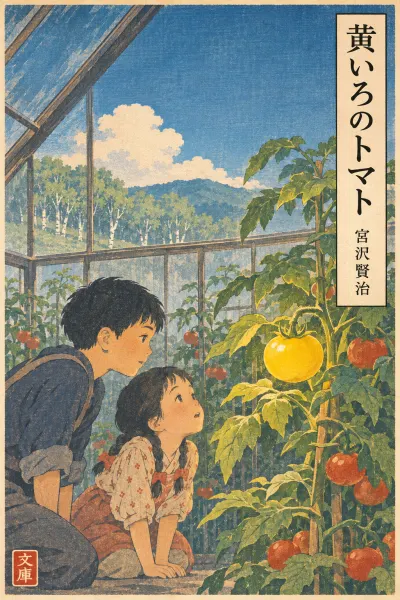
"The Tomato That Shone Like Gold" is a short fairy tale told within a frame. The narrator, Kyusute, remembers slipping into his hometown museum early one morning as a child, when a stuffed hummingbird behind the glass began to speak to him. The bird tells him about Pemperu and his little sister Neri, two children who live alone on a fruit farm among birch-covered hills. They grow tomatoes in glass houses, and one plant bears a dazzling yellow tomato that they take for gold. One evening, strange music reaches them from far across the fields. Throughout, the bird keeps hinting that something sad happened to them. The tone is gentle and dreamlike, with a quiet sorrow underneath. Learners will find the plot easy to follow, with short scenes and vivid images. The difficulty comes from the mix of voices: polite です/ます narration, the bird's chatty storytelling, an old guard's old-fashioned kindly speech, and a coarse circus doorman.
Contents
Easier versions
This story is also retold in simpler Japanese. Reading an easier version first makes the original much more approachable.
Before you read
- Learn the bird's refrain かあいそうなことをした first. かあいそう is an older, emotional spelling of かわいそう, and the phrase comes back again and again as a signal of the story's sadness.
- Expect three different speech styles. The narrator uses polite です/ます. The bird uses plain forms ending in よ and ね. The guard uses old-fashioned polite forms such as ようがすか (≈ よろしいですか) and 入らっしゃい (≈ いらっしゃい). The doorman is rude, using 餓鬼め, the verb ending 〜やがる, and 汝 for 'you'.
- The bird describes the children's daily life with 〜たり〜たりする and 〜ながら. Its emotional moments use 〜ておくれ (a gentle request), 〜もんか (a strong 'no way'), and いまにも〜そうな ('looking as if it might ... at any moment').
- Pay attention to 〜たまま, 〜っきり and 〜ようともしない in the scenes where the bird stops talking or the children hold back. These forms show who is refusing or failing to act, and that is often the emotional point of the scene.
- Keep the frame in mind. Sections switch between the museum in the present and the bird's tale, and the boy's questions and tears interrupt the story. Noticing who is speaking at each point will prevent most confusion.
Words to know
The most useful words from the notes across the story.
| Word | Meaning | JLPT |
|---|---|---|
| 番人ばんにん | guard, watchman番 means 'watch, turn', as in 交番. | — |
| 切れ切れきれぎれ | in bits and pieces, broken, intermittent | — |
| 果樹園かじゅえん | orchard, fruit farm果 fruit + 樹 tree + 園 garden. | — |
| 曇りましたくもる | to fog up, to become cloudydictionary form: 曇る | N5 |
| かあいいかわいい | cute, sweetdictionary form: 可愛いかあいい is an older spoken spelling of かわいい. | N5 |
| 故障こしょう | complaint, objectionOlder usage. Today 故障 normally means 'breakdown' of a machine. | N4 |
| かあいらしいかわいらしい | lovely, sweet, charmingdictionary form: かわいらしいかあい〜 is an old colloquial spelling of かわい〜; likewise かあいそう = かわいそう. | N3 |
| かあいそうかわいそう | pitiful, poor (thing)dictionary form: かわいそうかわいそうなことをした: 'a pitiful thing happened', expressing regret over someone's misfortune. | N3 |
| 叱ってしかる | to scolddictionary form: 叱る | N3 |
| 厭きっちまうあきる | to get tired of, grow bored withdictionary form: 厭きるUsually written 飽きる today; ちまう is a casual contraction of てしまう. | N3 |
| たまらないたまらない | unbearable; can't help (wanting)After a て-form: 行きたくってたまらない = 'dying to go'. | N3 |
| ほこりほこり | dustdictionary form: 埃 | N3 |
| 追いつくおいつく | to catch up with, keep up | N3 |
| 戸棚とだな | cabinet, cupboard with doors | N2 |
| 俄かににわか | suddenly, all at oncedictionary form: 俄かLiterary; used several times in this passage. Close to 急に. | N2 |
Plot summary
Show the full summary (contains spoilers)
As a boy, Kyusute sneaks into the town museum before opening time, and a stuffed hummingbird starts telling him about Pemperu and Neri. The two children live happily and alone on a fruit farm. When the bird breaks off its story, the boy cries until the old guard comes, scolds the bird for its old trick, and comforts him. The bird goes on. The children grow tomatoes, and one plant bears a shining yellow tomato that they believe is gold. Drawn by distant music, they follow riders and a cloth-covered elephant to a town where a circus has set up its tent. Seeing that people pay in gold or silver to get in, Pemperu runs home for yellow tomatoes and offers them at the gate. The doorman curses them, throws the tomatoes away, and strikes Neri. The crowd laughs, and the children run home in tears. The bird falls silent, and the narrator leaves crying.
About the author
Miyazawa Kenji was a poet and writer of children's stories from Hanamaki in Iwate Prefecture. He studied agricultural science in Morioka and later taught at an agricultural school. He devoted much of his life to helping local farmers improve their methods and their cultural lives. He was a devout Buddhist, and his faith, love of nature and interest in science run through his writing. His fame came after his death, with works such as 銀河鉄道の夜, 風の又三郎 and the poem 雨ニモマケズ.