 N5 · easy
Simplified retelling · JLPT N5
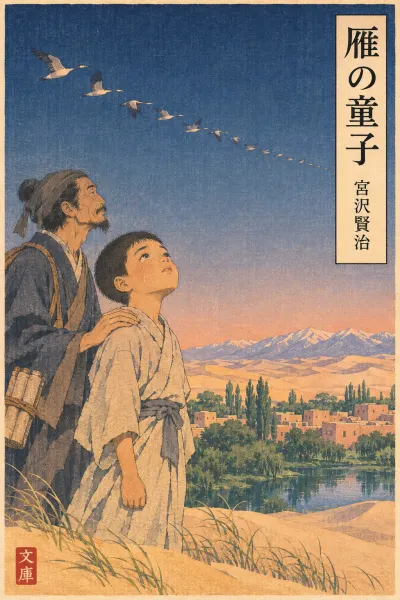
雁の童子 Kari no Dōji in easy Japanese (N5)
This is our own simplified retelling of The Child Who Came with the Wild Geese, written for N5 learners and checked word by word against the N5 vocabulary list. A few story words and grammar patterns go beyond N5; the notes below give each one's level. It keeps the characters, events and ending of the original. When it feels easy, move on to the N4 version or the original text.
The story in brief
A traveller resting by a spring meets an old man, who explains that the small building nearby belongs to the Wild Goose Child. He tells how wild geese shot from the sky turned into heavenly people and left their youngest, a little boy, with a kind man named Suriya, who raised him as his own son. Years later, in front of an ancient wall painting of heavenly children, the boy falls, says the old man is calling him, and tells Suriya that it was Suriya himself who painted that picture long ago; then the storyteller and the traveller go their separate ways.
AI translation · independently checked
わたしは一人で旅行をしていました。I was travelling on my own.
小さないずみのそばで、ひるごはんを食べました。I ate my lunch beside a small spring.
そこへ、一人のおじいさんが来ました。Just then, an old man came along.
いずみの後ろに、小さなたてものがありました。Behind the spring stood a small building.
「あれは何のたてものですか。」とわたしは聞きました。"What is that building?" I asked.
「がんの子どものたてものです。」とおじいさんはいいました。"It is the building of the Wild Goose Child," said the old man.
そして、話をはじめました。And then he began his tale.
「スリヤさんという男の人がいました。おくさんと二人で、しずかにすんでいました。"There once lived a man called Suriya. He lived quietly with his wife, just the two of them.
あるあさ、スリヤさんは、家族のわかい男と外をあるいていました。One morning, Suriya was out walking with a young man of his family.
わかい男は、てっぽうをもっていました。The young man was carrying a gun.
「とりをうつのは、よくないですよ。」とスリヤさんはいいました。"It is not good to shoot birds, you know," said Suriya.
でも、わかい男は聞きませんでした。But the young man would not listen.
そらを、くろいがんが七つとんでいました。Seven black wild geese were flying across the sky.
わかい男が、てっぽうでうちました。The young man fired at them with his gun.
がんが一つおちました。One goose fell.
からだが、あかくもえていました。Its body was burning red.
また一つ、また一つ。Then another, and then another.
六つのがんがおちました。Six geese fell.
でも、ほかのがんはとんで行きませんでした。Yet the other geese did not fly away.
いちばん小さいがんだけが、元気でした。Only the very smallest goose was unharmed.
がんは、みんな人になりました。All the geese turned into people.
おじいさんのがんがいいました。The goose that was an old man spoke.
「わたしたちは天の人です。今日、天にかえります。でも、この男の子はまだ天に行きません。あなたの子どもにしてください。あなたにたのみます。」"We are people of Heaven. Today we return to Heaven. But this boy will not go to Heaven yet. Please make him your child. I ask this of you."
「はい、わかりました。」とスリヤさんはいいました。"Yes, I understand," said Suriya.
おじいさんは、もえてきえました。The old man burned and vanished.
「今日から、あなたはわたしの子どもです。もうなかないでください。」"From today, you are my child. Please do not cry any more."
まちの人は、この男の子を「がんの子ども」とよびました。The people of the town called this boy "the Wild Goose Child."
男の子は六つになりました。The boy turned six.
ある夕がた、まちの子どもたちがわらいました。One evening, the children of the town laughed.
そして、いしが一つとんで来て、男の子にあたりそうになりました。Then a stone came flying and very nearly struck the boy.
「何をしますか。この子どもは何もわるくありません。」とスリヤさんはいいました。"What are you doing? This child has done nothing wrong at all," said Suriya.
子どもたちは、男の子のそばに来ました。The children came up close to the boy.
男の子は、はじめからおわりまでわらっていました。The boy kept smiling from beginning to end.
よる、スリヤさんは聞きました。That night, Suriya asked him,
「どうしてなきませんでしたか。」"Why didn't you cry?"
「お父さん、わたしの前のおじいさんのからだには、てっぽうでうたれた所が七つありました。」"Father, the old man who was before me had seven places on his body where he was shot by the gun."
十二になって、男の子はとおいまちの学校に入りました。When he was twelve, the boy entered a school in a distant town.
お母さんは毎日たくさんはたらいて、お金を出しました。His mother worked hard every day and paid for it.
ふゆの前に、男の子は一人で家にかえって来ました。Before winter, the boy came back home by himself.
「お母さん、わたしもいっしょにはたらきたいです。お母さんの手を見てください。わたしの手とちがいます。」"Mother, I want to work with you too. Please look at your hands. They are different from mine."
「早く学校にかえって、べんきょうしてください。あなたがりっぱになるのが、わたしのいちばん大切なものです。」"Go back to school quickly and study. Your becoming a fine person is the most precious thing to me."
男の子は学校にかえりました。The boy went back to school.
そらを、がんがとんで行きました。Wild geese flew away across the sky.
スリヤさんは、まどからそれを見ていました。Suriya was watching them from the window.
はるになりました。Spring came.
まちのちかくで、ふるいかべが出ました。Near the town, an old wall was dug up.
かべには、天の子どもが三人書いてありました。On the wall, three children of Heaven had been painted.
スリヤさんは、男の子といっしょに見に行きました。Suriya went with the boy to see it.
みちで、男の子はいいました。On the way, the boy said,
「お父さん、わたしはお父さんのそばにいたいです。だれも一人でとおくへ行かないでいいですか。」"Father, I want to stay by your side. Is it all right if no one goes far away alone?"
「はい、いいですよ。」"Yes, that's all right."
かべの前で、スリヤさんはいいました。In front of the wall, Suriya said,
「この天の子どもは、あなたとおなじですね。」"These children of Heaven are the same as you, aren't they?"
男の子はわらって、たおれました。The boy smiled, and fell down.
「おじいさんが、よんでいます。」"The old man is calling me."
「どこへも行かないでください。」"Please don't go anywhere."
「お父さん、わたしはあなたの子どもです。このかべの絵は、前にお父さんが書きました。」"Father, I am your child. The picture on this wall—you painted it, long ago."
男の子は、小さいこえで何かいいました。The boy said something in a small voice.
でも、スリヤさんにはわかりませんでした。」But Suriya could not understand it."
おじいさんの話は、おわりました。The old man's tale came to an end.
わたしはたっていいました。I stood up and said,
「どうも。とてもいい話でした。ここであったのは、大切なものです。では、また。」"Thank you. That was a very fine story. This meeting here is something precious. Well, until we meet again."
おじいさんは、何もいいませんでした。The old man said nothing.
そして、わたしが来たみちをあるいて行きました。Then he walked off along the road I had come by.
わたしも、ちがうみちを一人であるいて行きました。I, too, walked off alone along a different road.
Vocabulary
| Word | Meaning | JLPT |
|---|---|---|
| 旅行りょこう | travel, a journey旅行をする = to travel. | N5 |
| いずみいずみ | spring (of water)dictionary form: 泉Usually written 泉. In a desert, a spring is a precious resting place. | N3 |
| たてものたてもの | buildingdictionary form: 建物From 建つ (to stand, be built) + 物 (thing). Here, a small shrine-like building. | N5 |
| がんがん | wild goosedictionary form: 雁The same kanji 雁 can also be read かり, as in the story's title. | — |
| てっぽうてっぽう | gundictionary form: 鉄砲An older word for a gun; 鉄 means iron. | N2 |
| うちましたうつ | to shootdictionary form: 撃つSounds the same as 打つ (to hit); 撃つ is used for guns. | N3 |
| もえてもえる | to burndictionary form: 燃えるIntransitive: something burns by itself. もえてきえる = burn and vanish. | N3 |
| たのみますたのむ | to ask (a favour), to entrustdictionary form: 頼むあなたにたのみます = I am asking you / I leave it to you. | N5 |
| きえましたきえる | to disappear, vanishdictionary form: 消えるAlso used for lights going out. | N5 |
| よびましたよぶ | to call, to namedictionary form: 呼ぶAをBとよぶ = to call A 'B'. | N5 |
| あたりあたる | to hit, strike (a target)dictionary form: 当たるThe thing that is hit takes に: 男の子にあたる. | N3 |
| りっぱりっぱ | fine, admirable, splendiddictionary form: 立派A な-adjective; りっぱになる = to grow into a fine person. | N5 |
| 大切たいせつ | precious, importantA な-adjective, close to 大事 (だいじ). | N5 |
| たおれましたたおれる | to fall down, collapsedictionary form: 倒れるUsed for people collapsing as well as things toppling over. | N4 |
Grammar
〜という + noun N4 a … called ~
という links a name to the noun it describes. スリヤさんという男の人 means 'a man called Suriya' and introduces someone the listener doesn't know yet.
スリヤさんという男の人がいました。
There was a man called Suriya.
〜ていました N5 was doing ~ / was in the state of ~
The past form of 〜ている describes an action that was going on, or a state that held at a past moment. Here it sets the scene before the shooting begins.
スリヤさんは、家族のわかい男と外をあるいていました。
Suriya was out walking with a young man of his family.
verb stem + そうになる N3 almost ~, nearly ~
Attach そうになる to the masu-stem to say that something nearly happened but did not. あたりそうになりました means the stone nearly hit the boy.
いしが一つとんで来て、男の子にあたりそうになりました。
A stone came flying and very nearly struck the boy.
〜ないでください N5 please don't ~
The ない-form plus でください makes a polite request not to do something. With もう, it means 'please don't … any more'.
もうなかないでください。
Please do not cry any more.
〜てある N4 has been done (and remains so)
A transitive verb in the て-form plus ある describes a result left by someone's earlier action, without naming who did it. 書いてありました means the figures had been painted and could still be seen.
かべには、天の子どもが三人書いてありました。
On the wall, three children of Heaven had been painted.
verb stem + に行く N5 to go (in order) to ~
The masu-stem plus に before a verb of motion shows the purpose of going. 見に行きました means they went in order to see the wall.
スリヤさんは、男の子といっしょに見に行きました。
Suriya went with the boy to see it.