 N3 · easy
Simplified retelling · JLPT N3
黄いろのトマト Kiiro no Tomato in easy Japanese (N3)
This is our own simplified retelling of The Tomato That Shone Like Gold, written for N3 learners and checked word by word against the N3 vocabulary list. A few story words and grammar patterns go beyond N3; the notes below give each one's level. It keeps the characters, events and ending of the original. When it feels easy, move on to the original text.
The story in brief
Early one morning, a stuffed hummingbird in the town museum begins telling a boy about Pemperu and Neri, two children who lived alone on a farm, then suddenly falls silent until the old guard scolds it. It then explains how the children followed a circus to town and tried to pay for their tickets with shining yellow tomatoes they believed were gold. The doorman angrily threw a tomato at them; after crying, the children walked home without a word, leaving the boy deeply sad.
AI translation · independently checked
私の町のはくぶつかんには、大きなガラスのたながあります。In the museum in my town, there is a large glass case.
その中に、四わの小さなはちすずめがいます。Inside it are four little hummingbirds.
はくせいなので、もう生きていません。They are stuffed, so they are no longer alive.
私は、いちばん上のえだにいる一わが特に好きでした。I was especially fond of the one on the highest branch.
目が赤くて、むねは青とみどりの色で、きれいに光っていました。Its eyes were red, and its breast was blue and green, and it shone beautifully.
私が小さかったころのことです。This happened when I was small.
ある朝早く、学校へ行く前に、私はそっとガラスの前に立ちました。Early one morning, before going to school, I quietly stood in front of the glass.
すると、そのはちすずめが、ほそいきれいな声で急に話しかけました。Then, all of a sudden, that hummingbird spoke to me in a thin, lovely voice.
「おはよう。ペムペルという子は本当にいい子だったのに、かわいそうなことをした。妹のネリも、かわいい子だったのに。」"Good morning. That boy called Pemperu was a really good boy, and yet such a pitiful thing happened. His little sister Neri was a sweet child too."
「おはよう。どうしたの。話してよ。」"Good morning. What happened? Tell me!"
「話してあげるから、かばんをゆかに置いて、その上に座りなさい。」"I'll tell you, so put your satchel on the floor and sit on it."
私は少し困りましたが、話が聞きたかったので、その通りにしました。I was a little unsure what to do, but I wanted to hear the story, so I did as I was told.
はちすずめは話し始めました。The hummingbird began its story.
「ペムペルとネリは、こむぎをこなにしたり、キャベツを育てたりしていた。ペムペルはこなで体じゅう白くなっていた。ネリはキャベツを車に入れて、二人で運んだ。僕はいつも見に行ったよ。」"Pemperu and Neri used to grind wheat into flour and grow cabbages and things. Pemperu would be white all over with flour. Neri would load the cabbages into a cart, and the two of them would haul it together. I always went to watch them, you know."
「大人はいなかったの。」"Weren't there any grown-ups?"
「いなかった。二人だけで、とても楽しく暮らしていたんだ。でも、本当にかわいそうなことをした。」"No, there weren't. The two of them lived all on their own, and they were very happy. But such a pitiful thing happened, it really did."
そう言うと、はちすずめは急にだまってしまいました。Having said that, the hummingbird suddenly fell silent.
いつまで待っても、何も言いません。However long I waited, it said nothing at all.
私はガラスに手をついて、何度も「続きを話してよ」と言いました。I pressed my hands against the glass and said again and again, "Tell me the rest!"
でも、はちすずめはとなりの鳥を見ているだけでした。But the hummingbird only kept looking at the bird beside it.
私はとうとう泣き出してしまいました。At last I burst into tears.
すると、だれかが私のかたに手を置きました。Then someone laid a hand on my shoulder.
番人のおじいさんでした。It was the old man who kept watch over the museum.
「どうしてそんなに泣いているの。まだ開く前なのに、おまえだけ入れてあげたんだよ。大きな声で泣いてはいけない。」"Now, why are you crying like that? We're not even open yet, and I let you in all by yourself, didn't I? You mustn't cry so loudly."
「だって、はちすずめがもう話してくれないんだもの。」"But the hummingbird won't talk to me anymore!"
おじいさんは笑いました。The old man laughed.
「ああ、またか。このはちすずめは、よくそうやって人をからかうんだ。」"Ah, at it again, is it? This hummingbird often teases folks that way."
おじいさんはガラスの前で、「おい、はちすずめ。あまり悪いことをすると、遠い国へ送ってしまうぞ」としかりました。Standing in front of the glass, the old man scolded it: "Now then, hummingbird. If you get up to too much mischief, I'll ship you off to some faraway country, mind."
それから私のなみだをふいて、となりの部屋へ行きました。Then he wiped my tears and went into the next room.
足音が消えると、はちすずめはまた私の方を向きました。When his footsteps had faded away, the hummingbird turned toward me again.
「さっきはごめんなさい。すっかり疲れてしまったんだ。」"I'm sorry about before. I'd got completely tired out."
「ぜんぜん怒っていないよ。続きを話して。」"I'm not angry at all. Tell me the rest."
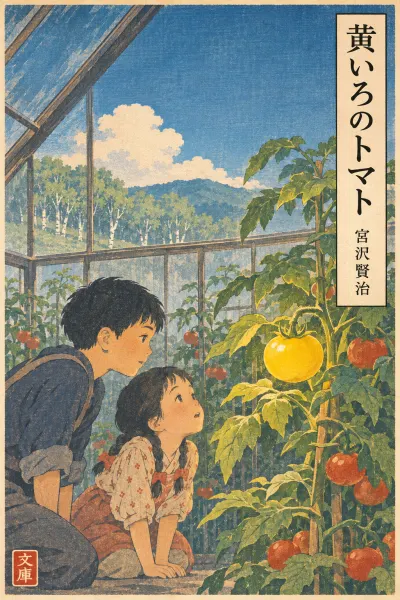
「二人の家はガラスでできていて、二人はよく一緒に歌を歌っていた。ある年、二人ははたけにトマトを十本うえた。その中の一本だけ、実がきいろで、とても光っていたんだ。ネリが『どうしてあんなに光るの』と聞くと、ペムペルは少し考えて、『おうごんだからだよ』と答えた。二人は『りっぱだね』と言って、その実にさわりもしなかった。"The two of them lived in a house made of glass, and they often sang songs together. One year, they planted ten tomato plants in the field. On just one of them, the fruit was yellow and shone ever so brightly. When Neri asked, 'Why does it shine like that?', Pemperu thought for a moment and answered, 'Because it's gold.' The two of them said, 'Isn't it splendid?', and they never even touched that fruit.
ある夕方、遠い野原の方から、とてもいい音が風にのって聞こえてきた。One evening, a wonderful sound came to them on the wind from a faraway field.
二人は手をつないで、その音の方へ走って行った。The two of them held hands and ran off toward the sound.
山をこえ、川をこえて、やっと大きな道に出た。They crossed hills, they crossed rivers, and at last they came out onto a big road.
そこへ、赤いシャツを着た七人ぐらいの人が、馬に乗って通った。Just then, about seven people in red shirts came riding by on horses.
いちばん後ろのかわいい男の子は、ペムペルにキスを送った。The pretty little boy at the very back blew Pemperu a kiss.
その後から、白い大きなしかくいものが、ゆっくり歩いて来た。Behind them came a big, white, square thing, walking slowly along.
下から、はいいろの大きな足が四本見えていた。Four big grey legs could be seen sticking out from underneath.
ぞうだったんだ。It was an elephant!
二人は少し怖かったけれど、ついて行った。The two of them were a little scared, but they followed along.
暗くなるころ、大きな町に着いた。Around the time it was getting dark, they reached a big town.
野原に大きなテントがあって、明かりがたくさんついていた。In a field stood a huge tent, with lots of lights lit.
きれいなかんばんの後ろから、あのいい音が聞こえていた。That wonderful sound was coming from behind a beautiful signboard.
でも近くで聞くと、ただのがくたいだった。But when they heard it up close, it was only a band.
人々は入口で番人に何かを渡して、中へ入って行った。At the entrance, people were handing something to the doorman and going inside.
ペムペルがよく見ると、それは金や銀のかけらだった。When Pemperu looked carefully, he saw they were bits of gold and silver.
『ネリ、ここで待っていて。ちょっと家へ行って来る。』'Neri, wait here. I'll just run home and come back.'
ペムペルは月の光の中を、家まで走って帰った。Pemperu ran all the way home through the moonlight.
僕もついて行ったけれど、とても疲れた。I went along with him too, but I got very tired.
ペムペルはあのきいろいトマトを四つ取って、すぐにまた走って戻った。Pemperu picked four of those yellow tomatoes and at once ran back again.
『さあ、入ろう。』'Come on, let's go in.'
二人は入口へ行き、ペムペルはトマトを二つ出した。The two of them went to the entrance, and Pemperu held out two tomatoes.
番人はそれを受け取ると、変な顔をして、急に怒り出した。As soon as the doorman took them, he made a strange face and suddenly flew into a rage.
『何だ。ばかにするな。トマトで入れるものか。帰れ。』そして、トマトを投げた。'What's this? Don't you make a fool of me! As if I'd let you in for tomatoes! Get out of here!' And he threw the tomatoes.
トマトはネリの耳に当たって、ネリは泣き出した。A tomato struck Neri on the ear, and Neri started to cry.
まわりの人たちは、みんな大きな声で笑った。All the people around them laughed out loud.
ペムペルはネリを抱いて逃げた。Pemperu took Neri in his arms and ran away.
暗いおかまで来ると、ペムペルも大きな声で泣き出した。When they reached a dark hill, Pemperu too began to cry out loud.
それから二人はだまって、来た道を家へ帰ったんだ。After that, the two of them went back home along the road they had come by, without saying a word.
本当にかわいそうだよ。It's really so pitiful.
じゃあ、さようなら。Well then, goodbye.
もう話せない。」I can't talk anymore."
はちすずめはそう言うと、口を閉じて、またとなりの鳥を見ていました。When it had said this, the hummingbird closed its beak and went back to looking at the bird beside it.
私もとても悲しくなりました。I too became very sad.
「さようなら、はちすずめ。また来るよ。ありがとう。」"Goodbye, hummingbird. I'll come again. Thank you."
私はかばんを持って、静かにろうかへ出ました。I picked up my satchel and quietly went out into the corridor.
外が明るすぎるのと、二人がかわいそうなのとで、目が痛くなり、なみだがたくさん出ました。Because it was far too bright outside, and because I felt so sorry for the two children, my eyes began to sting and many tears came.
私がまだ小さかったころの話です。This is a story from when I was still small.
Vocabulary
| Word | Meaning | JLPT |
|---|---|---|
| はくぶつかんはくぶつかん | museumdictionary form: 博物館博 = wide knowledge, 物 = things, 館 = building. | N3 |
| はちすずめはちすずめ | hummingbirddictionary form: 蜂雀Literally 'bee sparrow'. The modern word is ハチドリ. | — |
| はくせいはくせい | stuffed animal specimendictionary form: 剥製A real animal preserved for display, not a soft toy (that is ぬいぐるみ). | — |
| 暮らしてくらす | to live, to get by day to daydictionary form: 暮らすFocuses on everyday life and lifestyle rather than simply being alive (生きる). | N3 |
| だまってだまる | to fall silent, to stop talkingdictionary form: 黙るだまって as an adverb means 'without a word', as in the line about walking home. | N3 |
| 番人ばんにん | guard, watchman; (at the circus) doorman番 means 'watch, turn', as in 交番 (police box). | — |
| からかうからかう | to tease, to make fun of playfully | N2 |
| しかりましたしかる | to scolddictionary form: 叱るUsed for a person in authority correcting someone. 怒る is more about one's own anger. | N3 |
| おうごんおうごん | golddictionary form: 黄金A more literary, splendid-sounding word than 金 (きん). | N1 |
| がくたいがくたい | band (of musicians)dictionary form: 楽隊Slightly old-fashioned. Today バンド or 楽団 is more common. | — |
| かけらかけら | fragment, small pieceOften written 欠片, from 欠ける (to be chipped). | — |
| ばかにするばかにする | to make a fool of, to look down on | — |
| 抱いてだく | to hold in one's arms, to hugdictionary form: 抱くRead いだく in literary use, especially for feelings (夢を抱く). | N3 |
Grammar
〜のに N4 even though, and yet
Joins two facts where the result is disappointing or unexpected. Here a good, kind boy still met with misfortune, and the clause carries a feeling of regret.
ペムペルという子は本当にいい子だったのに、かわいそうなことをした。
That boy called Pemperu was a really good boy, and yet such a pitiful thing happened.
〜たり〜たりする N4 do things like A and B
Lists a few typical actions as examples, not a complete list. The past form していた describes the children's regular daily work.
こむぎをこなにしたり、キャベツを育てたりしていた。
They used to grind wheat into flour and grow cabbages and things.
いつまで〜ても N3 no matter how long ~
A question word plus the て-form plus も means 'no matter how/when ~'. Here no amount of waiting makes the bird speak.
いつまで待っても、何も言いません。
However long I waited, it said nothing at all.
〜出す N3 to suddenly start ~ing
Attached to a verb's ます-stem, 出す shows that an action begins suddenly or without control. It is common with emotional actions like crying or getting angry.
私はとうとう泣き出してしまいました。
At last I burst into tears.
だって〜んだもの N3 but ~, that's why (childish excuse)
だって opens a reason or protest, and 〜もの / 〜もん at the end gives it a pouting, self-justifying tone. The pattern is typical of children and casual speech.
だって、はちすずめがもう話してくれないんだもの。
But the hummingbird won't talk to me anymore!
〜ものか N2 as if I would ~; I'll never ~
Attached to a plain-form verb, it forms an emphatic, rough rejection. The doorman means he would never let anyone in for tomatoes.
トマトで入れるものか。
As if I'd let you in for tomatoes!