 N3 · easy
Simplified retelling · JLPT N3
恐竜艇の冒険 Kyōryūtei no Bōken in easy Japanese (N3)
This is our own simplified retelling of The Dinosaur Sub Caper, written for N3 learners and checked word by word against the N3 vocabulary list. A few story words and grammar patterns go beyond N3; the notes below give each one's level. It keeps the characters, events and ending of the original. When it feels easy, move on to the original text.
The story in brief
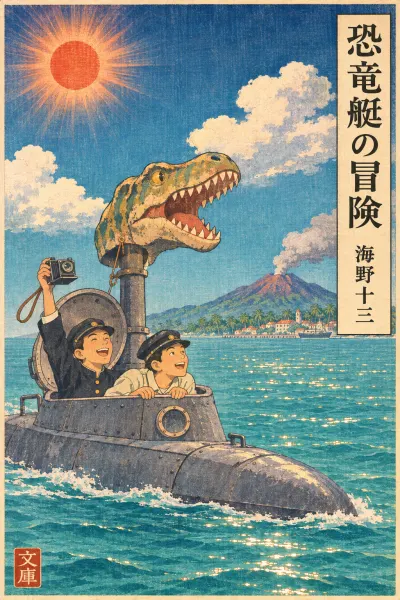
Jimmy and Sam spend their summer holiday in the tropical town of Gineta, where they buy a cheap two-man submarine and fix a fake dinosaur head to its mast to frighten passing ships. Their prank terrifies the crew of the big ship Gloria, so they have to hide on a small island while planes search for them. There they meet a real dinosaur, flee back to Gineta, and later grow rich telling the story.
AI translation · independently checked
みなさん、ジミー君とサム君をしょうかいします。Everyone, allow me to introduce Jimmy and Sam.
二人は夏休みに、ねったいのしまへ行きました。During their summer holidays, the two of them went off to an island in the tropics.
そこで、すごいぼうけんをしました。And there they had a tremendous adventure.
では、ジミー君、話してください。Now then, Jimmy, tell us all about it.
ぼくとサムは、たいくつな夏休みが大きらいです。Sam and I simply can't stand a boring summer holiday.
そこで今年は、遠いねったいのしまへ行くことに決めました。So this year we made up our minds to go to a faraway island in the tropics.
青い海、白いすな、大きな木。Blue sea, white sand, great big trees.
考えるだけで楽しくなりました。Just thinking about it put us in high spirits.
夏休みの最初の日、ぼくたちはひこうていに乗って出発しました。On the very first day of the holidays, we climbed aboard a flying boat and set off.
そして二日で、ギネタという小さな町に着きました。Two days later we arrived in a little town called Gineta.
町のすぐ近くには火山が三つもあります。Right next to the town there are no fewer than three volcanoes.
ぼくたちは「世界ホテル」にとまりました。We put up at the World Hotel.
名前はりっぱですが、小さくて古いホテルでした。It had a grand name, but it was a small, old hotel.
かいがんを歩いていたとき、小さなせんすいていをたくさん見つけました。While we were walking along the shore, we came across a whole lot of little submarines.
二人で動かせる小さな船です。They were small boats that two people could run.
戦争に負けた国が、ここに置いていったそうです。We heard that a country that had lost the war had gone off and left them here.
値段はおもちゃの電車と同じぐらいで、とても安かったです。They cost about as much as a toy train set, which was dirt cheap.
ぼくたちはうれしくて、すぐに一つ買いました。We were so pleased that we bought one on the spot.
名前は「きょうりゅう号」にしました。We named her the Dinosaur.
ぼくたちは船の会社に通って、アミールさんというぎしに動かし方を習いました。We went regularly to a boat company and learned from an engineer called Mr Amir how to run her.
昔、ぐんのせんすいていに八年乗っていた人です。Years ago he had served eight years aboard navy submarines.
「しずむ前に、必ず入口が閉まっているか確かめること。船の上に何も残っていないか、注意すること」と、アミールさんは教えてくれました。"Before you dive, always check that the hatch is shut. And make sure nothing has been left on deck," Mr Amir taught us.
ぼくたちが一生けんめいれんしゅうしたのには、理由がありました。There was a reason we practised so hard.
すばらしい計画があったのです。We had a splendid plan, you see.
せんすいていのマストに、作り物のきょうりゅうの首を付けます。We would attach a fake dinosaur's neck to the submarine's mast.
そして海から出たり、しずんだりします。Then we would pop up out of the sea and sink down again.
すると、本物のきょうりゅうが首を出しているように見えるでしょう。That way it would look just like a real dinosaur sticking its head up.
大きな船の人たちは、きっとびっくりします。The people on the big ships would surely be astonished.
そのようすを、きょうりゅうの目の中のカメラで写真にとります。We would take a photo of the scene with a camera inside the dinosaur's eye.
夏休みが終わったら、その写真を発表して、世界中を笑わせるつもりでした。When the holidays were over, we meant to publish the photos and set the whole world laughing.
ぼくたちは、自分の国の工場にきょうりゅうの頭を注文しました。We ordered a dinosaur head from a factory back in our own country.
十日後、箱がとどきました。Ten days later the crate arrived.
部屋で開けていると、ホテルのボーイが入ってきました。While we were opening it in our room, the hotel boy walked in.
ボーイは「きゃーっ」とさけんで逃げていきました。He let out a shriek, "Eeek!", and ran for his life.
かぎがこわれていたのです。The lock on the door was broken, you see.
ぼくたちは急いで箱をかたづけました。We hurried to pack the crate away.
そして、その夜のうちに、にもつをせんすいていへ運びました。Then, that very night, we carried our gear down to the submarine.
次の朝早く、マストに首を付けて出発しました。Early next morning we fixed the head to the mast and set out.
一日目は、船が一つも来ませんでした。On the first day, not a single ship came along.
二日目は、大きな船が通る遠い海まで行きましたが、やはりだめでした。On the second day we went all the way out to the open sea where the big ships pass, but again we had no luck.
帰る途中、海から帰る村の人たちのカヌーを見つけました。On the way home, we spotted the canoes of some villagers coming back from the sea.
ぼくたちは海の中から、ぬーっときょうりゅうの首を出しました。Up from under the water we slowly raised the dinosaur's head.
村の人たちはさけんで、海に飛び込みました。The villagers screamed and dived into the sea.
ぼくたちは笑いが止まりませんでした。We couldn't stop laughing.
次の日、一万トン以上の大きな船「グロリア号」が来ました。The next day a great ship of over ten thousand tons, the Gloria, came along.
きょうりゅうの首をふって、口を開けてみせました。We swung the dinosaur's head about and made it open its mouth for them.
すると、船の人たちはあわてて走り回りました。At that, the people aboard went dashing about in a panic.
船は向きを変えて、急いで逃げていきました。The ship turned round and fled as fast as it could.
ぼくたちはその写真をたくさんとって、ころがって笑いました。We took heaps of photographs of it and rolled about laughing.
まだ明るかったので、ぼくたちは人がいない小さなしまにかくれて休みました。It was still light, so we hid on a small uninhabited island and rested.
すると、たくさんの飛行機が空を飛び始めました。Then a great many aeroplanes began flying about overhead.
グロリア号が助けを呼んだのでしょう。The Gloria must have called for help.
飛行機は夜も朝もいて、ぼくたちは動けませんでした。The planes were there night and morning, and we couldn't move.
三日間そこにいて、食べ物も水もなくなりました。We stayed there three days, and our food and water ran out.
ヤシの実の水を飲んで、やっと生きていました。We only just kept alive by drinking the water from coconuts.
四日目の朝、飛行機の音がしなくなりました。On the morning of the fourth day, the sound of the planes stopped.
ぼくたちは、ヤシの実をひろいに行きました。We went off to gather coconuts.
帰るとき、サムが急に立ち止まりました。On the way back, Sam suddenly stopped dead.
「きょうりゅうの首が二つ見える」と言うのです。"I can see two dinosaur heads," he said.
見ると、ぼくたちの船のそばに、もう一頭のきょうりゅうがいました。I looked, and there beside our boat was another dinosaur.
大きな体で木を倒し、長いしっぽで木をたたいています。It was knocking down trees with its huge body and lashing them with its long tail.
本物のきょうりゅうでした。It was a real dinosaur.
ぼくたちは、もりのおくへ逃げました。We ran off deep into the forest.
船の入口を閉めるのも忘れていました。We had even forgotten to shut the boat's hatch.
船がこわされたら、もう帰れません。If the boat got smashed, we'd never get home.
しばらくして、そっと見に行きました。After a while, we crept back to have a look.
すると、きょうりゅうはいませんでした。And the dinosaur was gone.
ぼくたちは急いで船に飛び乗って、いちばん速いスピードで逃げました。We leapt aboard in a hurry and escaped at top speed.
ギネタの近くで船が止まると、ぼくたちはかいがんまで走りました。When the boat came to a stop near Gineta, we ran for the shore.
そして、そのまま二人とも気を失いました。And right there, both of us fainted dead away.
近くの人たちは、きょうりゅうが来たと思って、とてもおどろいたそうです。We heard that the people nearby got an awful fright, thinking a dinosaur had come.
ホテルの人たちも、ぼくたちを三日間探していました。The hotel people had been searching for us for three days too.
ぼくたちは、ぶじに自分の国へ帰りました。We got back home to our own country safe and sound.
そのあと、このぼうけんの話をラジオで話したり、本にしたりして、お金持ちになりました。After that, we told the story of this adventure on the radio and put it in a book, and we became rich.
次の休みには、日本へ行ってみたいです。Next holidays, I'd like to try going to Japan.
今度サムに相談してみます。I'll talk it over with Sam soon.
Vocabulary
| Word | Meaning | JLPT |
|---|---|---|
| たいくつたいくつ | boring, dulldictionary form: 退屈A な-adjective: たいくつな夏休み. Also means 'bored' when describing a person. | N3 |
| ひこうていひこうてい | flying boat (seaplane)dictionary form: 飛行艇艇 means 'boat'. It also appears in せんすいてい. | — |
| せんすいていせんすいてい | small submarinedictionary form: 潜水艇潜水 means 'diving'. The more common word for a large submarine is 潜水艦 (せんすいかん). | — |
| 値段ねだん | price | N4 |
| 通ってかよう | to go regularly, to attenddictionary form: 通うUsed for going somewhere again and again, such as school, work or a hospital. | N4 |
| 確かめるたしかめる | to check, to make sure | N3 |
| 計画けいかく | plan, scheme | N4 |
| 本物ほんもの | the real thing, genuineThe opposite is 作り物 or 偽物 (にせもの), both meaning 'fake'. | N3 |
| 注文ちゅうもん | order (goods)Takes に for the place you order from: 工場に注文する. | N3 |
| とどきましたとどく | to arrive, to be delivereddictionary form: 届くIntransitive. The transitive partner is 届ける, 'to deliver'. | N3 |
| あわててあわてる | to panic, to be flustereddictionary form: 慌てるThe te-form あわてて often works like an adverb meaning 'in a panic'. | N2 |
| 気を失いましたきをうしなう | to faint, to lose consciousnessdictionary form: 気を失う | — |
| 相談そうだん | consultation, talking something overUse に for the person you consult: サムに相談する. | N4 |
Grammar
〜ことに決める N4 to decide to do
Attach a dictionary-form verb plus こと to に決める to say that you made a decision to act. The past tense 決めました shows the decision was already made.
遠いねったいのしまへ行くことに決めました。
We made up our minds to go to a faraway island in the tropics.
〜だけで N3 just by doing ~, merely ~
Verb plus だけで means that this one small action is enough to cause the result. Here, simply imagining the trip made the boys happy.
考えるだけで楽しくなりました。
Just thinking about it put us in high spirits.
〜そうです (hearsay) N4 I hear that ~, apparently ~
When そうです follows a plain-form sentence, it reports information heard from someone else. Do not confuse it with the stem plus そう form, which means 'looks like'.
戦争に負けた国が、ここに置いていったそうです。
We heard that a country that had lost the war had gone off and left them here.
〜ように見える N3 to look as if ~
A plain-form clause plus ように見える describes how something appears, whether or not it is true. Here the fake head will look like a real dinosaur.
本物のきょうりゅうが首を出しているように見えるでしょう。
It would look just like a real dinosaur sticking its head up.
〜つもりでした N4 intended to, meant to
Dictionary form plus つもり expresses an intention. In the past tense, つもりでした states what one intended at that time. Whether the plan was carried out depends on context.
その写真を発表して、世界中を笑わせるつもりでした。
We meant to publish the photos and set the whole world laughing.
〜てみせる N2 to do something for others to see
Te-form plus みせる means performing an action deliberately to show it to someone. Here the boys put on a show for the ship's crew.
きょうりゅうの首をふって、口を開けてみせました。
We swung the dinosaur's head about and made it open its mouth for them.