Part 3 of 6 · JLPT N2
黄いろのトマト Kiiro no Tomato, part 3: A Tomato That Shines Like Gold
In this part
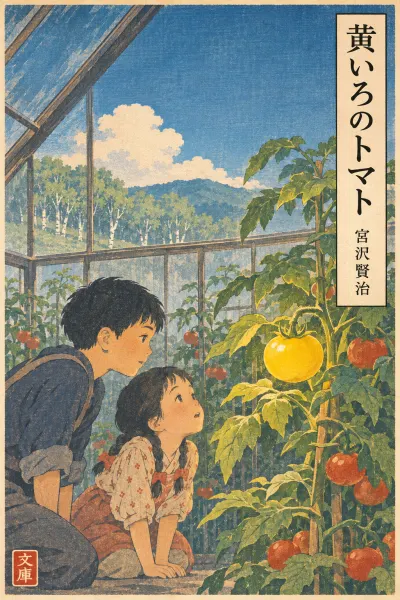
The old guard wipes the narrator's tears and goes off on his rounds, and the stuffed hummingbird quietly picks up its story again. It tells how Pemperu and Neri lived happily in their glass house and grew tomatoes, and how one Red Cherry plant bore a dazzling yellow tomato that the children took for gold and left untouched. One evening strange, beautiful music drifts to them on the wind from far across the fields.
AI translation · independently checked
お話がすんだら早く学校へ入らっしゃい。When the story's done, you hurry along to school, now.
あんまり長くなって厭きっちまうとこいつは又いろいろいやなことを云いますから。If it drags on too long and he gets tired of it, this fellow will start saying all manner of nasty things again.
ではようがすか。」Now then, will that do?"
番人のおじいさんは私の涙を拭いて呉れてそれから両手をせなかで組んでことりことり向うへ見まわって行きました。The old guard wiped away my tears for me, and then, clasping his hands behind his back, he went off on his rounds, tap, tap, into the distance.
おじいさんのあし音がそのうすくらい茶色の室の中から隣りの室へ消えたとき蜂雀はまた私の方を向きました。When the old man's footsteps had faded out of that dim brown room into the next, the hummingbird turned toward me again.
私はどきっとしたのです。My heart gave a jump.
蜂雀は細い細いハアモニカの様な声でそっと私にはなしかけました。In a thin, thin voice like a harmonica, the hummingbird softly spoke to me.
「さっきはごめんなさい。僕すっかり疲れちまったもんですからね。」"I'm sorry about before. You see, I'd got so terribly tired."
私もやさしく言いました。I spoke gently too.
「蜂雀。僕ちっとも怒っちゃいないんだよ。さっきの続きを話してお呉れ。」"Hummingbird, I'm not one bit angry, you know. Please tell me the rest of the story from before."
蜂雀は語りはじめました。The hummingbird began its tale.
「ペムペルとネリとはそれはほんとうにかあいいんだ。二人が青ガラスのうちの中に居て窓をすっかりしめてると二人は海の底に居るように見えた。そして二人の声は僕には聞えやしないね。"Pemperu and Neri, oh, they were truly sweet. When the two of them were inside the blue glass house with the windows shut tight, they looked as if they were at the bottom of the sea. And I couldn't hear their voices at all, you know.
それは非常に厚いガラスなんだから。That's because the glass was very thick.
けれども二人が一つの大きな帳面をのぞきこんで一所に同じように口をあいたり少し閉じたりしているのを見るとあれは一緒に唱歌をうたっているのだということは誰だってすぐわかるだろう。But when you saw the two of them peering into one big notebook, opening their mouths together in just the same way and then closing them a little, anybody at all would know right away that they were singing a school song together.
僕はそのいろいろにうごく二人の小さな口つきをじっと見ているのを大へんすきでいつでも庭のさるすべりの木に居たよ。I loved gazing at their two little mouths as they moved in all sorts of ways, so I was always there in the crape myrtle tree in the garden.
ペムペルはほんとうにいい子なんだけれどかあいそうなことをした。Pemperu was a really good boy, but it was such a pity, what happened.
ネリも全くかあいらしい女の子だったのにかあいそうなことをした。」Neri was a truly lovely little girl too, and yet it was such a pity, what happened."
「だからどうしたって云うの。」"So what happened, then?"
「だからね、二人はほんとうにおもしろくくらしていたのだから、それだけならばよかったんだ。"Well, you see, the two of them were living so happily, and if that had been all, everything would have been fine.
ところが二人は、はたけにトマトを十本植えていた。そのうち五本がポンデローザでね、五本がレッドチェリイだよ。But the two of them had planted ten tomato plants in the field. Five of them were Ponderosas, you see, and five were Red Cherries.
ポンデローザにはまっ赤な大きな実がつくし、レッドチェリーにはさくらんぼほどの赤い実がまるでたくさんできる。The Ponderosas bear big, bright-red fruit, and the Red Cherries grow simply heaps of red fruit about the size of cherries.
ぼくはトマトは食べないけれど、ポンデローザを見ることならもうほんとうにすきなんだ。I don't eat tomatoes, but when it comes to looking at Ponderosas, oh, I really do love that.
ある年やっぱり苗が二いろあったから、植えたあとでも二いろあった。だんだんそれが大きくなって、葉からはトマトの青いにおいがし、茎からはこまかな黄金の粒のようなものも噴き出した。One year, as usual, there were two kinds of seedlings, so after they were planted there were still two kinds. Little by little they grew bigger; the leaves gave off the green smell of tomatoes, and from the stems there even sprang out tiny things like grains of gold.
そしてまもなく実がついた。And before long the fruit came.
ところが五本のチェリーの中で、一本だけは奇体に黄いろなんだろう。But among the five Cherries, just one was strangely yellow, see.
そして大へん光るのだ。And it shone ever so brightly.
ギザギザの青黒い葉の間から、まばゆいくらい黄いろなトマトがのぞいているのは立派だった。It was a splendid sight, that dazzlingly yellow tomato peeping out from between the jagged, blue-black leaves.
だからネリが云った。So Neri said:
『にいさま、あのトマトどうしてあんなに光るんでしょうね。』'Brother, why do you suppose that tomato shines like that?'
ペムペルは唇に指をあててしばらく考えてから答えていた。Pemperu put his finger to his lips and thought for a while before he answered.
『黄金だよ。黄金だからあんなに光るんだ。』'It's gold. It shines like that because it's gold.'
『まあ、あれ黄金なの。』ネリがすこしびっくりしたように云った。'Oh my, is that gold?' said Neri, sounding a little surprised.
『立派だねえ。』'Isn't it splendid?'
『ええ立派だわ。』'Yes, it's splendid.'
そして二人はもちろん、その黄いろなトマトをとりもしなけぁ、一寸さわりもしなかった。And of course the two of them never picked that yellow tomato, nor even touched it the tiniest bit.
そしたらほんとうにかあいそうなことをしたねえ。」And then, oh, it was such a pity, what happened."
「だからどうしたって云うの。」"So what happened, then?"
「だからね、二人はこんなに楽しくくらしていたんだからそれだけならばよかったんだよ。"Well, you see, the two of them were living so happily, and if that had been all, everything would have been fine, you know.
ところがある夕方二人が羊歯の葉に水をかけてたら、遠くの遠くの野はらの方から何とも云えない奇体ないい音が風に吹き飛ばされて聞えて来るんだ。But one evening, while the two of them were watering the ferns, from far, far away across the fields came a strange and lovely sound, more than words can tell, blown along on the wind.
まるでまるでいい音なんだ。切れ切れになって飛んでは来るけれど、まるですずらんやヘリオトロープのいいかおりさえするんだろう、その音がだよ。Oh, it was the loveliest, loveliest sound. It came flying in scraps and snatches, but it was as if it even carried the sweet scent of lily of the valley and heliotrope, that sound, I mean.
二人は如露の手をやめて、しばらくだまって顔を見合せたねえ、それからペムペルが云った。The two of them stopped watering and looked at each other in silence for a while, and then Pemperu said:
Vocabulary
| Word | Meaning | JLPT |
|---|---|---|
| 厭きっちまうあきる | to get tired of, grow bored withdictionary form: 厭きるUsually written 飽きる today; ちまう is a casual contraction of てしまう. | N3 |
| 番人ばんにん | guard, keeper, watchman | — |
| 見まわってみまわる | to make one's rounds, patroldictionary form: 見まわるUsually written 見回る. | — |
| 帳面ちょうめん | notebook, book (here a songbook)Old-fashioned word; ノート is more common today. | — |
| 唱歌しょうか | song, especially a school songRefers to songs taught in schools in the Meiji–Shōwa eras. | — |
| さるすべりさるすべり | crape myrtleLiterally 'monkey slide', from its smooth bark (猿滑). | — |
| 苗なえ | seedling, young plant | N1 |
| 茎くき | stem, stalk | N1 |
| 噴き出したふきだす | to spring out, spout, gush outdictionary form: 噴き出す | — |
| 奇体きたい | strange, curious, oddOld-fashioned; a favourite word of Miyazawa Kenji. Modern equivalent: 奇妙. | — |
| まばゆいまばゆい | dazzling, blindingly bright | — |
| 羊歯しだ | fernAn irregular kanji reading; often written in katakana as シダ. | — |
| 切れ切れきれぎれ | in bits and pieces, broken, intermittent | — |
| 如露じょろ | watering canOld spelling of じょうろ (from Portuguese jorro). | — |
Grammar
〜ちまう N3 casual form of 〜てしまう (completely / ended up)
て + しまう contracts to ちまう in rough or casual speech, stressing that something has happened completely or unavoidably. The hummingbird says it got completely worn out.
僕すっかり疲れちまったもんですからね。
You see, I'd got so terribly tired.
〜やしない N2 emphatic negative: not at all
The verb stem + や + しない is a strong, colloquial way of saying 'does not'. Here 聞こえやしない means the voices simply can't be heard through the glass.
そして二人の声は僕には聞えやしないね。
And I couldn't hear their voices at all, you know.
〜たり〜たりする N4 doing things like A and B, alternating A and B
Listing two actions with たり shows them alternating or repeated. Here the children's mouths keep opening and half closing as they sing.
一所に同じように口をあいたり少し閉じたりしているのを見ると
when you saw them opening their mouths together in just the same way and then closing them a little
〜ならばよかった N3 if only it had been ~, it would have been fine
A conditional with よかった expresses that things would have been fine under that condition, hinting that something went wrong. It becomes the hummingbird's refrain before each turn in the story.
それだけならばよかったんだ。
If that had been all, everything would have been fine.
〜もしなけぁ〜もしなかった N2 neither did A nor even B
Verb stem + も + しない negates each action with emphasis; しなけぁ is a colloquial contraction of しなければ, used here to link the two negatives. The children neither picked the tomato nor so much as touched it.
その黄いろなトマトをとりもしなけぁ、一寸さわりもしなかった。
They never picked that yellow tomato, nor even touched it the tiniest bit.
〜ては来る N3 repeatedly do ~ and come
Vては + 来る (followed by けれど) uses contrastive は on the te-form to set up a concession: 'it does come flying, but...'. Here the music from the town does reach them, but only in broken scraps, so けれど follows.
切れ切れになって飛んでは来るけれど
It came flying in scraps and snatches, but