Upper intermediate · JLPT N2
蜘蛛となめくじと狸Kumo to Namekuji to Tanuki — A Spider, a Slug and a Tanuki
- JLPT N2
- 7,756 characters
- 6 parts
- about 65 minutes
- 3 easier versions
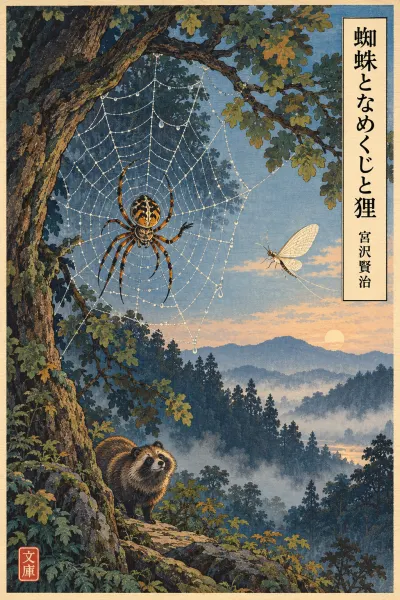
This is a dark, comic animal fable by Miyazawa Kenji. A talkative narrator follows three rivals in a wood, a spider, a silver slug and a tanuki, one after another. Each has a public face. The spider is a respected adviser to the Bug Society, the slug is famous for his kindness, and the tanuki is a holy man. Each one also has a private way of feeding itself on the weak creatures who come to it for help. The tone is playful on the surface and quite grim underneath, a satire of greed, vanity and religious hypocrisy told in a cheerful storybook voice. For learners, the narration is approachable: polite です/ます sentences, plenty of repetition and a clear episode-by-episode structure. The challenge lies in the dialogue. Every character speaks differently. The spider is rough and boastful, the slug laughs his oily ハッハハ, a blind mayfly uses archaic courtly forms and sings, and the tanuki preaches in an old-fashioned rustic sermon style built around the mock chant なまねこ. Reading it is good practice in hearing how register and word choice reveal character in Japanese.
Contents
Easier versions
This story is also retold in simpler Japanese. Reading an easier version first makes the original much more approachable.
Before you read
- Learn to tell the voices apart. The spider uses おれ, てまえ and やい. The slug laughs ハッハハ and speaks with false warmth. The mayfly uses archaic polite forms such as お〜なされて下されませ. The tanuki ends his sentences with じゃ, げな and ぞい and uses commands like 〜さっしゃれ. Spotting these endings tells you who is speaking even without a speech tag.
- なまねこ is a pun on なむあみだぶつ (namu amida butsu, the Buddhist prayer to Amida), with ねこ 'cat' slipped in. The tanuki's 'Great Wildcat God' extends the joke. Don't look for なまねこ in a dictionary; read it as a parody chant.
- 〜てしまう appears again and again, often for being eaten, dying or rotting away. It carries a sense of completion or of something irreversible and unfortunate, which suits the story's grim jokes. Watch for the casual form 〜ちゃう/〜ちまう in the rougher dialogue too.
- The narrator often reports events as hearsay with 〜のだそうです ('it is said that...'), and links actions with 〜ていますと ('while... was going on'). Recognising these patterns makes the long narrative sentences much easier to break apart.
- Before reading, learn a few key words: 蜘蛛 (spider), なめくじ (slug), 狸 (tanuki), 蚊 (mosquito), 網 (web/net), 相撲 (sumo wrestling) and 塩 (salt). Each episode repeats a similar pattern of a visitor arriving, a show of kindness and then betrayal, so once you know these words the later parts become easier.
Words to know
The most useful words from the notes across the story.
| Word | Meaning | JLPT |
|---|---|---|
| 評判ひょうばん | reputation, what people say〜という評判 = to be said to be ~. | N3 |
| 腐敗ふはい | rotting, decayA formal Sino-Japanese word; 腐る is the everyday verb. | N1 |
| ひもじいひもじい | starving; very hungrySomewhat old-fashioned; stronger than お腹がすいた. | — |
| 投げつけられましたなげつける | to fling down, hurl atdictionary form: 投げつけるつける adds force; here in the passive form. | — |
| おぼしめしおぼしめし | (divine) will, wishes of a superiordictionary form: 思し召しA very respectful word for someone's intention. | — |
| 競争きょうそう | competition; race; rivalry | N4 |
| 一生けん命いっしょうけんめい | with all one's might, as hard as one candictionary form: 一生懸命Usually written 一生懸命; here the difficult kanji 懸 is written in kana. | N4 |
| 参りましたまいる | to come (humble/polite)dictionary form: 参るThe narrator's polite storytelling style uses 参る for 来る. | N4 |
| 選手せんしゅ | athlete; competitorUsually a sports player chosen to compete; here it is used with mock seriousness. | N3 |
| さいわいにさいわい | taking advantage of; thanks todictionary form: 幸い〜をさいわいに means using some lucky circumstance as an opportunity. | N3 |
| 夫婦ふうふ | married couple, husband and wife | N3 |
| 云わばいわば | so to speak, as it weredictionary form: 言わば云 is an old kanji for 言う, used throughout this text. | N3 |
| 伝記でんき | biography; life story | N2 |
| てまえてまえ | you (rude)dictionary form: 手前A rough, insulting 'you' in a quarrel; the source of the even ruder てめえ. | N2 |
| 修繕しゅうぜん | repair, mendingA more formal word than 直す; often used of buildings, clothes and nets. | N2 |
Plot summary
Show the full summary (contains spoilers)
A spider blown onto an oak tree tricks a blind mayfly into his web by claiming it is an inn, and eats it. He grows prosperous, marries, has two hundred children and becomes an adviser to the Bug Society. The jealous slug and tanuki mock him in song. Trying to outdo them, he hoards so much prey that it rots, and the spider family rots with it until the rain washes them away. The slug, famed for kindness, wrestles a starving snail to death and dissolves an injured lizard while pretending to lick its wound. He then wrestles a frog, which scatters salt on the ring. The slug's foot melts, and the frog swallows him. The tanuki, posing as a priest chanting "Namaneko," eats a rabbit and then a wolf who come to him for help. He later swells up with mud and water and burns up and dies. The narrator concludes that all three were racing one another to Hell.
About the author
Miyazawa Kenji was a poet and writer of children's stories from Hanamaki in Iwate Prefecture. He studied agricultural science in Morioka and later taught at an agricultural school. He devoted much of his life to helping local farmers improve their methods and their cultural lives. He was a devout Buddhist, and his faith, love of nature and interest in science run through his writing. His fame came after his death, with works such as 銀河鉄道の夜, 風の又三郎 and the poem 雨ニモマケズ.