 N5 · easy
Simplified retelling · JLPT N5
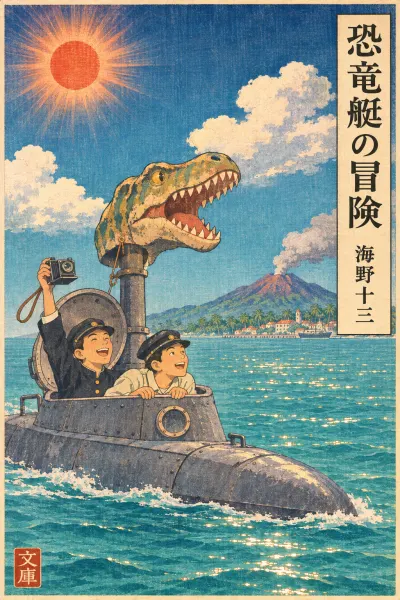
恐竜艇の冒険 Kyōryūtei no Bōken in easy Japanese (N5)
This is our own simplified retelling of The Dinosaur Sub Caper, written for N5 learners and checked word by word against the N5 vocabulary list. A few story words and grammar patterns go beyond N5; the notes below give each one's level. It keeps the characters, events and ending of the original. When it feels easy, move on to the N4 version or the original text.
The story in brief
Bored with their holidays, Jimmy and Sam fly to a tropical town, buy a cheap little submarine and fit it with a fake dinosaur's neck to scare passing ships. After frightening several boats, they hide on a deserted island while planes search for the monster, and there they see a real dinosaur knocking down trees. They escape back to town, go home, and become rich by telling their story on the radio and in a book.
AI translation · independently checked
ジミーとサムは友だちです。Jimmy and Sam are friends.
二人はなつ休みがきらいでした。The two of them hated the summer holidays.
毎年、とてもつまらないからです。That was because every year they were very dull.
「ことしのなつ休みは、南のしまへ行きましょう。」二人はそう話しました。"This summer holiday, let's go to the islands down south!" That's what the two of them said.
なつ休みの一日目に、二人はひこうきで出かけました。On the very first day of the holidays, the two of them set off by aeroplane.
二日で南の小さいまちにつきました。In two days they arrived at a small town in the south.
まちのちかくには、かざんが三つありました。Near the town there were three volcanoes.
二人はふるいホテルにとまりました。The two of them put up at an old hotel.
ある日、二人はうみのそばで小さいせんすいていを見ました。One day, down by the sea, the two of them spotted a little submarine.
とてもやすかったです。It was very cheap.
「これをかいましょう。」二人は一つかいました。"Let's buy this!" And so the two of them bought one.
名前は「きょうりゅうごう」です。Its name is the Dinosaur.
二人はアミールさんに、せんすいていののり方をならいました。The two of them learned from Amir how to pilot the submarine.
毎日たくさんれんしゅうしました。They practised a great deal every single day.
二人はおもしろいあそびを作りました。The two of them came up with a fun game.
せんすいていの上に、大きなきょうりゅうのくびをつけます。They would fix a big dinosaur's neck on top of the submarine.
うみの中からくびを出すと、ほんとうのきょうりゅうに見えます。When the neck pokes up out of the sea, it looks just like a real dinosaur.
ふねの人はびっくりするでしょう。The people on the ships will probably get a fright.
そのしゃしんをとって、あとでみんなに見せます。They would take photographs of it and show them to everybody afterwards.
二人は国のみせに、きょうりゅうのくびをたのみました。The two of them ordered a dinosaur's neck from a shop back home.
十日あとで、大きなはこが来ました。Ten days later, a big box arrived.
ホテルのへやではこをあけると、ホテルの人が入って来ました。When they opened the box in their hotel room, a man from the hotel came in.
その人は「きゃーっ」といって、はしって出て行きました。He cried "Eeeek!" and ran straight out again.
その夜、二人はくびをせんすいていにもって行きました。That night, the two of them carried the neck down to the submarine.
つぎの日のあさ、二人はくびをつけて、うみに出ました。The next morning, the two of them fitted the neck and went out to sea.
はじめに、小さいふねが六つ来ました。First of all, six little boats came along.
二人はうみの中からくびを出しました。The two of them raised the neck up out of the sea.
ふねの人たちはびっくりして、うみにとびこみました。The people in the boats got such a fright that they jumped into the sea.
つぎの日は、大きいふねが来ました。The next day, a big ship came along.
二人はくびを出して、右と左にまげました。The two of them raised the neck and bent it to the right and to the left.
ふねの人たちはあぶないといって、はしりました。The people on the ship said, "It's dangerous!" and ran.
ふねはむこうへ行ってしまいました。The ship steamed off into the distance.
二人はしゃしんをたくさんとりました。The two of them took lots and lots of photographs.
それから、二人はだれもいない小さいしまで休みました。After that, the two of them rested on a little island where nobody lived.
でも、そらにひこうきがたくさん来ました。But a great many aeroplanes came into the sky.
きょうりゅうをさがしていたのです。They were searching for the dinosaur, you see.
二人は三日そこにいました。The two of them stayed there for three days.
食べ物も水もなくなりました。Their food and their water both ran out.
二人はヤシの実の水をのみました。The two of them drank the water from coconuts.
四日目のあさ、ひこうきはいませんでした。On the morning of the fourth day, the aeroplanes were gone.
二人はヤシの実をとりに行きました。The two of them went off to gather coconuts.
かえる時、サムが「あっ」といいました。On the way back, Sam said, "Oh!"
せんすいていのそばに、もう一つきょうりゅうがいました。Beside the submarine there was another dinosaur.
ほんとうのきょうりゅうです。It was a real dinosaur!
長いくびと大きなからだで、木をたおしていました。With its long neck and its huge body, it was knocking down trees.
二人は木がたくさんある所へはしって行きました。The two of them ran off to a place where there were lots of trees.
すこしあとで、二人はしずかに見に行きました。A little while later, the two of them crept quietly back to look.
きょうりゅうはもういませんでした。The dinosaur was no longer there.
「今です。」二人はせんすいていにのって、とてもはやくまちへかえりました。"Now's our chance!" The two of them jumped into the submarine and sped back to the town as fast as they could.
うみのそばについて外に出ると、二人はすぐたおれました。When they reached the shore and climbed out, the two of them collapsed at once.
ホテルの人たちは、二人をさがしていました。The people at the hotel had been searching for them.
二人は国にかえりました。The two of them went back home.
それからラジオでこの話をして、本も書きました。After that they told this story on the radio, and they wrote a book as well.
二人はお金をたくさんもらいました。The two of them were paid a great deal of money.
ジミーはいいます。Jimmy says:
「つぎの休みは、日本へ行きたいです。サムに聞いてみます。」"Next holiday, I want to go to Japan. I'll ask Sam what he thinks."
Vocabulary
| Word | Meaning | JLPT |
|---|---|---|
| なつ休みなつやすみ | summer holidaysdictionary form: 夏休み夏 (summer) + 休み (rest, holiday). | N5 |
| かざんかざん | volcanodictionary form: 火山Written with the kanji for 'fire' and 'mountain'. | N2 |
| とまりましたとまる | to stay (the night) somewheredictionary form: 泊まるUsed with に: ホテルにとまる. | N4 |
| せんすいていせんすいてい | small submarinedictionary form: 潜水艇潜水 means 'diving under water'; 艇 is a small boat. | — |
| ならいましたならう | to learn (from a teacher)dictionary form: 習うThe teacher is marked with に. | N5 |
| れんしゅうれんしゅう | practicedictionary form: 練習Becomes a verb with する. | N5 |
| きょうりゅうきょうりゅう | dinosaurdictionary form: 恐竜Literally 'terrible dragon'. | — |
| たのみましたたのむ | to order; to ask fordictionary form: 頼むHere: to place an order with a shop. | N5 |
| びっくりするびっくりする | to be startled, get a fright | — |
| とびこみましたとびこむ | to jump intodictionary form: 飛び込む飛ぶ (jump) + 込む (into). | N2 |
| まげましたまげる | to benddictionary form: 曲げる | N2 |
| さがしていたさがす | to search for, look fordictionary form: 探す | N4 |
| たおしていましたたおす | to knock downdictionary form: 倒すPair with たおれる (to fall down) in the story: たおす has an object, たおれる does not. | N3 |
| たおれましたたおれる | to collapse, fall downdictionary form: 倒れる | N4 |
Grammar
〜ましょう N5 let's ~
The ます stem plus ましょう makes a polite suggestion to do something together. The boys use it to propose the trip.
ことしのなつ休みは、南のしまへ行きましょう。
This summer holiday, let's go to the islands down south!
〜方 N4 how to ~, the way of ~ing
Adding 方 to a verb's ます stem makes a noun meaning 'the way to do it'. のる becomes のり方, 'how to ride/pilot'.
二人はアミールさんに、せんすいていののり方をならいました。
The two of them learned from Amir how to pilot the submarine.
〜と (when / whenever) N4 when A happens, B (naturally) follows
Dictionary form plus と shows that the second part follows automatically from the first. Raising the neck means it always looks like a real dinosaur.
うみの中からくびを出すと、ほんとうのきょうりゅうに見えます。
When the neck pokes up out of the sea, it looks just like a real dinosaur.
〜てしまう N4 to end up ~; to ~ completely
The て form plus しまう shows that an action is finished, often with a feeling that it cannot be undone. The ship has gone away for good.
ふねはむこうへ行ってしまいました。
The ship steamed off into the distance.
〜のです N4 explanation: 'it's that ~', 'you see'
の (or ん) plus です gives the reason behind what was just said. Here it explains why so many planes appeared.
きょうりゅうをさがしていたのです。
They were searching for the dinosaur, you see.
〜てみる N4 to try ~ing, to ~ and see
The て form plus みる means doing something to see what happens. Jimmy will ask Sam and find out what he says.
サムに聞いてみます。
I'll ask Sam what he thinks.