 N3 · easy
Simplified retelling · JLPT N3
なめとこ山の熊 Nametokoyama no Kuma in easy Japanese (N3)
This is our own simplified retelling of Kojūrō and the Bears of Nametoko, written for N3 learners and checked word by word against the N3 vocabulary list. A few story words and grammar patterns go beyond N3; the notes below give each one's level. It keeps the characters, events and ending of the original. When it feels easy, move on to the original text.
The story in brief
Kojūrō, a master bear hunter on Mount Nametoko, kills bears only because he has no other way to feed his family, and he is forced to sell their pelts to a town shopkeeper for very little. A bear he spares keeps its promise to come and die at his door two years later. In the end Kojūrō himself is killed by a great bear, and the bears gather in silence around his body as if they are praying.
AI translation · independently checked
なめとこ山は大きな山です。Mount Nametoko is a big mountain.
昔、その山にはくまがたくさん住んでいました。Long ago, many bears lived on that mountain.
なめとこ山のくまのいは、おなかが痛いときによく効く薬として有名でした。The bear gall of Mount Nametoko was famous as a medicine that worked well for stomachaches.
こじゅうろうは、くまをとる名人のりょうしでした。Kojūrō was a hunter, and a master at catching bears.
体が大きく、手も大きくて厚い男です。He was a man with a big body and big, thick hands.
重いてっぽうを持ち、強い黄色い犬を連れていました。He carried a heavy gun and took a strong yellow dog with him.
そして、山の中を自分の家のように歩きました。And he walked through the mountains as if they were his own home.
ふしぎなことに、山のくまたちはこじゅうろうが好きでした。Strangely enough, the bears of the mountain liked Kojūrō.
こじゅうろうがたにを通ると、くまたちは高い所からだまって見ていました。When Kojūrō passed through a valley, the bears watched him silently from high places.
でも、てっぽうを向けられるのは好きではありませんでした。But they did not like having a gun pointed at them.
怒って向かってくるくまもいました。Some bears got angry and came at him.
こじゅうろうはあわてないで、そのくまをうちました。Kojūrō did not panic, and he shot that bear.
くまが死ぬと、こじゅうろうはそばへ行って言いました。When the bear died, Kojūrō went up beside it and spoke.
「くま、おれはお前がきらいで殺したのではないぞ。これがおれの仕事なんだ。はたけもないし、木も国のものになった。だから、りょうしをするしかないんだ。次は、くまなんかに生まれるなよ。」"Bear, I didn't kill you because I hate you, you hear? This is my job. I've got no fields, and the trees belong to the government now. So all I can do is hunt. Next time, don't go and get born a bear."
ある年の春の初め、こじゅうろうは犬と山に登りました。One year, early in spring, Kojūrō climbed the mountain with his dog.
夕方、道を間違えて、やっと古い小屋を見つけました。In the evening he lost his way, and at last he found an old hut.
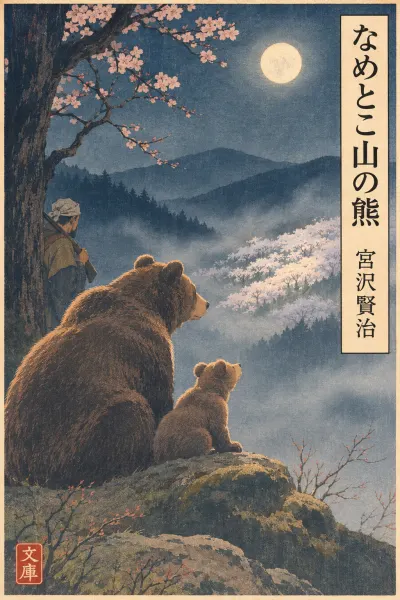
少し下りると、月の光の中に母ぐまと子ぐまがいました。When he went down a little, there in the moonlight were a mother bear and her cub.
二ひきは向こうのたにを見ていました。The two of them were looking at the valley across from them.
「お母さん、あそこだけ白いよ。きっと雪だよ。」"Mother, only that spot over there is white. It must be snow."
「雪じゃないよ。あそこだけ降るはずがないもの。」"It isn't snow. Snow couldn't fall on just that one spot."
「じゃあ、しもだね。」"Then it's frost, isn't it?"
「お母さんは分かったよ。あれは花ですよ。」"Mother knows now. Those are flowers."
こじゅうろうは、なぜかむねがいっぱいになりました。For some reason, Kojūrō's heart grew full.
そして、音をたてないように、そっと戻りました。And he went back quietly, so as not to make a sound.
でも、町へけがわを売りに行くときのこじゅうろうは、とてもかわいそうでした。But when Kojūrō went to town to sell the pelts, he was a truly pitiful sight.
町の大きな店の主人は「もう要りません」と言います。The master of the big shop in town says, "We don't need any more."
こじゅうろうの家は、九十歳の母と子どもたちの七人家族です。Kojūrō's household is a family of seven, with his ninety-year-old mother and his children.
米を買うお金がどうしても必要でした。He badly needed money to buy rice.
こじゅうろうは何度も頭を下げて頼みました。Kojūrō bowed his head again and again and begged.
主人はやっと、けがわ二まいを二円で買いました。At last the master bought two pelts for two yen.
とても安いねだんです。It is a very low price.
それでも、こじゅうろうはうれしそうにお金を受け取りました。Even so, Kojūrō took the money and looked happy.
くまはこじゅうろうに負け、こじゅうろうは町の主人に負けるのです。The bears lose to Kojūrō, and Kojūrō loses to the master in town.
ある年の夏、こじゅうろうは木に登っている大きなくまを見つけました。One summer, Kojūrō found a big bear climbing a tree.
てっぽうを向けると、くまは木から落ちてきて、両手を上げて言いました。When he pointed his gun at it, the bear fell down from the tree, raised both its paws, and spoke.
「お前は何がほしくて、おれを殺すんだ。」"What is it you want, that you would kill me?"
「お前のけがわとくまのいがほしいだけだ。高く売れるわけでもない。かわいそうだが、仕方がないんだ。」"I only want your pelt and your gall. It's not as if they sell for much, either. I'm sorry for you, but it can't be helped."
「あと二年待ってくれ。まだやり残した仕事がある。二年たったら、お前の家の前で死んでいてやるよ。」"Wait two more years for me. I still have work I've left undone. When two years have passed, I'll be lying dead in front of your house for you."
こじゅうろうは何も言えずに立っていました。Kojūrō stood there, unable to say anything.
くまは後ろも見ないで、ゆっくり歩いて行きました。The bear walked slowly away without even looking back.
ちょうど二年たった、風の強い朝のことです。It was on a windy morning, exactly two years later.
こじゅうろうが外へ出ると、家の前にあのくまがちをはいて倒れていました。When Kojūrō went outside, that same bear lay fallen in front of his house, having coughed up blood.
こじゅうろうは思わず手を合わせました。Without thinking, Kojūrō put his hands together in prayer.
一月のある朝、こじゅうろうは九十歳の母に言いました。One morning in January, Kojūrō spoke to his ninety-year-old mother.
「おれも年をとった。今日は初めて、水に入るのが嫌な気がする。」母は、笑うようにも泣くようにも見える顔をしました。"I've gotten old too. Today, for the first time, I feel like I don't want to go into the water." His mother made a face that looked as if she might be laughing, or might be crying.
こじゅうろうは子どもたちに「行ってくるよ」と言って、犬と出かけました。Kojūrō told the children, "I'll be off now," and set out with his dog.
こじゅうろうは、夏に見つけておいた大きなくまをさがしに、雪の山を登りました。Kojūrō climbed the snowy mountain to look for a big bear he had found back in the summer.
山の上で休んでいると、犬がはげしくほえました。While he was resting at the top of the mountain, his dog barked wildly.
後ろを見ると、あの大きなくまが立って向かって来ます。When he looked behind him, that big bear was standing up and coming at him.
こじゅうろうはてっぽうをうちました。Kojūrō fired his gun.
でも、くまは倒れません。But the bear does not fall.
次のしゅんかん、頭にがあんと音がして、まわりが真っ青になりました。The next moment, there was a loud bang in his head, and everything around him turned deep blue.
遠くで声が聞こえました。He heard a voice far away.
「おお、こじゅうろう、お前を殺すつもりはなかった。」"Oh, Kojūrō, I didn't mean to kill you."
こじゅうろうは、青いほしのような光を見ながら思いました。Looking at a light like blue stars, Kojūrō thought:
「これが死ぬときに見る火だ。くまたち、許してくれ。」"This is the fire you see when you die. Bears, forgive me."
それから三日目の晩、空にはこおりのような月が出ていました。On the night of the third day after that, a moon like ice had come out in the sky.
山の上に、大きな黒いくまたちがたくさん集まって、まるくなっていました。At the top of the mountain, many big black bears had gathered and sat in a circle.
くまたちは、いのるように雪に頭をつけて、いつまでも動きませんでした。The bears pressed their heads to the snow as if praying, and did not move for a long, long time.
そのいちばん高い所に、こじゅうろうの体が置かれていました。In the highest place among them, Kojūrō's body had been laid.
死んだこじゅうろうの顔は、生きているときのように、笑っているようにさえ見えました。The dead Kojūrō's face looked just as it had when he was alive, and even seemed to be smiling.
Vocabulary
| Word | Meaning | JLPT |
|---|---|---|
| くまのいくまのい | bear gall (a bear's dried gallbladder, used as medicine)dictionary form: 熊の胆A prized traditional medicine for stomach trouble. 胆 (い) is an old word for the gallbladder. | — |
| 効くきく | to work, to be effective (of medicine)Same sound as 聞く (to hear), but the kanji 効 is used for effects: 薬が効く. | N3 |
| 名人めいじん | master, expertSomeone famous for great skill at something. | N3 |
| りょうしりょうし | hunterdictionary form: 猟師Do not confuse it with 漁師 (りょうし), a fisherman. | — |
| 連れてつれる | to take (a person or animal) alongdictionary form: 連れるUsed for people and animals; for things, use 持っていく. | N4 |
| だまってだまる | to be silent; だまって = silently, without a worddictionary form: 黙る | N3 |
| あわてないあわてる | to panic, to get flustereddictionary form: 慌てる | N2 |
| しもしも | frostdictionary form: 霜 | N3 |
| けがわけがわ | fur pelt, animal skin with the fur ondictionary form: 毛皮毛 (hair) + 皮 (skin); かわ becomes がわ through rendaku. | N2 |
| 頭を下げてあたまをさげる | to bow one's head (in request or apology)dictionary form: 頭を下げる | — |
| 仕方がないしかたがない | it can't be helpedAlso said as しょうがない in casual speech. | — |
| 思わずおもわず | without thinking, in spite of oneself | N3 |
| 手を合わせましたてをあわせる | to put one's palms together (in prayer)dictionary form: 手を合わせる | — |
| いのるいのる | to praydictionary form: 祈る | N4 |
Grammar
〜しかない N3 have no choice but to ~; all one can do is ~
A dictionary-form verb + しかない means there is no other option. Kojūrō uses it to explain that hunting is his only way to live.
だから、りょうしをするしかないんだ。
So all I can do is hunt.
〜はずがない N3 there's no way that ~; ~ can't be
This shows the speaker is sure something is impossible, judging by reason. The もの at the end is a soft, explaining "because".
あそこだけ降るはずがないもの。
Snow couldn't fall on just that one spot.
〜ないように N4 so as not to ~
A negative verb + ように gives the purpose of an action: Kojūrō moves quietly in order to avoid making noise. (example: 音をたてないように、そっと戻りました。)
音をたてないように、そっと戻りました。
He went back quietly, so as not to make a sound.
〜わけでもない N3 it's not (even) that ~; it doesn't mean ~
This denies a possible assumption. The も adds "either": Kojūrō isn't killing for much profit. (example: 高く売れるわけでもない。)
高く売れるわけでもない。
It's not as if they sell for much, either.
〜ておく N4 to do ~ in advance / for later
The て-form + おく shows an action done ahead of time for a later purpose. Kojūrō found the bear in summer and planned to hunt it later.
夏に見つけておいた大きなくまをさがしに
to look for a big bear he had found back in the summer
〜ようにさえ見える N3 even seems to ~
〜ように見える means "looks as if ~", and さえ adds "even", stressing something surprising: the dead man's face even looks like it is smiling.
笑っているようにさえ見えました。
It even seemed to be smiling.