 N4 · easy
Simplified retelling · JLPT N4
恐竜艇の冒険 Kyōryūtei no Bōken in easy Japanese (N4)
This is our own simplified retelling of The Dinosaur Sub Caper, written for N4 learners and checked word by word against the N4 vocabulary list. A few story words and grammar patterns go beyond N4; the notes below give each one's level. It keeps the characters, events and ending of the original. When it feels easy, move on to the N3 version or the original text.
The story in brief
Jimmy and Sam buy a cheap little submarine in a tropical town and fix a dinosaur's head and neck to its mast to scare passing ships, and a huge ship flees in terror. The prank becomes world news. While hiding on an empty island, the boys meet a real dinosaur beside their submarine. They flee from it, race back to town in the submarine, and go home safely, then grow rich by telling the story.
AI translation · independently checked
ジミーとサムは友だちです。Jimmy and Sam are friends.
二人は「夏休みはつまらない」と思っていました。The two of them thought, "Summer holidays are boring."
そこで、今年の夏休みは、南の海の小さな町へ旅行することにしました。So this summer holiday they decided to take a trip to a little town by the southern seas.
二人はひこうきで町に着きました。The two of them arrived in the town by aeroplane.
町の海で、古いせんすいていを売っていました。In the sea by the town, someone was selling old submarines.
せんそうにまけた国が、おいていったものです。They had been left behind by a country that had lost the war.
二人で運転できる、小さなせんすいていでした。This one was a little submarine that just two people could pilot.
とても安かったので、二人はすぐにひとつ買いました。It was so cheap that the two of them bought one on the spot.
二人は毎日、アミールさんに運転を習いました。Every day the two of them learned to pilot it from Mr Amir.
アミールさんは「海の中に入る前に、上のドアがしまっているか、かならず見なさい」と教えました。Mr Amir taught them, "Before you go under the water, always check that the top hatch is shut."
二人はねっしんにれんしゅうしました。The two of them practised very hard.
二人には、大きな計画がありました。The pair had a grand plan.
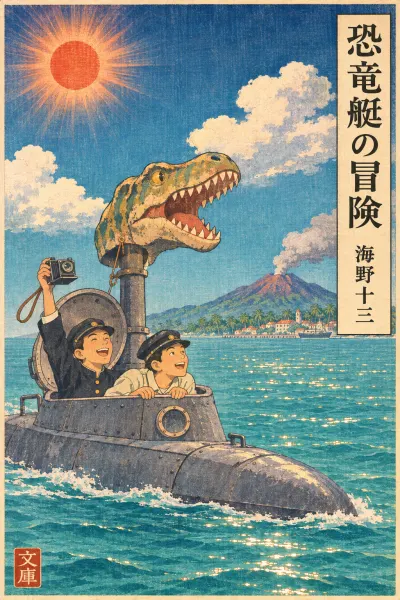
せんすいていのマストに、きょうりゅうのあたまとくびをつけるのです。They were going to fix a dinosaur's head and neck onto the submarine's mast.
せんすいていが海の上に出ると、きょうりゅうがくびを出したように見えます。When the submarine came up to the surface, it would look as if a dinosaur had stuck its neck out of the sea.
ふねの人たちがびっくりする写真をとって、あとで世界のみんなをわらわせるつもりでした。They meant to take photographs of the people on ships getting the fright of their lives, and later make the whole world laugh.
二人は、国の工場に、きょうりゅうのあたまをたのみました。The two of them ordered a dinosaur head from a factory back home.
十日後に、大きなはこが着きました。Ten days later, a big box arrived.
ホテルのへやで開けていると、ホテルの人が入ってきました。While they were opening it in their hotel room, a man from the hotel walked in.
その人は大きなこえを出して、にげました。He let out a great yell and ran away.
二人は、いそいではこをせんすいていに運びました。The two of them hurried the box over to the submarine.
つぎの朝早く、二人はマストにきょうりゅうのあたまをつけて、海へ出ました。Early the next morning, the pair fixed the dinosaur head onto the mast and set out to sea.
はじめの二日は、ふねが来ませんでした。For the first two days, no ships came.
帰るとちゅうで、カヌーが六つ見えました。On the way back, they spotted six canoes.
二人はきょうりゅうを海の上に出しました。The two of them raised the dinosaur up above the water.
カヌーの人たちはびっくりして、海に入ってにげました。The people in the canoes got such a fright that they jumped into the sea and fled.
二人はおかしくて、ずっとわらいました。The pair found it so funny that they laughed and laughed.
つぎの朝、とても大きなふねが来ました。The next morning, an enormous ship came along.
二人はきょうりゅうのくびを出して、あたまを動かしたり、口を開けたりしました。The two of them stuck out the dinosaur's neck, moved its head about and opened its mouth.
ふねの人たちはびっくりして、小さいふねに乗る用意をしました。The people on the ship were terrified and got ready to climb into the lifeboats.
大きなふねは、いそいでとおくへにげました。The great ship hurried off into the distance.
二人はカメラで、たくさん写真をとりました。The two of them took lots of photographs with their camera.
それから二人は、だれも住んでいない小さなしまで休みました。After that, the pair rested on a little island where nobody lived.
すると、ひこうきがたくさん来て、空からきょうりゅうをさがし始めました。Then a whole lot of aeroplanes came and began searching for the dinosaur from the sky.
大きなニュースになったのです。It had turned into big news.
見つかるとこまるので、二人はしまから出られませんでした。They would be in trouble if they were found, so the two of them couldn't leave the island.
食べ物も水もなくなって、ヤシのみの水を飲みました。Their food and water ran out, and they drank the water from coconuts.
四日目の朝、ひこうきの音が聞こえませんでした。On the morning of the fourth day, there was no sound of aeroplanes.
二人はヤシのみを集めに行きました。The two of them went off to gather coconuts.
帰ってくると、サムが「あっ」と大きなこえを出しました。When they came back, Sam cried out loudly, "Oh!"
二人のせんすいていのそばに、もう一つきょうりゅうがいたのです。Right beside their submarine, there was another dinosaur!
長いくびを動かしていて、まわりの木がたおれていました。It was swinging its long neck about, and the trees around it had been knocked down.
ほんとうのきょうりゅうでした。It was a real dinosaur.
二人はもりの中へ走ってにげました。The two of them ran off into the woods.
「上のドアをしめなかったよ」「きょうりゅうがせんすいていをこわしたら、帰れないね」と、二人はしんぱいしました。"We didn't shut the top hatch!" "If the dinosaur smashes the submarine, we can't get home!" the pair fretted.
しばらくして、しずかに見に行くと、きょうりゅうはもういませんでした。After a while they crept quietly back to look, and the dinosaur was gone.
二人はいそいでせんすいていに乗って、町までできるだけはやく走りました。The two of them jumped into the submarine in a hurry and raced to the town as fast as they could.
町の近くに着くと、二人は外に出て、すなの上にたおれました。When they got near the town, the pair climbed out and collapsed on the sand.
町の人たちは、きょうりゅうが来たと思って、びっくりしました。The townspeople thought a dinosaur had come, and got a terrible fright.
ホテルの人たちも、二人をさがしていました。The people from the hotel had been looking for the two of them, too.
二人は元気に国へ帰りました。The two of them went home safe and sound.
その後、このせんすいていの話をラジオで話したり、本に書いたりしました。Afterwards, they told the story of this submarine on the radio and wrote it up in a book.
それで、二人はお金もちになりました。And that is how the two of them became rich.
つぎの休みには、日本へ行きたいと思っています。Next holiday, they're thinking they'd like to go to Japan.
Vocabulary
| Word | Meaning | JLPT |
|---|---|---|
| せんすいていせんすいてい | (small) submarinedictionary form: 潜水艇潜水 = diving underwater, 艇 = small boat. A large submarine is usually 潜水艦 (せんすいかん). | — |
| せんそうせんそう | wardictionary form: 戦争戦争に負ける = to lose a war; 戦争に勝つ = to win a war. | N4 |
| 運転うんてん | driving, piloting, operating (a vehicle)運転する is used for cars, trains, boats and machines. | N4 |
| ねっしんにねっしん | eagerly, hard, with enthusiasmdictionary form: 熱心A な-adjective; add に to use it as an adverb. | N4 |
| 計画けいかく | plan, scheme | N4 |
| きょうりゅうきょうりゅう | dinosaurdictionary form: 恐竜Literally 'terrible dragon'. The original story uses the older spelling 恐龍. | — |
| たのみましたたのむ | to order, to ask fordictionary form: 頼むHere it means placing an order with a factory, not only asking a favour. | N5 |
| とちゅうとちゅう | on the way, partwaydictionary form: 途中帰るとちゅうで = on the way home. | N4 |
| 用意ようい | preparation(s)〜する用意をする = to get ready to do something. | N4 |
| さがしさがす | to search for, to look fordictionary form: 探す | N4 |
| こまるこまる | to be in trouble, to be in a fixdictionary form: 困る | N5 |
| ヤシのみやしのみ | coconutdictionary form: 椰子の実ヤシ = palm tree, み (実) = fruit or nut. | — |
| たおれてたおれる | to fall down, to collapsedictionary form: 倒れるUsed for falling trees and also for people collapsing from exhaustion. | N4 |
| しんぱいしんぱい | worry; to worry (with する)dictionary form: 心配 | N4 |
Grammar
〜ことにする N4 to decide to do
A plain verb plus ことにする shows that someone makes a decision. The past form ことにしました means the decision was made.
南の海の小さな町へ旅行することにしました。
They decided to take a trip to a little town by the southern seas.
〜ように見える N3 to look as if, to seem like
ように見える after a plain-form clause describes how something appears, even if it is not really so. The dinosaur only looks as if it has put its neck out.
きょうりゅうがくびを出したように見えます。
It would look as if a dinosaur had stuck its neck out.
〜つもりだ N4 to intend to, to plan to
A plain verb plus つもり states an intention. つもりでした tells us what the boys meant to do at that time.
あとで世界のみんなをわらわせるつもりでした。
They meant to make the whole world laugh later.
〜たり〜たりする N4 doing things like A and B
Two verbs in the た-form plus り, followed by する, list example actions without giving a full list or a fixed order.
あたまを動かしたり、口を開けたりしました。
They moved its head about and opened its mouth.
〜のです N4 explanation (it's that…)
のです adds an explanation or the reason for what came before. Here it explains why so many aeroplanes came: the prank had become big news.
大きなニュースになったのです。
It had turned into big news.
〜始める N4 to begin doing
Attach 始める to the ます-stem of a verb to say that an action starts. さがす becomes さがし始める.
空からきょうりゅうをさがし始めました。
They began searching for the dinosaur from the sky.