 N4 · easy
Simplified retelling · JLPT N4
久助君の話 Kyūsukekun no Hanashi in easy Japanese (N4)
This is our own simplified retelling of Kyūsuke and the Haystack Afternoon, written for N4 learners and checked word by word against the N4 vocabulary list. A few story words and grammar patterns go beyond N4; the notes below give each one's level. It keeps the characters, events and ending of the original. When it feels easy, move on to the original text.
The story in brief
After his daily hour of study, Kyūsuke searches the quiet village for friends and finds only Hyōtarō lying by a haystack. The two boys wrestle in the hay until dusk, and when they finally stop, Hyōtarō's lonely face makes him look like a stranger for a moment. Kyūsuke realises that even people we know well can sometimes seem like people we do not know at all.
AI translation · independently checked
きゅうすけくんは、四年生から五年生になる春に、学校でほうびをもらいました。In the spring when he moved up from fourth grade to fifth, Kyūsuke received a prize at school.
お父さんはとてもよろこびました。His father was very pleased.
そして、「学校から帰ったら、すぐ一時間勉強しなさい」ときめました。And he made a rule: "When you come home from school, study for one hour straight away."
きゅうすけくんは、このきまりがすきではありませんでした。Kyūsuke did not like this rule.
一時間勉強して外に出ても、近くで友だちがあそんでいないことが多かったからです。That was because, after he had studied for an hour and gone outside, his friends were often not playing anywhere nearby.
そうすると、友だちをさがして歩かなければなりませんでした。Then he had to walk around looking for them.
秋のよくはれた午後でした。It was a clear, fine autumn afternoon.
三時半に勉強がすんで、きゅうすけくんは外に出ました。His studying was finished at half past three, and Kyūsuke went outside.
外はとても明るいです。Outside it is very bright.
でも、友だちのこえは聞こえません。But he cannot hear his friends' voices.
じんじゃのもりの方も、はんたいの方も、しずかでした。It was quiet toward the shrine wood, and quiet in the other direction too.
しかたがないので、きゅうすけくんは友だちをさがしに行きました。There was nothing else to do, so Kyūsuke went to look for his friends.
はじめに、みんながよくあそぶ大きなにわに行きました。First he went to the big yard where everyone often played.
でも、にわにはまめがたくさんほしてあって、だれもいませんでした。But lots of beans had been spread out in the yard to dry, and nobody was there.
つぎに、北のてらに行きました。Next he went to the temple to the north.
そこにも、だれもいませんでした。Nobody was there either.
それから、医者の家の方へ歩いて行きました。After that, he walked off toward the doctor's house.
そのとちゅう、ほしくさの山のそばで、へいたろうくんに会いました。On the way, beside a haystack, he met Heitarō.
へいたろうくんは、よくうそを話す男の子でした。Hyōtarō was a boy who often told lies.
歌も下手でしたが、いつも大きなこえで歌いました。He was bad at singing, too, but he always sang in a loud voice.
でも、悪い子ではありません。Still, he is not a bad boy.
みんなは、へいたろうくんがきらいではありませんでした。Nobody disliked Hyōtarō.
「みんな、どこに行ったか知らない?」"Do you know where everybody's gone?"
と、きゅうすけくんが聞きました。Kyūsuke asked.
「知らないよ。」"Dunno."
へいたろうくんは、どうでもいいというかおで答えました。Hyōtarō answered with a face that said he couldn't care less.
「医者の家にいるかな。行ってみようよ。」"Maybe they're at the doctor's house. Let's go and see."
「あの家の子は、さっきお母さんと町へ出かけたよ。」"The kid from that house went off to town with his mom a while ago."
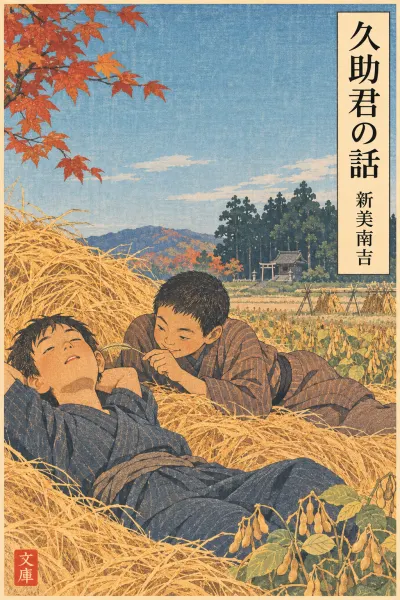
そして、へいたろうくんは、いいにおいのするほしくさの上によこになりました。Then Hyōtarō lay down on the sweet-smelling hay.
きゅうすけくんは、みんなに会えなくて、ざんねんでした。Kyūsuke was disappointed that he could not meet everyone.
でも、へいたろうくんと二人であそぼうと思いました。But he decided he would play with Hyōtarō, just the two of them.
きゅうすけくんも、ほしくさの上に体をなげました。Kyūsuke threw himself down on the hay as well.
ほしくさはやわらかくて、あたたかいです。The hay is soft and warm.
お母さんのそばにいるような気持ちになりました。He felt as if he were close beside his mother.
「すもうをしようよ。」"Let's do sumo!"
「いやだ。きのうすもうをして、服がだめになって、家でしかられたんだ。」"No way. I did sumo yesterday, wrecked my clothes, and got told off at home."
「じゃあ、ほかのあそびをしよう。」"Then let's play something else."
「おもしろくないよ。」"That's no fun."
きゅうすけくんは、たのしくありません。Kyūsuke is not having a good time.
くさの先で、へいたろうくんのみみをさわりました。He touched Hyōtarō's ear with the tip of a piece of grass.
「やめろ!」"Quit it!"
へいたろうくんはおこりました。Hyōtarō got angry.
でも、すぐにわらい出しました。But right away he burst out laughing.
そして、きゅうすけくんを強く押しました。Then he gave Kyūsuke a hard shove.
それから二人は、ねこの子のように、ほしくさの中で上になったり下になったりして、あそびはじめました。After that the two of them began to play like kittens, rolling over and under each other in the hay.
しばらくして、きゅうすけくんは思いました。After a while, Kyūsuke thought:
「へいたろうくんは本気かな。」へいたろうくんの手は、とても強い力でした。"Is Hyōtarō doing this for real?" Hyōtarō's hands were very strong.
それで、きゅうすけくんもいっしょうけんめいになりました。So Kyūsuke put all his effort into it too.
でも、へいたろうくんは小さくわらいました。But Hyōtarō gave a little laugh.
「やっぱり、じょうだんかな。」きゅうすけくんには、どちらかわかりませんでした。"So it's just a joke after all?" Kyūsuke could not tell which it was.
きゅうすけくんは、あたまを土にうって、なみだが出ました。Kyūsuke banged his head on the ground, and tears came to his eyes.
じぶんの足とへいたろうくんの足が、わからなくなることもありました。Sometimes he could not even tell his own legs from Hyōtarō's.
二人は夕方まで、ずっとあそびました。The two of them played on and on until evening.
着物はきたなくなりました。Their kimonos got dirty.
さいごに、きゅうすけくんが上になりました。In the end, Kyūsuke came out on top.
へいたろうくんは、もう動きませんでした。Hyōtarō no longer moved.
二人とも、しずかになりました。Both of them fell quiet.
とおくの道から、車の音が聞こえてきました。From a road far away came the sound of a cart.
もう夕方です。It is already evening.
きゅうすけくんは、急にさびしくなりました。Kyūsuke suddenly felt lonely.
もうやめようと思いました。He thought he would stop now.
でも、もしへいたろうくんが泣いていたら、どうしよう、としんぱいになりました。But he began to worry: what if Hyōtarō was crying?
きゅうすけくんは、一度もへいたろうくんのかおを見ていませんでした。Kyūsuke had not looked at Hyōtarō's face even once.
きゅうすけくんは、手を少しよわくしました。Kyūsuke loosened his grip a little.
でも、へいたろうくんは動きません。But Hyōtarō does not move.
手をはなしても、動きません。Even when Kyūsuke let go, he does not move.
きゅうすけくんは立ちました。Kyūsuke stood up.
すると、へいたろうくんも起きて、立ちました。Then Hyōtarō got up and stood too.
へいたろうくんは何も話さないで、とおくの空を長い間見ていました。Without saying a word, Hyōtarō gazed at the distant sky for a long time.
とてもさびしそうな目でした。His eyes looked very lonely.
きゅうすけくんはびっくりしました。Kyūsuke was startled.
前に立っているのは、へいたろうくんではありません。The boy standing in front of him is not Hyōtarō.
一度も見たことがない、さびしいかおの男の子です。He is a lonely-faced boy Kyūsuke has never seen before.
じぶんは、こんな知らない子と、午後の間ずっとあそんでいたのです。And he had spent the whole afternoon playing with this boy he did not know.
世界がはんたいになったように思いました。He felt as if the world had turned upside down.
でも、よく見ると、やっぱりいつものへいたろうくんでした。But when he looked carefully, it was the same old Hyōtarō after all.
きゅうすけくんは安心しました。Kyūsuke was relieved.
もうくらくなっていました。It had already grown dark.
きゅうすけくんは、着物からくさをとりました。Kyūsuke picked the grass off his kimono.
そして、少しはずかしい気持ちで、何も話さないで、へいたろうくんと別れました。Then, feeling a little embarrassed, he parted from Hyōtarō without saying anything.
それから、きゅうすけくんは、こう思うようになりました。From then on, Kyūsuke came to think like this.
よく知っている人でも、ときどき、全然知らない人のようになる。Even someone you know well sometimes becomes like a complete stranger.
じぶんが知っている人がほんとうのその人か、知らない人がほんとうのその人か、わからない。You cannot tell whether the person you know is the real one, or the stranger is.
これは、きゅうすけくんにとって、新しいかなしいことでした。For Kyūsuke, this was a new kind of sadness.
Vocabulary
| Word | Meaning | JLPT |
|---|---|---|
| ほうびほうび | prize, rewarddictionary form: 褒美Often said politely as ごほうび; a reward for good work or behaviour. | N1 |
| きまりきまり | ruledictionary form: 決まりNoun from きまる (to be decided); compare きめる in the sentence before. | N3 |
| しかたがないしかたがない | it can't be helped; there's nothing else to dodictionary form: 仕方がないAlso heard as しょうがない in speech. | — |
| ほしてほす | to dry (by spreading out in the sun or air)dictionary form: 干すUsed for laundry, beans, fish and so on. | N2 |
| とちゅうとちゅう | on the way, partwaydictionary form: 途中そのとちゅう = on the way there. | N4 |
| ほしくさほしくさ | hay (dried grass)dictionary form: 干し草Literally 'dried grass' (干す + 草, with rendaku avoided here); ほしくさの山 = a haystack. | — |
| うそうそ | lie, fibdictionary form: 嘘うそをつく is the usual verb; here うそを話す. | N4 |
| すもうすもう | sumo wrestlingdictionary form: 相撲Children played informal sumo, trying to push or throw each other down. | N2 |
| しかられたしかる | to scold, tell offdictionary form: 叱るPassive しかられる = to be scolded. | N3 |
| 本気ほんき | serious, in earnestThe opposite of じょうだん (joking). | N1 |
| いっしょうけんめいいっしょうけんめい | with all one's mightdictionary form: 一生懸命いっしょうけんめいになる = to start trying as hard as one can. | N4 |
| じょうだんじょうだん | joke, kiddingdictionary form: 冗談 | N3 |
| 安心あんしん | relief; feeling at ease安心する = to be relieved. | N4 |
| はずかしいはずかしい | embarrassed, shydictionary form: 恥ずかしい | N4 |
Grammar
〜たら N4 when / after (something happens)
The past form plus ら sets up a condition or a sequence: once the first action is done, the second follows. Here it means 'once you get home from school'.
学校から帰ったら、すぐ一時間勉強しなさい
When you come home from school, study for one hour straight away.
〜なければなりません N4 must, have to
The ない-form with ければなりません expresses necessity. In the past, なりませんでした means 'had to'.
友だちをさがして歩かなければなりませんでした
He had to walk around looking for his friends.
〜てある N4 has been done (and the result remains)
A transitive verb in the て-form plus ある describes a state left by someone's action, without saying who did it. Here the beans had been spread out and were lying there drying.
にわにはまめがたくさんほしてあって
Lots of beans had been spread out in the yard to dry.
〜ような / 〜ように N4 like, as if
ようだ after a plain verb or noun + の makes a comparison. ような comes before a noun (気持ち), ように before a verb or adjective (思いました).
お母さんのそばにいるような気持ちになりました
He felt as if he were close beside his mother.
〜たり〜たりする N4 doing things like A and B; alternating A and B
Two past-form verbs with り, finished with する, list actions as examples or show them happening back and forth. Here the boys keep switching between being on top and underneath.
ほしくさの中で上になったり下になったりして、あそびはじめました
They began to play, rolling over and under each other in the hay.
〜ようになる N4 come to (do); begin to
The dictionary form plus ようになる shows a gradual change in ability, habit or way of thinking. Here Kyūsuke starts to see people differently after that afternoon.
きゅうすけくんは、こう思うようになりました
Kyūsuke came to think like this.