 N5 · easy
Simplified retelling · JLPT N5
久助君の話 Kyūsukekun no Hanashi in easy Japanese (N5)
This is our own simplified retelling of Kyūsuke and the Haystack Afternoon, written for N5 learners and checked word by word against the N5 vocabulary list. A few story words and grammar patterns go beyond N5; the notes below give each one's level. It keeps the characters, events and ending of the original. When it feels easy, move on to the N4 version or the original text.
The story in brief
After his daily study hour, Kyūsuke walks around looking for his friends and finds only Heitarō by a haystack. The two boys wrestle in the warm hay until dusk, and when they stand up, Heitarō's lonely face looks like a stranger's. Kyūsuke realises that even a friend you know well can sometimes seem like someone you don't know at all, and this is a new kind of loneliness for him.
AI translation · independently checked
きゅうすけくんは 小学校の 四年生でした。Kyūsuke was in the fourth grade at elementary school.
五年生に なる 前に、学校で いい せいとの しょうを とりました。Before he became a fifth-grader, he won a prize at school for being a good pupil.
お父さんは 電気かいしゃで はたらいて います。His father works at an electric company.
お父さんは 言いました。His father said:
「毎日、学校から かえったら、すぐ 一時間 べんきょうしなさい。」"Every day, when you get home from school, study for an hour straight away."
きゅうすけくんは これが 好きでは ありませんでした。Kyūsuke did not like this.
べんきょうの 後で 外に 出ると、友だちは もう いません。When he went outside after studying, his friends were already gone.
だから、毎日 いろいろな 所へ 歩いて 行きます。So every day he walked off to all sorts of places.
ある あきの 午後、よく はれて いました。One autumn afternoon, the sky was beautifully clear.
三時半に べんきょうが おわりました。His studying ended at half past three.
きゅうすけくんは 外に 出ました。Kyūsuke went outside.
でも、友だちの こえが しません。But he could not hear his friends' voices.
まず、みんなが よく あそぶ にわへ 行きました。First, he went to the yard where everyone often played.
でも、にわには やさいが たくさん ならべて ありました。But in the yard, lots of vegetables had been laid out in rows.
これでは あそべません。He couldn't play like this.
つぎに、北の おてらへ 行きました。Next, he went to the temple to the north.
だれも いません。No one was there.
犬も いません。There wasn't even a dog.
それから、とくいちくんの いえへ 行きました。After that, he set off for Tokuichi's house.
みちで、ほしくさの 山の そばに、へいたろうくんが いました。On the way, Heitarō was there beside a haystack.
へいたろうくんは よく 大きな 話を します。Hyōtarō often tells tall tales.
うたは へたですが、みんなと いっしょに 大きな こえで うたいます。He is bad at singing, but he sings in a loud voice along with everyone.
でも、わるい 人では ありません。Still, he is not a bad person.
「みんな、どこに いるか 知ってる?」"Know where everybody is?"
「知らない。」"Nope."
「とくいちくんの いえに いる?」"Are they at Tokuichi's?"
「いないよ。とくいちくんは 今日、お母さんと まちへ 出かけたよ。」"They're not. Tokuichi went off to town with his mom today."
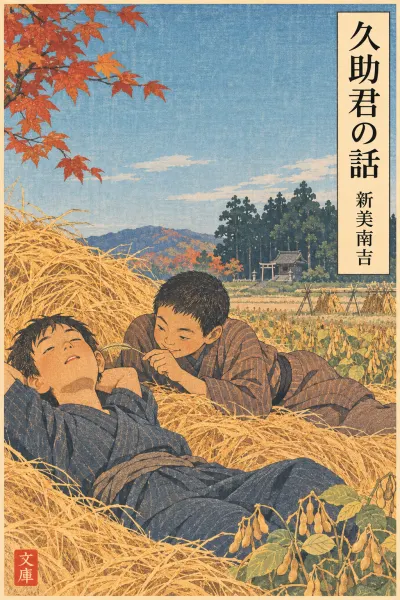
へいたろうくんは ほしくさの 上に ねました。Hyōtarō lay down on top of the hay.
きゅうすけくんは 少し さびしく なりました。Kyūsuke felt a little lonely.
でも、二人で あそぶのも おもしろいです。But playing with just the two of them was fun too.
きゅうすけくんも ほしくさの 上に とびました。Kyūsuke jumped onto the hay as well.
ほしくさは あたたかかったです。The hay was warm.
「すもうを しない?」"Wanna do some sumo?"
「いやだ。きのう、すもうで ふくが きたなく なったから。」"No way. I got my clothes all dirty doing sumo yesterday."
「じゃあ、何か しよう。」"Then let's do something."
「おもしろくない。」"That's no fun."
きゅうすけくんは ほしくさの 先を、へいたろうくんの みみに 入れました。Kyūsuke poked the tip of a piece of hay into Hyōtarō's ear.
「いやだ!」"Quit it!"
でも、きゅうすけくんは また みみに 入れました。But Kyūsuke poked it into his ear again.
へいたろうくんは 「ひゃっ」と 大きな こえを 出して、きゅうすけくんの 上に 来ました。With a loud "Hyaa!", Hyōtarō came down on top of Kyūsuke.
二人は ほしくさの 中で、上に なったり 下に なったり しました。In the hay, the two boys rolled about, first one on top, then the other.
へいたろうくんの ては とても つよいです。Hyōtarō's hands are very strong.
きゅうすけくんも つよく おしました。Kyūsuke pushed hard too.
でも、へいたろうくんは 「クックッ」と こえを 出しました。But Hyōtarō made a little "heh-heh" sound.
たのしいのかな。Was he having fun?
本当に つよく おして いるのかな。Was he really pushing hard?
きゅうすけくんは 何回も 分からなく なりました。Again and again, Kyūsuke could not tell.
あたまを 下に ぶつけて、とても いたい 時も ありました。Sometimes he banged his head on the ground and it hurt a lot.
二人は ゆうがたまで あそびました。The two of them played until evening.
ふくは きたなく なりました。Their clothes got dirty.
最後に、きゅうすけくんが 上に なりました。In the end, Kyūsuke ended up on top.
へいたろうくんは もう 何も しません。Hyōtarō did nothing any more.
二人は しずかに なりました。The two boys grew quiet.
むこうの みちから、車の おとが しました。From the road over there came the sound of a cart.
もう ゆうがたです。It was already evening.
きゅうすけくんは きゅうに さびしく なりました。Suddenly Kyūsuke felt lonely.
でも、へいたろうくんが ないて いたら、どうしよう。But what if Hyōtarō was crying?
きゅうすけくんは 一回も へいたろうくんの かおを 見て いませんでした。Not once had Kyūsuke looked at Hyōtarō's face.
きゅうすけくんは てを はなして、たちました。Kyūsuke let go and stood up.
へいたろうくんも たちました。Hyōtarō stood up too.
へいたろうくんは 何も いわないで、むこうの そらを 長い 時間 見て いました。Without saying anything, Hyōtarō looked at the distant sky for a long time.
とても さびしい かおでした。His face was very lonely.
きゅうすけくんの 前に いるのは、へいたろうくんでは ありません。The one standing in front of Kyūsuke was not Hyōtarō.
知らない、さびしい かおの 男の子です。It was a boy he didn't know, a boy with a lonely face.
こんな 知らない 男の子と、半日 あそんで いたのでしょうか。Had he really been playing for half the day with a boy he didn't know like this?
これは だれ?Who is this?
でも、よく 見ると、それは いつもの へいたろうくんでした。But when he looked closely, it was the same old Hyōtarō.
「ああ、よかった。」"Oh, thank goodness."
外は もう くらく なって いました。Outside, it had already grown dark.
きゅうすけくんは ふくの ほしくさを とって、何も いわないで いえへ かえりました。Kyūsuke picked the hay off his clothes and went home without saying a word.
それから、きゅうすけくんは 分かりました。After that, Kyūsuke understood something.
よく 知って いる 友だちも、ときどき 知らない 人に なります。Even a friend you know well sometimes becomes someone you don't know.
本当の その人は どちらでしょうか。Which one is the real person?
だれにも 分かりません。No one can tell.
これは、きゅうすけくんの あたらしい さびしさでした。This was a new kind of loneliness for Kyūsuke.
Vocabulary
| Word | Meaning | JLPT |
|---|---|---|
| しょうしょう | prize, awarddictionary form: 賞しょうを とる = to win a prize. | N3 |
| はたらいてはたらく | to work (at a job)dictionary form: 働くUse 〜で はたらく for the place where someone works. | N5 |
| ならべてならべる | to line up, to lay out in rowsdictionary form: 並べるThis verb takes an object. Its partner verb ならぶ means 'to stand in a line'. | N5 |
| ほしくさほしくさ | hay (dried grass)dictionary form: 干し草From 干す 'to dry' + 草 'grass'. ほしくさの 山 = a haystack. | — |
| へたへた | bad at, unskilleddictionary form: 下手The opposite is じょうず (上手). | N5 |
| さびしくさびしい | lonelydictionary form: 寂しいA key word in this story. さびしさ (s.75) is its noun form, 'loneliness'. | N4 |
| すもうすもう | sumo wrestlingdictionary form: 相撲A traditional Japanese wrestling sport. Children often play it in fun. | N2 |
| きたなくきたない | dirtydictionary form: 汚いThe opposite is きれい. | N5 |
| おしましたおす | to pushdictionary form: 押すThe opposite is ひく (引く), 'to pull'. | N5 |
| ぶつけてぶつける | to bang, to hit (something against something)dictionary form: ぶつける | N2 |
| ゆうがたゆうがた | evening, duskdictionary form: 夕方 | N5 |
| きゅうにきゅうに | suddenlydictionary form: 急に | N3 |
| はなしてはなす | to let go, to releasedictionary form: 離すDo not mix this up with 話す 'to speak'. The two words sound the same. | N3 |
Grammar
〜なさい N4 do ~ (a command)
Add なさい to the verb's ます-stem to make a firm but polite command. Parents and teachers often speak to children this way.
すぐ 一時間 べんきょうしなさい。
Study for an hour straight away.
〜て ある N4 has been done (and is still in that state)
Use this with a て-form verb that takes an object. It shows that someone did something on purpose and the result is still there. Here, someone set out the vegetables, and they are still lying in rows.
にわには やさいが たくさん ならべて ありました。
In the yard, lots of vegetables had been laid out in rows.
〜く なる N5 to become ~
Change the final い of an い-adjective to く and add なる to show a change of state. This passage uses it with さびしく なる and きたなく なる; 分からなく なる applies the same pattern to the negative ない form (分からない → 分からなく なる).
きゅうすけくんは 少し さびしく なりました。
Kyūsuke felt a little lonely.
〜たり〜たり する N4 doing things like ~ and ~, back and forth
This pattern lists actions as examples, or shows actions that take turns. Here it shows the boys rolling over and over, one on top, then the other.
上に なったり 下に なったり しました。
First one was on top, then the other.
〜のかな N4 I wonder if ~
The ending の asks for an explanation, and かな adds a feeling of wondering. Together they show Kyūsuke asking himself questions in his head.
たのしいのかな。
Was he having fun?
〜ないで N4 without doing ~
Attach this to the negative form of a verb to say that someone does one thing without doing another. Here Hyōtarō looks at the sky and says nothing.
へいたろうくんは 何も いわないで、むこうの そらを 長い 時間 見て いました。
Without saying anything, Hyōtarō looked at the distant sky for a long time.