 N5 · easy
Simplified retelling · JLPT N5
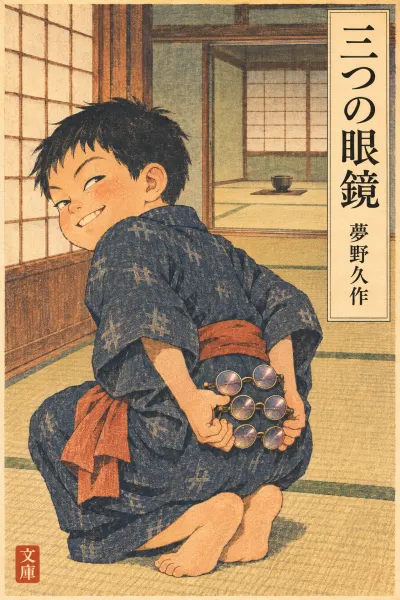
三つの眼鏡 Mitsu no Megane in easy Japanese (N5)
This is our own simplified retelling of Takeo and the Three Pairs of Spectacles, written for N5 learners and checked word by word against the N5 vocabulary list. A few story words and grammar patterns go beyond N5; the notes below give each one's level. It keeps the characters, events and ending of the original. When it feels easy, move on to the N4 version or the original text.
The story in brief
After his mother dies, Takeo becomes mischievous and takes the glasses of his grandmother, father and sister. Without their glasses the family has accidents and cannot carry on as usual, so his father shuts Takeo in the storehouse and tells him to put on all three pairs. In a dream his mother appears, gently scolds him and asks him to be good, and from then on Takeo becomes a quiet, well-behaved boy.
AI translation · independently checked
たけおさんのお母さんはしにました。Takeo's mother died.
それから、たけおさんは毎日いたずらをしました。After that, Takeo got up to mischief every day.
ある朝、へやのつくえの上に、おばあさんのめがねがありました。One morning, Grandmother's glasses were lying on the desk in her room.
たけおさんはそのめがねをポケットに入れました。Takeo put those glasses into his pocket.
お父さんとおねえさんのめがねもとりました。He took Father's glasses and his big sister's glasses too.
そして、外へ行って、ずっと遊びました。Then he went outside and played for a long, long time.
おばあさんはへやにかえりました。Grandmother came back to her room.
でも、めがねがありません。But her glasses were not there.
お父さんは出かけたいです。Father wanted to go out.
でも、たいせつなめがねがありません。But his precious glasses were not there.
おねえさんもかいものからかえりました。Big Sister came home from her shopping, too.
おねえさんのめがねもありません。Her glasses were gone as well.
「たけおさんですね。めがねがありません。ばんごはんをつくるのはむずかしいです。」とおねえさんはいいました。"It must be Takeo. My glasses are gone. It will be hard to make supper," said Big Sister.
「わたしもしごとに行きません。」とお父さんはいいました。"I won't be going to work either," said Father.
「わたしもこまります。」とおばあさんもいいました。"I'm in trouble too," said Grandmother.
三人はめがねをかけないで、ばんごはんをつくりました。The three of them made supper without wearing their glasses.
おねえさんはマッチをつけました。Big Sister struck a match.
でも、マッチのはこがすこしあいていました。But the matchbox was a little open.
はこの中のマッチに火がつきました。The matches inside the box caught fire.
おねえさんはてにやけどをして、なきました。Big Sister burned her hand and cried.
おばあさんが来ました。Grandmother came.
でも、くらいところでころんで、あしにけがをしました。But she fell over in the dark and hurt her leg.
お父さんがばんごはんをつくります。Father made supper.
でも、もうマッチがありません。But there were no matches left.
お父さんはマッチをかいに、みせへ行きました。Father went to the shop to buy matches.
その間に、たけおさんがかえりました。While he was away, Takeo came home.
「ごはん、ごはん!」"Supper! Supper!"
たけおさんは大きなこえでいいました。Takeo said it in a loud voice.
おねえさんはないています。Big Sister was crying.
おばあさんは「いたい、いたい。」といっています。Grandmother was saying, "Oh, it hurts, it hurts."
「どうしたの。」"What's the matter?"
たけおさんは聞きました。Takeo asked.
でも、だれもこたえません。But nobody answered.
たけおさんはおなかがすいて、なきました。Takeo was hungry, and he cried.
「お母さん!」"Mother!"
でも、お母さんはこたえません。But Mother did not answer.
お父さんがかえりました。Father came home.
「たけお、お母さんに会いたいですか。そのめがねを三つかけて、見なさい。」"Takeo, do you want to see your mother? Then put on those three pairs of glasses and look!"
お父さんはたけおさんをくらに入れました。Father shut Takeo in the storehouse.
たけおさんはくらの中で大きなこえでなきました。Inside the storehouse, Takeo cried in a loud voice.
でも、だんだんおなかがすいて、つかれました。But little by little he grew hungry and tired.
つめたい下にねて、またなきました。He lay down on the cold floor and cried again.
「お母さんはやさしかったです。」"Mother was kind."
たけおさんはお父さんのことばをわすれていませんでした。Takeo had not forgotten his father's words.
めがねを三つ出して、かけました。He took out the three pairs of glasses and put them on.
でも、何もありません。But there was nothing there.
たけおさんはくらい中で、しずかにまちました。Takeo waited quietly in the dark.
そして、お母さんが来ました。And then his mother came.
お母さんはかなしい目で、いいました。Mother looked at him with sad eyes and spoke.
「たけお、お母さんがいませんから、いたずらをしますか。それはわるいです。お母さんはいつもあなたのそばにいます。いつもあなたを見ています。あなたがわるいと、みんなはお母さんもわるいといいます。わすれないでください。いいこどもになってください。」"Takeo, are you being naughty because your mother is not here? That is wrong. Your mother is always by your side. She is always watching you. If you are bad, everyone will say that your mother is bad too. Please do not forget that. Please become a good child."
そして、お母さんはきえました。And then Mother vanished.
「お母さん、まって!わたしがわるかったです!」"Mother, wait! I was the one who was wrong!"
それはゆめでした。It had been a dream.
たけおさんはくらの中でねていました。Takeo had been sleeping inside the storehouse.
くらのドアがあきました。The storehouse door opened.
お父さんがいいました。Father spoke.
「さあ、たけお、ごはんを食べなさい。もういたずらをしないでください。」"Now then, Takeo, eat your supper. And please, no more mischief."
たけおさんはこのゆめをだれにも話しませんでした。Takeo told no one about this dream.
でも、たけおさんはしずかないい男の子になりました。But Takeo became a quiet, good boy.
みんなは「たけおさんはほんとうにいい男の子ですね。」といいました。Everyone said, "Takeo really is a good boy, isn't he?"
Vocabulary
| Word | Meaning | JLPT |
|---|---|---|
| いたずらいたずら | mischief, a prankいたずらをする means to play tricks or be naughty. | N3 |
| めがねめがね | glasses, spectaclesKanji: 眼鏡. You 'hang' glasses on your face: めがねをかける = to put on or wear glasses. | N5 |
| とりましたとる | to takedictionary form: とるHere it means taking something that belongs to someone else. | N5 |
| こまりますこまる | to be in trouble, to be at a lossdictionary form: こまるKanji: 困る. Very common for 'this is a problem for me'. | N5 |
| やけどやけど | a burn (injury)やけどをする = to get burned. | N2 |
| ころんでころぶ | to fall over, to tripdictionary form: ころぶKanji: 転ぶ. | N3 |
| けがけが | an injuryけがをする = to get hurt. Kanji: 怪我. | N4 |
| こたえませんこたえる | to answer, to replydictionary form: こたえるKanji: 答える. | N5 |
| おなかがすいておなかがすく | to get hungrydictionary form: おなかがすくLiterally 'the stomach becomes empty'. | — |
| くらくら | storehouseKanji: 蔵. A thick-walled building beside a Japanese house for keeping valuables; dark and cool inside. | N1 |
| つかれましたつかれる | to get tireddictionary form: つかれるThe past form つかれました often means 'I am tired (now)'. | N5 |
| そばそば | side, nearby〜のそばにいる = to be at someone's side. | N2 |
| きえましたきえる | to disappear, to vanishdictionary form: きえるKanji: 消える. Also used for lights or fire going out. | N5 |
| ゆめゆめ | dreamKanji: 夢. | N4 |
Grammar
〜たいです N5 want to do
Add たい to the verb's ます-stem to say you want to do something. 出かける becomes 出かけたい, 'want to go out'.
お父さんは出かけたいです。
Father wanted to go out.
〜ないで N4 without doing
The negative ない-form plus で shows that one action happens without another. Here they made supper without putting on their glasses.
三人はめがねをかけないで、ばんごはんをつくりました。
The three of them made supper without wearing their glasses.
ます-stem + に行く N5 go (somewhere) to do
The ます-stem of a verb plus に before 行く gives the purpose of going. かいに行く means 'go to buy'.
お父さんはマッチをかいに、みせへ行きました。
Father went to the shop to buy matches.
〜ています N5 be doing (ongoing action)
The て-form plus います describes an action in progress. When Takeo comes home, his sister is in the middle of crying.
おねえさんはないています。
Big Sister was crying.
〜なさい N4 do ~ (command)
The ます-stem plus なさい is a firm instruction, typically from a parent or teacher to a child. Father uses it with 見る and 食べる.
そのめがねを三つかけて、見なさい。
Put on those three pairs of glasses and look!
〜ないでください / 〜てください N4 please don't do / please do
The て-form plus ください makes a polite request, and the ない-form plus でください politely asks someone not to do something. The mother uses both to gently guide Takeo.
わすれないでください。いいこどもになってください。
Please do not forget that. Please become a good child.