 N4 · easy
Simplified retelling · JLPT N4
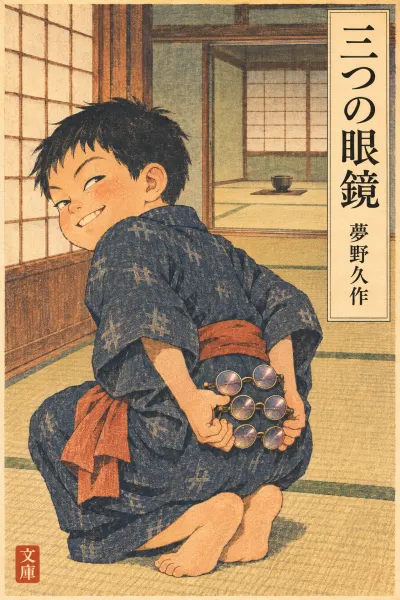
三つの眼鏡 Mitsu no Megane in easy Japanese (N4)
This is our own simplified retelling of Takeo and the Three Pairs of Spectacles, written for N4 learners and checked word by word against the N4 vocabulary list. A few story words and grammar patterns go beyond N4; the notes below give each one's level. It keeps the characters, events and ending of the original. When it feels easy, move on to the original text.
The story in brief
After his mother dies, Takeo becomes naughty and hides the spectacles of his father, sister and grandmother, so the household falls into trouble: his sister burns her hand and his grandmother twists her ankle. Father shuts Takeo in the storehouse and tells him to put on all three pairs of glasses to find his mother. In a dream, his mother sadly asks him to be good, and afterwards Takeo becomes a quiet, well-behaved boy.
AI translation · independently checked
たけおさんは、お母さんがなくなってから、とても悪い子になりました。After his mother died, Takeo became a very naughty boy.
ある日、たけおさんは何かおもしろいいたずらはないかと考えながら、へやに入りました。One day Takeo went into a room, wondering whether there was some fun mischief he could get up to.
つくえの上に、おばあさんのめがねがありました。On the desk lay Grandmother's spectacles.
たけおさんはよろこんで、そのめがねをポケットに入れました。Takeo was delighted, and he put the spectacles in his pocket.
それから、お父さんとお姉さんのめがねもさがして、いっしょにポケットに入れました。Then he hunted for Father's and Big Sister's spectacles as well, and put them in his pocket with the others.
そして、どこかへあそびに行きました。And then he went off somewhere to play.
おばあさんはへやに帰って来ましたが、めがねがないのでこまりました。Grandmother came back to the room, but she did not know what to do, for her spectacles were gone.
お父さんは出かけようとしましたが、大切なめがねがありません。Father was just about to go out, but his precious spectacles were nowhere to be found.
お姉さんも買い物から帰ると、めがねがありませんでした。When Sister came home from her shopping, her spectacles were gone too.
「きっとたけおさんよ。めがねがないと、ばんごはんのしたくができないわ。」"It must be Takeo, I'm sure of it. Without my glasses I can't get supper ready, you know."
「こまったな。めがねがなければ、用事ができない。しかたがない。出かけるのはやめよう。」"Well, this is a fine fix. Without my glasses I can't do my business. Can't be helped. I won't go out, then."
「わたしもぬいものができないよ。お母さんがなくなってから、たけおはほんとうに悪くなった。」"And I can't do my sewing, either. Ever since his mother passed away, Takeo has grown truly wicked."
三人はかおを見て、こまってしまいました。The three of them looked at one another and were quite at a loss.
しかたがないので、三人は何もかもやめて、手でさわりながら、ばんごはんのしたくを始めました。There was nothing else for it, so the three of them put everything aside and began to make supper, feeling their way with their hands.
お姉さんは火をつけようとして、マッチをすりました。Sister struck a match to light the fire.
でも、マッチのはこが少し開いていました。But the matchbox was a little open.
はこの中のマッチにいっぺんに火がついて、お姉さんは手にやけどをしてしまいました。All the matches in the box caught fire at once, and Sister burned her hand.
お姉さんがなき出したので、おばあさんがへやから出て来ました。Sister began to cry, and so Grandmother came out of her room.
でも、くらいところですりばちにつまずいて、足をくじいてしまいました。But in the dark she tripped over the grinding bowl and twisted her ankle.
お父さんはびっくりして、二人の世話をしました。Father was startled, and he looked after the two of them.
そして、ごはんを作ろうとしましたが、今度はマッチがありません。Then he tried to make supper himself, but this time there were no matches.
どこをさがしてもないので、お父さんは近くの店へマッチを買いに行きました。No matter where he looked he could not find any, so Father went to the shop nearby to buy some.
その間に、たけおさんが帰って来ました。While he was gone, Takeo came home.
「ごはん、ごはん。」と大きなこえで言いながら、すわりました。"Supper, supper!" he said in a loud voice as he sat down.
お姉さんはないています。Sister was crying.
おばあさんはいたくて、うんうんと言っています。Grandmother was in pain and kept groaning, "Oh, oh."
「どうしたの。」と何度聞いても、だれもへんじをしません。No matter how many times he asked, "What's the matter?", nobody answered him.
たけおさんはおなかがすいて、なき出しました。Takeo was hungry, and he began to cry.
「お母さん。」"Mother!"
でも、お母さんはへんじをしません。But Mother did not answer.
そこへお父さんが帰って来ました。Just then Father came home.
「たけお、お母さんに会いたければ、そのめがねを三つともかけて、さがしなさい。そして、ごはんを食べさせてもらいなさい。」"Takeo, if you want to see your mother, put on all three of those pairs of spectacles and look for her. And then ask her to give you your supper."
お父さんはそう言って、たけおさんをくらの中に入れました。With these words, Father shut Takeo inside the storehouse.
たけおさんはくらの中で大きなこえでなきました。Inside the storehouse, Takeo cried at the top of his voice.
でも、だんだんおなかがすいて、なく力もなくなりました。But little by little he grew hungrier, until he had no strength left even to cry.
つめたいゆかの上にねて、「お母さんがいたら、すぐにあやまって、ごはんを食べさせてくれるのに。」と思って、なきました。He lay on the cold floor and wept, thinking, "If only Mother were here, I would say sorry right away, and she would give me my supper."
その時、たけおさんはお父さんのことばを思い出しました。Just then, Takeo remembered his father's words.
たけおさんは、めがねを三つともかけてみました。Takeo tried putting on all three pairs of spectacles.
でも、いつまで待っても、何も見えません。But no matter how long he waited, he could see nothing at all.
ほかにできることもないので、たけおさんはめがねをかけたまま、くらい中でしずかに待ちました。There was nothing else he could do, so Takeo waited quietly in the dark with the spectacles still on.
すると、くらい中に、お母さんがはっきり見えて来ました。Then, there in the darkness, he began to see his mother quite clearly.
お母さんはかなしいかおで言いました。Mother spoke with a sorrowful face.
「たけお、お母さんがいないからいたずらをするなら、もうあなたを私の子だと思いません。私の心は、いつもあなたのそばにいます。あなたがどこで悪いことをしても、お母さんはいつも見ています。あなたが悪いことをすると、お母さんがわらわれるのです。だから、どうぞいい子になってね。わすれてはいけませんよ……。」"Takeo, if you are going to get up to mischief because your mother is no longer here, then I shall no longer think of you as my child. My heart is always close beside you. Wherever you may do wrong, your mother is always watching. When you do wrong, it is your mother who is laughed at. So, I beg you, be a good child. You must never forget this..."
そう言うと、お母さんはすぐにきえてしまいました。As soon as she had said this, Mother vanished.
「お母さん、待って。ごめんなさい。お母さん!」"Mother, wait! I'm sorry! Mother!"
たけおさんはお母さんの方へ走ろうとしました。Takeo tried to run toward his mother.
でも、それはゆめでした。But it was a dream.
たけおさんは、ゆかの上でねむっていたのです。Takeo had been sleeping on the floor.
その時、くらの入口が開いて、お父さんが言いました。Just then the door of the storehouse opened, and Father said:
「さあ、たけお、ごはんを食べなさい。これから悪いことをしたら、ゆるさないぞ。」"Come now, Takeo, eat your supper. If you do anything bad from now on, I won't forgive you, mind."
たけおさんは、このことをだれにも話しませんでした。Takeo never told anyone about what had happened.
でも、たけおさんがとてもしずかないい子になったので、みんなびっくりしました。But Takeo became such a quiet, good boy that everyone was amazed.
Vocabulary
| Word | Meaning | JLPT |
|---|---|---|
| なくなってなくなる | to pass away, to diedictionary form: なくなるWritten 亡くなる when it means 'to die'; a polite way to speak of a death. 無くなる (to be lost) sounds the same. | N4 |
| いたずらいたずら | mischief, a prankいたずらをする = to play a prank, to get up to mischief. | N3 |
| こまりましたこまる | to be in trouble, to not know what to dodictionary form: こまるこまったな is a common sigh: 'What a fix!' | N5 |
| したくしたく | preparation (of a meal)Kanji 支度. ごはんのしたく = getting a meal ready. | N4 |
| しかたがないしかたがない | it can't be helpedKanji 仕方がない; literally 'there is no way (to do it)'. | — |
| ぬいものぬいもの | sewing, needleworkFrom ぬう (to sew) + もの (thing). Kanji 縫い物. | — |
| やけどやけど | a burn (on the skin)やけどをする = to burn oneself, to get burned. | N2 |
| つまずいてつまずく | to trip, to stumbledictionary form: つまずくYou trip over something with に: すりばちにつまずく. | N2 |
| くじいてくじく | to sprain, to twist (a joint)dictionary form: くじく足をくじく = to twist one's ankle. | — |
| 世話せわ | care, looking after someone〜の世話をする = to take care of someone. | N4 |
| くらくら | storehouseKanji 蔵. A thick-walled building beside a Japanese house for keeping valuables; dark inside, so children were sometimes shut in one as punishment. | N1 |
| あやまってあやまる | to apologise, to say sorrydictionary form: あやまるKanji 謝る. | N1 |
| きえてきえる | to vanish, to disappeardictionary form: きえるKanji 消える; also used for a fire or light going out. | N5 |
| ゆるさないゆるす | to forgivedictionary form: ゆるすKanji 許す. ゆるさないぞ is a firm warning; ぞ is a strong, masculine sentence ending. | N3 |
Grammar
〜ようとする N3 to try to / be about to do
The volitional form plus とする shows an attempt, or the moment just before an action. Followed by が, it shows the action did not happen as planned.
お父さんは出かけようとしましたが、大切なめがねがありません。
Father was just about to go out, but his precious spectacles were nowhere to be found.
〜てしまう N4 to end up doing (something unfortunate)
The te-form plus しまう shows that something happened completely, often with regret. Here it stresses that the burn was an unhappy accident.
お姉さんは手にやけどをしてしまいました。
Sister burned her hand.
どこ/いつまで/何度 + 〜ても N4 no matter where / how long / how often
A question word (どこ, いつまで, 何度, etc.) plus the te-form and も means 'no matter where/how long/how many times ...'. The clause that follows usually gives a result that goes against what was hoped. Example: どこをさがしてもないので — Since there were none no matter where he looked, (Father went out to buy some).
どこをさがしてもないので
No matter where he looked he could not find any, so
〜たまま N4 while still in the state of ~
The ta-form plus まま means a state continues unchanged while something else happens. Takeo keeps the glasses on while he waits.
たけおさんはめがねをかけたまま、くらい中でしずかに待ちました。
Takeo waited quietly in the dark with the spectacles still on.
〜たら、〜のに N4 if only ~, then ~ (but it is not so)
たら sets up an imagined condition, and のに at the end shows regret that it is not real. Takeo wishes his mother were alive.
お母さんがいたら、すぐにあやまって、ごはんを食べさせてくれるのに。
If only Mother were here, I would say sorry right away, and she would give me my supper.
〜させてもらう N3 to get someone to let / have one do something
The causative plus もらう means receiving permission or a favour to do something. 食べさせてもらう means having someone give you food to eat.
そして、ごはんを食べさせてもらいなさい。
And then ask her to give you your supper.