 N3 · easy
Simplified retelling · JLPT N3
虫の生命 Mushi no Seimei in easy Japanese (N3)
This is our own simplified retelling of The Charcoal Burner's First Dream, written for N3 learners and checked word by word against the N3 vocabulary list. A few story words and grammar patterns go beyond N3; the notes below give each one's level. It keeps the characters, events and ending of the original. When it feels easy, move on to the original text.
The story in brief
On the second day of the New Year, a lonely charcoal burner named Kantarō dreams of a weeping princess whose insect home is about to be burned, so he breaks open his kiln and carries a hollow oak log deep into the mountains to save the insect. He loses his way, suffers through the winter, and collapses in spring, only to wake as a white-haired god among heavenly maidens inside the insect's hole. Flying back to his old hut, he sees a double of his former self, who scoffs at the idea of saving a bug and lights the kiln, and Kantarō can no longer tell dream from reality.
AI translation · independently checked
かんたろうは、山のおくですみやきをしている男です。Kantarō was a man who burned charcoal deep in the mountains.
妻も子供もいません。He had neither a wife nor children.
毎日一人でかまの前に立って、煙を見ながら、「さびしいなあ」と思っていました。Every day he stood alone in front of his kiln, watching the smoke and thinking, "How lonely I am."
今年もかんたろうは、かまの中にかしの木などをたくさん入れて、正月をむかえました。This year, too, Kantarō filled his kiln with plenty of oak and other wood, and so he welcomed the New Year.
あとは火をつけるだけです。All that was left was to light the fire.
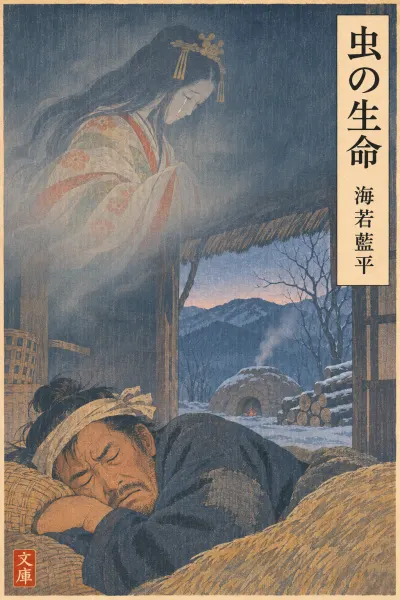
正月二日の朝、かんたろうは不思議な夢を見ました。On the morning of the second day of the New Year, Kantarō had a strange dream.
どこからか、小さくて悲しい歌声が聞こえてきます。From somewhere came the sound of a small, sad singing voice.
「冬の間、わたしは木の中で静かにくらしています。でも、その木は切られて、かまに入れられました。明日はやかれて、煙になって消えてしまいます。小さいむしの命を、だれがかわいそうだと思ってくれるでしょう。」"All winter long I dwell / in quiet within a tree. / But now that tree is felled / and laid inside the kiln. / Tomorrow it shall burn / and vanish into smoke. / A tiny insect's life: / who will feel pity for me?"
歌がだんだん近くなったので、かんたろうは目を開けました。The song came nearer and nearer, so Kantarō opened his eyes.
すると、暗い中に美しいおひめさまが一人立っていました。And there in the darkness stood a beautiful princess, all alone.
きれいな着物のそでで顔をかくして、ないていました。She was hiding her face behind the sleeve of her lovely kimono, weeping.
かんたろうはびっくりして起きました。Kantarō started up in surprise.
それは夢でした。It had been a dream.
もう朝で、外には雪がたくさん積もっていました。It was already morning, and outside the snow lay deep.
かんたろうは急いでかまに火を入れようとしました。Kantarō hurried to light the fire in his kiln.
でも、夢のことが気になって、どうしてもできません。But the dream weighed on his mind, and no matter how he tried, he could not do it.
かまの中の木には、きっとむしが住んでいるでしょう。Surely an insect was living in the wood inside the kiln.
家ごとやかれると知ったら、むしはとても悲しむにちがいありません。If it learned that its home was going to be burned with it inside, the insect would certainly be terribly sad.
かんたろうは思い切って、かまをこわしました。Kantarō made up his mind and broke open the kiln.
そして、木を一本ずつ出して、よく調べました。Then he took the wood out one piece at a time and looked each one over carefully.
ところが不思議なことに、あなのある木は一本もありません。But strangely enough, not a single piece had a hole in it.
「ばかなことをした。この木をやかなければ、ご飯が食べられないのに。」"What a foolish thing I've done. If I don't burn this wood, I won't be able to eat."
かんたろうはとても残念に思いました。Kantarō felt very sorry about it.
でも、最後に大きなかしのまるたが一本残りました。But in the end, one big oak log was left.
その真ん中に、小さなあなが一つありました。Right in the middle of it was a single small hole.
「これがむしの家だな。」とかんたろうは思いました。"So this is the insect's home," Kantarō thought.
割ったら、中のむしが死んでしまうかもしれません。If he split it, the insect inside might die.
そこで、かんたろうはおべんとうを作って、まるたを持って、人が来ない山のおくのおくまで運びました。So Kantarō packed a lunch, took the log, and carried it deep, deep into the mountains where no one ever came.
そして、いわの間にそっと立てかけておきました。Then he gently leaned it between some rocks and left it there.
春になれば、むしは外に出て、ちょうになって飛べるだろうと思ったのです。He thought that when spring came, the insect would come out, turn into a butterfly and fly away.
むしは助かりましたが、かんたろうはもうすみやきをする気になりません。The insect was saved, but Kantarō no longer felt like burning charcoal.
でも、ほかの仕事は何も知りません。Yet he knew no other work at all.
何をしようかと考えながら帰るうちに、道が分からなくなって、山の中で迷ってしまいました。As he walked home wondering what to do, he lost his way and ended up lost in the mountains.
どこまで行っても山ばかりで、食べ物もありません。No matter how far he went, there was nothing but mountains, and no food either.
かんたろうは草のねや木のかわを食べ、葉を体に着て、家の方へ歩きつづけました。Kantarō ate the roots of grasses and the bark of trees, dressed himself in leaves, and kept on walking toward home.
雪や雨や風の中を歩くのは、とても苦しいことでした。Walking through the snow, the rain and the wind was very hard.
「むし一ぴきを助けたから、こんなことになった。夢を本当にしたからだ。」"This happened because I saved one insect. Because I took a dream for the truth."
かんたろうは悲しくて、なみだをぽろぽろこぼしました。Kantarō was so sad that the tears rolled down one after another.
やがて春が来ました。At last spring came.
風があたたかくなり、木には新しいめが出て、鳥の楽しい声が聞こえてきました。The wind grew warm, new buds came out on the trees, and the happy voices of birds could be heard.
でも、かんたろうはもうつかれて、目もよく見えません。But Kantarō was worn out by now, and his eyes could hardly see.
石の上でころんだり、木にぶつかったりしながら歩いて、とうとうたおれてしまいました。Stumbling over stones and bumping into trees as he walked, he finally collapsed.
すると、どこからか明るい歌が聞こえてきました。Then, from somewhere, a bright song could be heard.
「小さなむしでも、大きなぞうでも、助けた命は一つです。助けた心の美しさは同じです。人の命を助けるのは、人の心を持った人。むしの命を助けるのは、神様の心を持った人です。」"Be it a tiny insect, / be it a mighty elephant, / a life that's saved is one life. / The beauty of the heart that saves / is ever just the same. / Who saves a human life / bears a human heart; / who saves an insect's life / bears the heart of a god."
かんたろうが目を開けると、りっぱなベッドの上にねていました。When Kantarō opened his eyes, he was lying on a splendid bed.
そばでは、たくさんの美しい天女たちが世話をしています。Beside him, many beautiful heavenly maidens were taking care of him.
そして、ベッドのそばには、あの夢のおひめさまがにっこり笑って立っていました。And next to the bed stood the princess from that dream, smiling sweetly.
かんたろうがおどろいて起きると、かみもひげも真っ白になっていて、神様のような白い大きな着物を着ていました。When Kantarō sat up in surprise, he found his hair and beard had turned pure white, and he was wearing a large white robe like a god's.
心もきれいになって、今までの苦しいことや悲しいことは全部忘れてしまいました。His heart had become pure as well, and he had completely forgotten all the pain and sorrow he had known until then.
「神様が目をさまされた。」"The god has awakened."
天女たちはみんな頭を下げました。The heavenly maidens all bowed their heads.
それから、かんたろうは神様としてそこでくらしました。From then on, Kantarō lived there as a god.
食べ物の心配もありません。He had no worries about food, either.
毎日、天女たちの春の歌を聞き、おどりを見て過ごしました。Every day he passed the time listening to the maidens' songs of spring and watching their dances.
ある日、かんたろうは天女たちと一緒に外へ飛び出しました。One day, Kantarō flew out with the heavenly maidens.
ふり返って見ると、自分たちの家は、あのいわの間のかしのまるたにある、小さなむしのあなでした。When he looked back, he saw that their home was the little insect hole in the oak log between those rocks.
かんたろうは、まず昔の自分の家へ行ってみました。First of all, Kantarō went to have a look at his old house.
家もかまも、昔と同じようにありました。The house and the kiln were both there, just as they had always been.
しばらくすると、家の中から一人の男が出てきました。After a while, a man came out of the house.
昔のかんたろうにそっくりで、着物まで同じです。He looked exactly like Kantarō used to, right down to his clothes.
男は、かんたろうたちを見て言いました。The man saw Kantarō and the others and said:
「ああ、ちょうがたくさん飛んできたな。正月にあの夢を本当にして、かしの木のむしを助けていたら、今ごろむしはあんなちょうになっていただろう。でも、そのかわりに、おれは死んでいたかもしれない。ばかばかしい。自分の命とむしの命を取りかえられるものか。さあ、すみをやこう。今度の木は、とくにむしのあなが多かったなあ。」"Huh, a whole bunch of butterflies flying in. If I'd taken that New Year dream for real and saved the bug in that oak, I bet it'd be a butterfly like those by now. But then I might've ended up dead instead. What rubbish. Like I'd ever trade my own life for a bug's! Right, time to burn some charcoal. Sure were a lot of bug holes in this batch of wood, though."
男がかまに火を入れると、やがて煙がもくもくと空へ上っていきました。When the man lit the fire in the kiln, before long smoke went billowing up into the sky.
神様のかんたろうは、これが夢なのか本当なのか、まったく分からなくなってしまいました。Kantarō the god could no longer tell at all whether this was a dream or real.
Vocabulary
| Word | Meaning | JLPT |
|---|---|---|
| すみやきすみやき | charcoal burning; making charcoaldictionary form: 炭焼き炭 (charcoal) + 焼く (to burn). In 62 the verb form appears as すみをやく. | — |
| かまかま | kilndictionary form: 窯The same sound can also mean a cooking pot (釜); here it is the charcoal kiln. | — |
| むかえましたむかえる | to welcome; to greet (a season or day)dictionary form: 迎える正月をむかえる is the set phrase for "to see in the New Year". | N4 |
| 不思議ふしぎ | strange; mysteriousA な-adjective: 不思議な夢; 不思議なことに means "strangely enough". | N3 |
| 積もってつもる | to pile up (of snow)dictionary form: 積もる | N3 |
| 気になってきになる | to weigh on one's mind; to bother onedictionary form: 気になるCompare 気になりません in 31 (する気になる), "to feel like doing". | — |
| 思い切っておもいきる | to make up one's mind; to act boldlydictionary form: 思い切る思い切って is mostly used as an adverb: "boldly, taking the plunge". | — |
| まるたまるた | logdictionary form: 丸太丸 (round) + 太 (thick). | — |
| 立てかけてたてかける | to lean (something) against somethingdictionary form: 立て掛ける | — |
| 迷ってまよう | to get lost; to lose one's waydictionary form: 迷うAlso "to hesitate, be unable to decide". | — |
| 天女てんにょ | heavenly maiden; celestial nymphNote the reading にょ for 女, as in 女房 (にょうぼう). | — |
| 世話せわ | care; looking after someone世話をする = to take care of. | N4 |
| そっくりそっくり | exactly alikeAにそっくりだA = to look just like A. | N3 |
| 取りかえられるとりかえる | to exchange; to swapdictionary form: 取り替えるHere in the potential form: "can trade". | N4 |
Grammar
〜ようとする N3 to try to do; to be about to do
The volitional form plus とする shows an attempt or a moment just before an action. Here Kantarō sets out to light the kiln but, as the next sentence shows, cannot go through with it.
かんたろうは急いでかまに火を入れようとしました。
Kantarō hurried to light the fire in his kiln.
〜にちがいない N3 must be; surely
This expresses a strong conviction by the speaker. Kantarō is certain the insect would grieve. The polite form is にちがいありません.
むしはとても悲しむにちがいありません。
The insect would certainly be terribly sad.
〜ておく N4 to do something and leave it that way
The て-form plus おく shows an action done in advance or left in a certain state on purpose. Kantarō leans the log against the rocks and leaves it there for the insect.
いわの間にそっと立てかけておきました。
He gently leaned it between some rocks and left it there.
〜うちに N3 while; in the course of (something changes)
〜うちに after a plain-form verb (dictionary or ている form) means 'while; in the course of doing'. It shows that a change happens, or something is done, during an ongoing action or state. Here, while he walks home wondering what to do, he gradually loses the path.
何をしようかと考えながら帰るうちに、道が分からなくなって
As he walked home wondering what to do, he lost his way
〜ていたら〜ていただろう N3 if (something) had happened, (something else) would have happened
たら plus a past conjecture describes an imagined outcome that did not really happen. The double imagines what would have followed if he had saved the insect.
かしの木のむしを助けていたら、今ごろむしはあんなちょうになっていただろう。
If I'd saved the bug in that oak, I bet it'd be a butterfly like those by now.
〜ものか N2 as if...!; there's no way...
Added after a plain-form verb, ものか makes a strong rhetorical denial. It is casual and emphatic, and here it shows the double's blunt rejection of the idea.
自分の命とむしの命を取りかえられるものか。
Like I'd ever trade my own life for a bug's!