 N4 · easy
Simplified retelling · JLPT N4
伸び支度 Nobijitaku in easy Japanese (N4)
This is our own simplified retelling of Getting Ready to Grow, written for N4 learners and checked word by word against the N4 vocabulary list. A few story words and grammar patterns go beyond N4; the notes below give each one's level. It keeps the characters, events and ending of the original. When it feels easy, move on to the original text.
The story in brief
Sodeko, a motherless girl of fourteen or fifteen, once loved her dolls. Now she plays instead with Kinnosuke, a toddler from next door, while her father still thinks of her as his little doll. One morning her first period begins, and the maid O-Hatsu helps her. Sodeko feels shame, worry and sadness as she leaves her childhood behind, and she can no longer hold Kinnosuke the way she used to.
AI translation · independently checked
そでこは十四か十五の女の子です。Sodeko was a girl of fourteen or fifteen.
小さかったそでこは、にんぎょうが大すきでした。When she was little, Sodeko had loved dolls.
にんぎょうのために、小さな着物をたくさん作りました。She made many little kimonos for her dolls.
いちばん大切だったにんぎょうは、お父さんが町の大きな店で買ってくれたものです。Her most treasured doll was one that Father had bought for her at a big shop in town.
外国の男の子のにんぎょうで、茶色のかみでした。It was a doll of a foreign boy, with brown hair.
よこにすると目がしまって、立てると目が開きました。When you laid it down, its eyes closed, and when you stood it up, its eyes opened.
そでこは毎日そのにんぎょうと話しました。Sodeko talked with that doll every day.
病気で学校を休んだ日も、にんぎょうはいつもそばにいました。Even on days when she stayed home from school because she was ill, the doll was always beside her.
きんじょには、みつこという小さな女の子もいました。In the neighbourhood there was also a little girl called Mitsuko.
二人はよくいっしょにあそびました。The two of them often played together.
でも、そでこはだんだんにんぎょうを忘れて、みつことも、あまりあそばなくなりました。But little by little Sodeko forgot her dolls, and she stopped playing much with Mitsuko too.
そのかわりに、そでこはきんじょの家から、きんのすけという男の子をつれて来るようになりました。Instead, Sodeko began bringing over a boy called Kinnosuke from a house in the neighbourhood.
まだ二つの赤ちゃんです。He was still a baby of two.
わらうと、とてもかわいいかおになります。When he laughed, his face became very sweet.
みつことちがって、きんのすけはいい子で、そでこの話をよく聞きました。Unlike Mitsuko, Kinnosuke was a good child and listened closely to whatever Sodeko said.
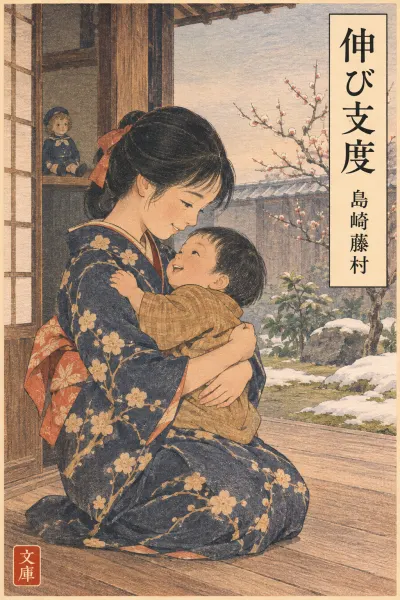
そでこは、にんぎょうのように、きんのすけをだっこしてあそびました。Sodeko held Kinnosuke in her arms and played with him as though he were a doll.
きんのすけは、まだ言葉をあまり知りません。Kinnosuke did not yet know many words.
すきな人は、みんな「ちゃあちゃん」とよびます。He called everyone he liked "Chā-chan."
そでこも、お手つだいさんのおはつも「ちゃあちゃん」です。Sodeko was "Chā-chan," and so was O-Hatsu, the maid.
きんのすけをはじめてつれて来たのは、おはつでした。It was O-Hatsu who had first brought Kinnosuke to the house.
おはつも子どもが大すきです。O-Hatsu loved children too.
三月のある日、みつこがまどから「そでこさん、どうしてあそんでくれないの。」とよびました。One day in March, Mitsuko called through the window, "Sodeko-san, why won't you play with me?"
そでこは新しい学校の試験の勉強で、いそがしかったのです。Sodeko was busy studying for the entrance examination for her new school.
その日、そでこはきんのすけをおこらせてしまいました。That day, Sodeko ended up making Kinnosuke cross.
きんのすけは、おはつのそばにばかり行きます。Kinnosuke would go to no one but O-Hatsu.
「ちゃあちゃん。」"Chā-chan."
「はい、きんのすけさん。」"Yes, Kinnosuke-san."
二人はずっと同じ言葉をくりかえしました。The two of them kept repeating the same words over and over.
お父さんが来て、わらいました。Father came in and laughed.
おはつは「きょう、そでこさんときんのすけさんはけんかです。」と話しました。O-Hatsu told him, "Today Sodeko-san and Kinnosuke-san have had a quarrel."
お父さんは「きんのすけさんは、そでちゃんのにんぎょうだね。」とわらいました。Father laughed and said, "So Kinnosuke is Sode-chan's doll, eh?"
そでこのお母さんは、もう死んでいます。Sodeko's mother had already died.
お父さんは一人で子どもたちをそだてました。Father had raised the children on his own.
お父さんも、そでこをにんぎょうのように思っていました。Father, too, thought of Sodeko as something like a doll.
そでこの服も物も、ぜんぶお父さんがえらびました。Sodeko's clothes and belongings had all been chosen by Father.
きゃくが「赤いきれいな服も着させたら。」と話しても、お父さんは聞きませんでした。Even when visitors said, "Why not let her wear pretty red clothes as well?", Father would not listen.
そでこに、ずっと子どもでいてほしかったのです。He wanted Sodeko to stay a child for ever.
ある朝、そでこは青いかおで、だいどころのおはつのところへ来ました。One morning, Sodeko came to O-Hatsu in the kitchen, her face pale.
何も話しません。She said nothing at all.
おはつはすぐに分かりました。O-Hatsu understood at once.
生理が始まったのです。Sodeko's monthly time had begun.
おはつはそでこをへやへつれて行って、ねさせました。O-Hatsu took Sodeko to her room and had her lie down.
「しんぱいしなくていいですよ。だれにでもあることです。きょうは学校を休みなさい。」"There's no need to worry. It happens to everyone. You should stay home from school today."
そでこの家には、お母さんもおばあさんもいません。In Sodeko's house there was no mother and no grandmother.
だから、だれも教えてくれませんでした。So no one had told her anything.
お父さんは心配して、よく見に来ました。Father was worried and came often to look in on her.
おはつは「病気ではありません。」とだけ答えました。O-Hatsu answered only, "It isn't an illness."
お父さんは、それ以上聞けませんでした。Father could not ask anything more.
そして「お兄さんたちには、少しあたまがいたいから休んだと話しておいて。」とたのみました。Then he asked her, "Tell the boys she stayed home because she has a bit of a headache."
昼、お兄さんたちが帰って来ました。At noon her elder brothers came home.
一人のお兄さんは「あたまがいたいぐらいで休むのか。よわいなあ。」とおこりました。One of the brothers said angrily, "You're staying home just for a headache? What a weakling!"
そでこはなきそうになりました。Sodeko was close to tears.
おはつは「わたしが休ませたんですよ。」とお兄さんをとめました。O-Hatsu stopped the brother, saying, "I'm the one who told her to stay home, you know."
お父さんは何も話さないで、ろうかを行ったり来たりしました。Without a word, Father paced back and forth along the corridor.
そでこの子どもの日は、もう終わりだと思ったのです。He felt that Sodeko's childhood was already over.
夕方、外からみつこの高いこえが聞こえました。In the evening, Mitsuko's high voice could be heard from outside.
そでこはねながら、そのこえを聞きました。Lying in bed, Sodeko listened to that voice.
とてもかなしい気持ちでした。She felt very sad.
つぎの日、そでこは学校へ行きました。The next day, Sodeko went to school.
おはつは「わたしは十七の年でした。おそかったから、あなたにもっと早く話せばよかったです。学校の運動は休んだほうがいいですよ。」と教えました。O-Hatsu told her, "I was seventeen. Since mine came late, I should have told you sooner. You had better sit out the exercises at school."
学校への道で、そでこははずかしくて、しんぱいでした。On the way to school, Sodeko felt ashamed and anxious.
お母さんがいたら、と思いました。If only Mother were here, she thought.
学校では、友だちが先生と楽しくあそんでいます。At school, her friends were playing happily with the teacher.
そでこは一人で、すみからそれを見ていました。Sodeko watched them alone from a corner.
七日ぐらいあとで、そでこの体はやっとふつうになりました。About a week later, Sodeko's body was at last back to normal.
「よかった。」でも、そでこは少しかなしくなりました。"Thank goodness." And yet Sodeko felt a little sad.
子どもの日にさようならをするかなしさです。It was the sadness of saying goodbye to the days of childhood.
みつこが家のまわりを走っているのを見ると、もう一度何も知らない子どもにもどりたいと思いました。When she saw Mitsuko running around the house, she wished she could go back once more to being a child who knew nothing.
男と女はちがいます。Men and women are different.
お兄さんたちとちがって、そでこはじぶんの体を大切にしなければなりません。Unlike her brothers, Sodeko had to take care of her own body.
そでこは大人の世界を、少し見たのです。Sodeko had caught a small glimpse of the grown-up world.
そでこが生まれて少しあとに、お母さんはたくさんのちが出て死にました。A little while after Sodeko was born, her mother had lost a great deal of blood and died.
十五年あとに、それがむすめのそでこの体に来たようでした。Fifteen years later, it seemed, that same thing had come to the body of her daughter, Sodeko.
毎月来るということも、そでこにはまだよく分かりません。Sodeko did not yet really understand that it would come every month.
しんぱいは、まだつづいていました。Her worry still went on.
そでこは、子どもと大人の間に立っていました。Sodeko stood between childhood and womanhood.
おはつは、またきんのすけをつれて来ました。O-Hatsu brought Kinnosuke over again.
きんのすけは前よりかわいいかおで、そでこの後ろを歩きました。With a face even sweeter than before, Kinnosuke toddled along behind Sodeko.
「ちゃあちゃん。」"Chā-chan."
よぶこえは前と同じです。The voice calling her was the same as before.
でも、そでこはもう前と同じように、きんのすけをだっこすることはできませんでした。But Sodeko could no longer hold Kinnosuke in her arms the way she used to.
Vocabulary
| Word | Meaning | JLPT |
|---|---|---|
| にんぎょうにんぎょう | dolldictionary form: 人形Kanji: 人 'person' + 形 'shape'. The doll is a key image of childhood in this story. | N4 |
| よこにするよこにする | to lay (something) down flatdictionary form: 横にする横 means 'side'. 横になる means 'to lie down' yourself. | — |
| きんじょきんじょ | neighbourhood; nearbydictionary form: 近所Often seen in the phrase 近所の人, 'the neighbours'. | N4 |
| だっこしてだっこする | to hold (a child) in one's armsdictionary form: 抱っこするA soft, family word, used mainly about babies and small children. | — |
| くりかえしましたくりかえす | to repeatdictionary form: 繰り返す | N3 |
| そだてましたそだてる | to raise; to bring up (children)dictionary form: 育てるTransitive. The intransitive partner 育つ means 'to grow up'. | N4 |
| 生理せいり | menstrual periodThe ordinary, polite word. The original story never names it directly. | N1 |
| ろうかろうか | corridor; hallwaydictionary form: 廊下 | N5 |
| はずかしくてはずかしい | embarrassed; ashamed; shydictionary form: 恥ずかしい | N4 |
| すみすみ | corner (inside a room or space)dictionary form: 隅For a street corner, 角 (かど) is used instead. | N4 |
| 大切にたいせつにする | to take good care of; to treat with caredictionary form: 大切にする大切 means 'precious'. With にする it becomes 'to treat as precious'. | — |
| 大人おとな | adult; grown-upA special reading: neither kanji is read this way on its own. | N5 |
| つづいてつづく | to continue; to go ondictionary form: 続くIntransitive. The transitive partner is 続ける. | N4 |
Grammar
〜なくなる N4 to stop doing; to no longer do
Take the negative ない-form, change ない to なく, and add なる. This shows a change into a state of not doing something. Here, Sodeko gradually stops playing with Mitsuko.
みつことも、あまりあそばなくなりました。
She stopped playing much with Mitsuko too.
〜ようになる N4 to come to do; to start doing (as a habit)
Dictionary form + ようになる describes a gradual change in behaviour. Bringing Kinnosuke over becomes Sodeko's new habit.
きんのすけという男の子をつれて来るようになりました。
She began bringing over a boy called Kinnosuke.
Causative 〜せる/〜させる N4 to make or let someone do
休む becomes 休ませる, 'to have someone rest or stay home'. O-Hatsu takes responsibility: she is the one who made Sodeko stay home. ねさせました in the same passage works the same way.
わたしが休ませたんですよ。
I'm the one who told her to stay home, you know.
〜に〜てほしい N4 to want someone (else) to do something
The person you want to act is marked with に, and the verb is in the て-form + ほしい. The のです at the end gives the reason for Father's behaviour in the sentence before.
そでこに、ずっと子どもでいてほしかったのです。
He wanted Sodeko to stay a child for ever.
〜ばよかった N4 I should have …; if only I had …
The conditional ば-form + よかった expresses regret about something you did not do. O-Hatsu regrets that she did not talk to Sodeko sooner.
あなたにもっと早く話せばよかったです。
I should have talked to you sooner.
もう〜ことはできない N4 can no longer do
Dictionary form + ことができる means 'can do'. With もう and the negative form, it means something that was possible before is not possible now. The は adds contrast with the past.
そでこはもう前と同じように、きんのすけをだっこすることはできませんでした。
Sodeko could no longer hold Kinnosuke in her arms the way she used to.