 N5 · easy
Simplified retelling · JLPT N5
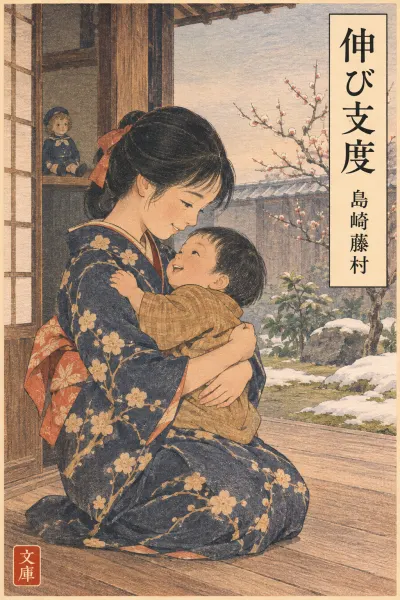
伸び支度 Nobijitaku in easy Japanese (N5)
This is our own simplified retelling of Getting Ready to Grow, written for N5 learners and checked word by word against the N5 vocabulary list. A few story words and grammar patterns go beyond N5; the notes below give each one's level. It keeps the characters, events and ending of the original. When it feels easy, move on to the N4 version or the original text.
The story in brief
Sodeko, almost fifteen, has outgrown her doll and her games with Mitsuko, and now loves the little neighbour boy Kinnosuke. One morning her body becomes a woman's body, and the maid O-Hatsu gently takes care of her while her father worries and her brothers tease. Even after she is well again, Sodeko feels sad, because she has said goodbye to the child she used to be.
AI translation · independently checked
そでこは、もうすぐ十五になる女の子です。Sodeko was a girl who would soon be fifteen.
前は、にんぎょうが大すきでした。She used to love dolls very much.
お父さんが大きな本のみせでかった、外国の男の子のにんぎょうです。It was a foreign boy doll that her father had bought at a big bookshop.
そでこは毎日そのにんぎょうと話しました。Every day Sodeko talked with that doll.
小さいふくも、たくさんつくりました。She made many little clothes for it, too.
ちかくのいえの、みつこという小さい女の子とも、よくあそびました。She also often played with a little girl called Mitsuko from a house nearby.
でも、そでこはだんだんにんぎょうをわすれました。But little by little, Sodeko forgot about the doll.
みつこともあまりあそばなくなりました。She stopped playing much with Mitsuko, too.
今、そでこは、ちかくのいえのきんのすけという男の子がすきです。Now Sodeko was fond of a boy called Kinnosuke from a house nearby.
まだ二つで、しずかでかわいい子どもです。He was only two, a quiet and sweet little child.
いえではたらくおはつが、きんのすけをだいて来ました。O-Hatsu, who worked in the house, came in carrying Kinnosuke in her arms.
きんのすけは、まだ「ちゃあちゃん」しかいえません。Kinnosuke could still say nothing but "Chā-chan."
そでこも、おはつも「ちゃあちゃん」です。Sodeko was "Chā-chan," and O-Hatsu was "Chā-chan" too.
あるゆうがた、そでこときんのすけはけんかをしました。One evening, Sodeko and Kinnosuke had a quarrel.
きんのすけは、おはつのそばにばかり行きます。Kinnosuke kept going only to O-Hatsu's side.
「ちゃあちゃん。」"Chā-chan."
「はあい、きんのすけさん。」"Ye-es, Kinnosuke."
お父さんが来て、「きんのすけは、そでこのにんぎょうだね。」といいました。Father came in and said, "So Kinnosuke is Sodeko's doll, eh?"
でも、そでこも、お父さんのにんぎょうでした。But Sodeko, too, had been Father's doll.
お母さんは、そでこが生まれて、すぐにしにました。Her mother had died soon after Sodeko was born.
お父さんは一人で子どもたちを大きくしました。Father had raised the children by himself.
そでこのふくも、お父さんがかいました。It was Father who bought Sodeko's clothes, too.
あかいふくはかいませんでした。He did not buy her red clothes.
お父さんは、そでこにいつも子どもでいてほしかったです。Father had wanted Sodeko to stay a child forever.
あるあさ、そでこはあおいかおで、だいどころに来ました。One morning, Sodeko came into the kitchen with a pale face.
そでこのからだが、大人の女のからだになりました。Sodeko's body had become the body of a grown woman.
おはつはすぐに分かりました。O-Hatsu understood at once.
「しんぱいしないで。だれでもなります。今日は学校を休みましょう。」"Don't worry. It happens to everyone. Let's have you stay home from school today."
お父さんはしんぱいして、ときどき見に来ました。Father was worried and came to look in on her from time to time.
おはつは「びょう気ではありません。」といいました。O-Hatsu said, "It isn't an illness."
お父さんは男なので、もう聞きませんでした。Because Father was a man, he asked no more.
ひるに、にいさんたちがかえって来ました。At noon, her elder brothers came home.
「どうして休むんだ。よわいな。」そでこは、とてもかなしくなりました。"Why are you staying home? What a weakling." Sodeko felt very sad.
おはつが「わたしが休んでくださいといいました。」といいました。O-Hatsu said, "I was the one who told her to stay home."
お父さんは何もいいませんでした。Father said nothing.
ろうかを行ったり来たりしました。He walked back and forth along the corridor.
ゆうがた、外でみつこが大きいこえでよんでいました。In the evening, Mitsuko was outside, calling in a loud voice.
そでこはねながら、それを聞きました。Sodeko heard it as she lay in bed.
とてもかなしかったです。She felt very sad.
次のあさ、そでこは学校へ行きました。The next morning, Sodeko went to school.
おはつは「わたしは十七でなりました。もっとはやく話したかったです。」といいました。O-Hatsu said, "For me it came at seventeen. I wish I had talked to you about it sooner."
学校で、そでこは、もう前のそでこではありませんでした。At school, Sodeko was no longer the Sodeko she had been before.
友だちは外であそびましたが、そでこは一人で見ていました。Her friends played outside, but Sodeko watched alone.
お母さんにあいたかったです。She longed to see her mother.
七日ぐらいで、からだはまたげんきになりました。In about seven days, her body was well again.
でも、そでこはかなしかったです。But Sodeko was sad.
子どものじぶんに、さようならをしました。She had said goodbye to her child self.
外でみつこがげんきにはしっています。Outside, Mitsuko was running about happily.
そでこは、また何もしらない子どもになりたかったです。Sodeko wished she could become a child again, one who knew nothing.
おはつは、またきんのすけをだいて来ました。O-Hatsu came in again, carrying Kinnosuke in her arms.
「ちゃあちゃん。」"Chā-chan."
きんのすけのこえは、前とおなじです。Kinnosuke's voice was the same as before.
でも、そでこは、もう前とおなじには、きんのすけをだけませんでした。But Sodeko could no longer hold Kinnosuke the way she used to.
Vocabulary
| Word | Meaning | JLPT |
|---|---|---|
| にんぎょうにんぎょう | dolldictionary form: 人形Kanji 人 'person' + 形 'shape': a 'person-shape'. | N4 |
| だんだんだんだん | gradually, little by littledictionary form: 段々Used for slow change over time. | N1 |
| わすれましたわすれる | to forgetdictionary form: 忘れるHere it means she stopped thinking about the doll, not that she lost her memory of it. | N5 |
| だいてだく | to hold in one's arms, to carry (a child)dictionary form: 抱くUsed for hugging or holding a baby. | N3 |
| けんかけんか | quarrel, fightdictionary form: 喧嘩Used with する: けんかをする 'to have a fight'. | N4 |
| そばそば | side, close besidedictionary form: 側〜のそば 'next to, near (someone)'. | N5 |
| だいどころだいどころ | kitchendictionary form: 台所 | N5 |
| 大人おとな | adult, grown-upA special reading: not だいにん. | N5 |
| しんぱいしんぱい | worrydictionary form: 心配しんぱいする 'to worry'; しんぱいしないで 'don't worry'. | N4 |
| よわいよわい | weakdictionary form: 弱いOpposite: つよい 'strong'. Here it is a teasing insult. | N5 |
| ろうかろうか | corridor, hallwaydictionary form: 廊下 | N5 |
| じぶんじぶん | oneself, one's own selfdictionary form: 自分子どものじぶん: 'her child self', the person she was as a child. | N5 |
Grammar
〜なくなる N4 to stop doing; to no longer do
The ない-form of a verb with く + なる shows a change from doing something to not doing it. あそばなくなりました means she came to not play anymore.
みつこともあまりあそばなくなりました。
She stopped playing much with Mitsuko, too.
〜しか〜ない N4 nothing but, only
しか after a word, followed by a negative verb, means 'only this and nothing else'. The verb is always negative even though the English meaning is 'can only say'.
きんのすけは、まだ「ちゃあちゃん」しかいえません。
Kinnosuke could still say nothing but "Chā-chan."
〜てほしい N4 to want someone to do or be something
The て-form + ほしい expresses a wish for another person's action or state. The person is marked with に: そでこに〜いてほしい 'wanted Sodeko to stay'.
お父さんは、そでこにいつも子どもでいてほしかったです。
Father had wanted Sodeko to stay a child forever.
〜たり〜たりする N4 doing things like A and B; back and forth
Two verbs in the た-form + り, ending with する, list actions that happen in turn. 行ったり来たり is a set phrase meaning 'going back and forth'.
ろうかを行ったり来たりしました。
He walked back and forth along the corridor.
〜ながら N4 while doing
The ます-stem + ながら joins two actions done by the same person at the same time. Here she hears the voice while lying in bed.
そでこはねながら、それを聞きました。
Sodeko heard it as she lay in bed.
〜たい N5 to want to do
The ます-stem + たい expresses one's own wish. It changes like an い-adjective, so the past is なりたかった 'wanted to become'.
そでこは、また何もしらない子どもになりたかったです。
Sodeko wished she could become a child again, one who knew nothing.