 N4 · easy
Simplified retelling · JLPT N4
シグナルとシグナレス Shigunaru to Shigunaresu in easy Japanese (N4)
This is our own simplified retelling of A Signal Post in Love, written for N4 learners and checked word by word against the N4 vocabulary list. A few story words and grammar patterns go beyond N4; the notes below give each one's level. It keeps the characters, events and ending of the original. When it feels easy, move on to the N3 version or the original text.
The story in brief
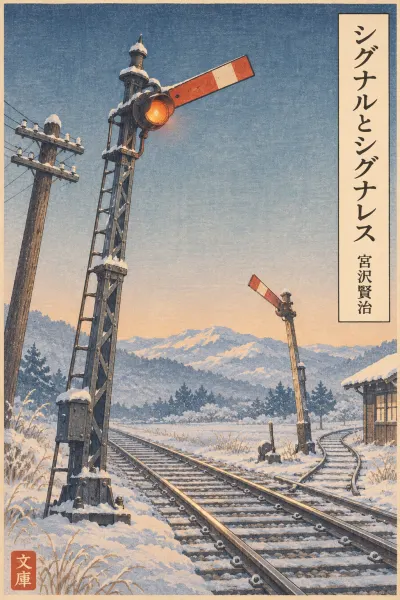
Signal, a fine new main-line signal, falls in love with Signaless, a small wooden signal of the light railway. A fat telegraph pole learns of their secret engagement and turns everyone against it. The kindly warehouse helps the two share a dream of being alone together high among the stars, and they wake still in their places, relieved.
AI translation · independently checked
朝早く、小さいてつどうのきしゃが、歌いながら来て、止まりました。Early in the morning, the little train of the light railway came along singing and stopped.
そこに立っているシグナレスは、白いうでを上げました。Signaless, who stood there, raised her white arm.
シグナレスは、木でできた小さなシグナルです。Signaless is a small signal made of wood.
うしろには、大きいてつどうのシグナルが立っていました。Behind her stood the signal of the main railway line.
新しくて、りっぱなシグナルです。He is a new and splendid signal.
「おはようございます。今朝はあたたかいですね」"Good morning. It's warm this morning, isn't it?"
シグナルがあいさつしました。Signal greeted her.
「おはようございます」"Good morning."
シグナレスは小さなこえで答えました。Signaless answered in a small voice.
すると、シグナルの近くにいる、ふとったでんしんばしらがおこりました。At that, the fat telegraph pole standing near Signal grew angry.
「あんなものと話してはいけませんよ」"You must not talk with such a thing."
シグナルはしばらく何も話しませんでした。For a while, Signal said nothing at all.
でも、あとでシグナレスにこう話しました。But later, he said this to Signaless:
「ぼくは世界でいちばん、あなたが大切です。どうか、ぼくをすきになってください」"You are more precious to me than anything in the world. Please, I beg you, come to love me."
シグナレスは何も答えないで、下を見ていました。Signaless did not answer and kept looking down.
シグナルは「ああ、もうだめだ。死にたい」と大きなこえを出しました。Signal cried out in a loud voice, "Oh, it's hopeless now. I want to die!"
夜になりました。Night came.
シグナレスは、ほしにいのっていました。Signaless was praying to the stars.
「シグナルさんが死ぬなら、わたしもいっしょに死なせてください」"If Mr. Signal is going to die, please let me die together with him."
そのこえが、シグナルに聞こえました。Signal heard her voice.
シグナルはとてもうれしくなりました。Signal became very happy.
「ぼくは、おこっていませんよ。ぼくとけっこんしてください」"I'm not angry, you know. Please marry me."
「でも、わたしはつまらないシグナルです。あなたは新しくて、目が二くみあります。夜も電気です。わたしは木でできていて、夜はランプです」"But I'm just an insignificant signal. You are new, and you have two pairs of eyes. At night, too, you use electricity. I am made of wood, and at night I have a lamp."
「わかっています。だから、ぼくはあなたがすきなんです」"I know. That's exactly why I love you."
「うれしい。やくそくします」"I'm so happy. I promise."
シグナルは、空の小さなまるいひかりを見せました。Signal showed her a small round light in the sky.
「あのひかりを、けっこんのゆびわにしてください」"Please take that light as your wedding ring."
すると、くらいところで、大きなそうこがわらいました。Just then, in a dark place, the big warehouse laughed.
「はっはっは。だいじょうぶ、だれにも話さないよ」"Ha ha ha! Don't you worry, I won't tell a soul."
つぎの日は、風がとても強い日でした。The next day was a very windy day.
シグナルは「風が強いから、だれにも聞こえないだろう」と思って、シグナレスにたくさん話しました。Thinking, "The wind is so strong that nobody will be able to hear us," Signal talked a great deal to Signaless.
でんしんばしらのことも「あたまがわるい」と話しました。He even said that the telegraph pole was "a blockhead."
シグナレスはわらいました。Signaless laughed.
でんしんばしらは、とてもおこりました。The telegraph pole was furious.
そして、東京を通して、シグナレスの近くにいる、耳のいいでんしんばしらに話を聞きました。Then, by way of Tōkyō, the fat telegraph pole got the story from a sharp-eared telegraph pole standing near Signaless.
ぜんぶわかると、大きなこえで話しました。Once he had learned everything, he spoke in a loud voice.
「わたしのおじさんは、てつどうの社長ですよ。けっこんなんて、だめです」"My uncle, I'll have you know, is the president of the railway. Marriage? Quite out of the question!"
そして、あちこちにでんぽうを送って、みんなにはんたいしてもらいました。And he sent telegrams here and there and got everyone to oppose it.
ゆきがふりはじめました。Snow began to fall.
シグナレスは、ないていました。Signaless was crying.
その夜、二人はほしを見ました。That night, the two of them looked at the stars.
「二人だけで、とおいところへ行きたいですね」"I wish we could go somewhere far away, just the two of us."
「ええ、どこへでも行きます」"Yes, I'll go anywhere with you."
二人はほしにいのって、そのままねむりました。The two prayed to the stars and fell asleep just as they were.
朝になると、そうこが大きなこえで話しました。When morning came, the warehouse spoke in a loud voice.
「おい、でんしんばしら。あの二人をけっこんさせてやれよ」"Hey, telegraph pole. Let those two get hitched, will ya?"
でんしんばしらはおこって、何も答えられませんでした。The telegraph pole was so angry that he couldn't answer anything.
その夜は、きりがとてもふかくて、二人はかおが見えませんでした。That night the fog was very thick, and the two could not see each other's faces.
そうこがやさしく話しました。The warehouse spoke gently.
「わたしと同じように歌いなさい。アルファー」"Sing just the way I do. Alpha."
「アルファー」"Alpha."
「ビーター」"Beta."
「ビーター」"Beta."
「ガムマー」"Gamma."
「ガムマー」"Gamma."
すると、二人はくらい夜の中に、ならんで立っていました。And then the two of them were standing side by side in the dark night.
空はほしでいっぱいです。The sky was full of stars.
前には夜の海があって、青く光っていました。In front of them lay the night sea, shining blue.
水の中には、赤いひとでがいました。In the water there were red starfish.
空が何かいも回って、さむくなりました。The sky turned round and round many times, and it grew cold.
まわりが青白い火で明るくなりました。Everything around them grew bright with a pale blue fire.
でも、あつくありません。But it was not hot.
「ここは空の上ですよ。とうとう、二人だけになりましたね」"We are up above the sky. At last, it's just the two of us."
「ええ」"Yes."
「あのでんしんばしらも、ほんとうはかわいそうですね。そうこも親切でした」"Really, I feel sorry for that telegraph pole too. And the warehouse was kind to us."
「そうだよ、親切だよ」"That's right, I am kind!"
大きなこえがしました。A loud voice rang out.
気がつくと、二人はいっしょにゆめを見ていたのでした。When they came to, they realised that the two of them had been dreaming the same dream together.
きりはもうなくて、空にはほしがたくさん光っていました。The fog was gone, and many stars were shining in the sky.
むこうでは、そうこがわらいながら立っていました。Over there, the warehouse stood laughing.
二人はまた小さく、ほっとしました。Once more, the two quietly sighed with relief.
Vocabulary
| Word | Meaning | JLPT |
|---|---|---|
| きしゃきしゃ | steam traindictionary form: 汽車Written 汽車 (steam + vehicle). This is the old word for a train pulled by a steam engine. | N4 |
| でんしんばしらでんしんばしら | telegraph poledictionary form: 電信柱電信 (telegraph) + 柱 (pillar). はしら becomes ばしら here (rendaku). Today it usually means a utility pole. | — |
| あいさつあいさつ | greetingdictionary form: 挨拶Used as a verb with する: あいさつする (to greet). | N4 |
| いのっていのる | to praydictionary form: 祈るThe person or thing you pray to is marked with に: ほしにいのる. | N4 |
| けっこんけっこん | marriagedictionary form: 結婚You marry someone with と: ぼくとけっこんする. | N5 |
| つまらないつまらない | insignificant; worthless (self-deprecating); dullOften means 'boring', but here it is a humble way to call oneself unimportant. | N5 |
| やくそくやくそく | promisedictionary form: 約束やくそくする = to promise. | N4 |
| ゆびわゆびわ | ring (for a finger)dictionary form: 指輪指 (finger) + 輪 (ring, circle). | N4 |
| そうこそうこ | warehouse; storehousedictionary form: 倉庫 | N2 |
| でんぽうでんぽう | telegramdictionary form: 電報Messages sent along the telegraph wires. | N4 |
| はんたいはんたい | opposition; objectiondictionary form: 反対はんたいする = to be against something. | N4 |
| きりきり | fog; mistdictionary form: 霧Thick fog is described with ふかい (deep): きりがふかい. | N3 |
| ひとでひとで | starfishdictionary form: 海星 | — |
| かわいそうかわいそう | pitiful; poor thingExpresses feeling sorry for someone. Do not confuse it with かわいい (cute). | N3 |
Grammar
〜ながら N4 while doing
The verb stem plus ながら shows two actions done by the same subject at the same time. Here the train sings as it comes along.
小さいてつどうのきしゃが、歌いながら来て、止まりました。
The little train of the light railway came along singing and stopped.
〜てはいけません N4 must not do
The te-form plus はいけません forbids an action. The telegraph pole uses it to forbid Signal from talking to Signaless.
あんなものと話してはいけませんよ
You must not converse with such a thing, young master.
〜ないで N4 without doing
The ない-form plus で means doing one thing without doing another. Signaless keeps looking down instead of answering.
シグナレスは何も答えないで、下を見ていました。
Signaless did not answer and kept looking down.
〜させてください N4 please let me do
The causative form (死なせる, 'let die') plus てください asks for permission to do something: 'please let me…'. Signaless asks the stars to let her die together with Signal.
わたしもいっしょに死なせてください
Please let me die together with him.
〜だろう N4 probably; I suppose
だろう is the plain form of でしょう and shows a guess. Signal supposes that nobody will hear them in the strong wind.
風が強いから、だれにも聞こえないだろう
The wind is so strong that nobody will be able to hear us.
〜てもらう N4 to have someone do something (for you)
The te-form plus もらう means the subject gets others to do an action for him. The pole gets everyone to oppose the marriage.
あちこちにでんぽうを送って、みんなにはんたいしてもらいました。
He sent telegrams here and there and got everyone to oppose it.