 N4 · easy
Simplified retelling · JLPT N4
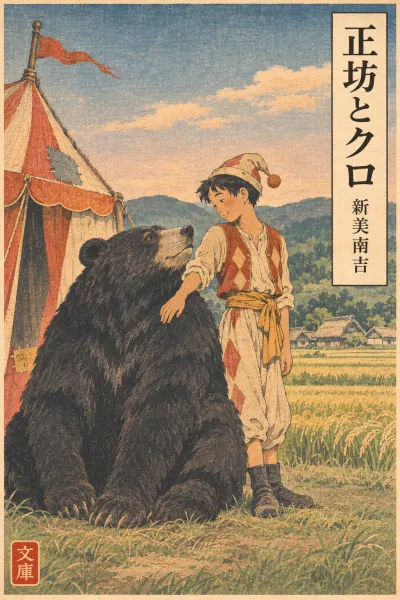
正坊とクロ Shōbō to Kuro in easy Japanese (N4)
This is our own simplified retelling of Shōbō and Kuro the Circus Bear, written for N4 learners and checked word by word against the N4 vocabulary list. A few story words and grammar patterns go beyond N4; the notes below give each one's level. It keeps the characters, events and ending of the original. When it feels easy, move on to the N3 version or the original text.
The story in brief
Kuro, the circus's old bear, falls ill and will not take his medicine, so Ochiyo rides to the hospital to bring back Shōbō, who gets Kuro to swallow it by singing their favourite song. Later the circus runs out of money and breaks up: Kuro is sold to a town zoo, and Shōbō and Ochiyo find work at a factory. On their first day off they visit Kuro, who comes back to life at the sound of Shōbō's voice and song.
AI translation · independently checked
小さなサーカスがありました。There was once a small circus.
十人ぐらいの人と、年をとった黒いくまのクロと、うまがいました。It had about ten people, an old black bear called Kuro, and horses.
サーカスはむらからむらへ行って、ぶたいを見せていました。The circus went from village to village, putting on its shows.
ある日の午後、クロがぶたいに出るばんになりました。One afternoon, it was Kuro's turn to go on stage.
でも、クロはおりの中で目をとじて、立ちません。But Kuro kept his eyes closed in his cage and would not stand up.
体があつくて、おなかがいたいようでした。His body was hot, and it seemed his stomach hurt.
だんちょうやみんなが来て、くすりを飲ませようとしましたが、クロは口を強くとじて、開けません。The ringmaster and everyone else came and tried to make him take some medicine, but Kuro shut his mouth tight and would not open it.
見物の人たちは、早く見たいと待っています。The audience was waiting, eager to see the show soon.
それで、ほかの人がクロの代わりにぶたいに出ました。So someone else went on stage in Kuro's place.
「まさぼうがいたら、クロはくすりを飲むのになあ。」と、だれかが小さなこえで話しました。"If only Masabō were here, Kuro would take his medicine," someone said in a small voice.
だんちょうは「そうだ。おちよ、まさぼうをつれて来い。」と大きなこえで話しました。"That's it! Ochiyo, go and fetch Shōbō!" the ringmaster said in a loud voice.
まさぼうは足にけがをして、となりのむらの病院に入院していました。Shōbō had hurt his leg and was in hospital in the next village.
おちよさんはうまにのって、病院へ行きました。Ochiyo got on a horse and rode to the hospital.
まさぼうはおちよさんを見て、とてもよろこびました。When Shōbō saw Ochiyo, he was overjoyed.
おちよさんは、いつもまさぼうをほんとうの弟のようにかわいがっていました。Ochiyo had always treated Shōbō with affection, just like her own little brother.
「お姉さん、ぼく、もう元気だよ。」"Big sister, I'm all better now!"
「よかった。まさぼう、クロが病気で、くすりを飲まないの。みんなこまっているのよ。」"I'm so glad. Shōbō, Kuro's sick, and he won't take his medicine. Everyone's at their wits' end."
「じゃあ、ぼく、帰る。」"Then I'm going back."
二人は先生に聞いて、いっしょにうまにのって帰りました。The two of them asked the doctor, and then rode back together on the horse.
まさぼうはくすりを手に持って、クロのはなをやさしくさわりました。Shōbō held the medicine in his hand and gently stroked Kuro's nose.
それから、クロの大すきな歌を歌いました。Then he sang Kuro's favourite song.
二人がいつもぶたいに出る、楽しい歌です。It was the cheerful song the two of them always performed on stage.
クロはその歌を聞いて、ゆっくり立ちました。When Kuro heard that song, he slowly stood up.
まさぼうがくすりを口に入れると、クロはすぐに飲みました。When Shōbō put the medicine in his mouth, Kuro swallowed it at once.
それから、まさぼうとクロは前よりもっといい友だちになりました。After that, Shōbō and Kuro became even better friends than before.
見物の人たちも、二人が大すきになりました。The audiences came to love the two of them, too.
ある日、だんちょうがどろぼうになって、まさぼうとクロといっしょにぶたいに出ました。One day, the ringmaster played a robber and went on stage with Shōbō and Kuro.
まさぼうはクロのせなかにのって、何回もおちてみせて、みんなをわらわせました。Shōbō rode on Kuro's back and made a show of falling off again and again, making everyone laugh.
クロにビスケットもあげました。He gave Kuro biscuits, too.
どろぼうのだんちょうが、大きなかたなを持って出てきました。Then the ringmaster, as the robber, came out holding a big sword.
まさぼうはこわがって、クロのくびを強く持ちました。Shōbō acted frightened and held tightly on to Kuro's neck.
だんちょうは大きなこえを出して、こわい目でまさぼうを見ました。The ringmaster shouted and glared at Shōbō with fierce eyes.
それは、だんちょうがほんとうにおこっている目と同じでした。They were just the same as the ringmaster's eyes when he was truly angry.
クロは、だんちょうがまさぼうを打つと思いました。Kuro thought the ringmaster was going to hit Shōbō.
だんちょうがもう一度かたなを上げると、クロは大きくほえて、まさぼうをつれて、見物の人の間を走って、外へにげました。When the ringmaster raised the sword once more, Kuro gave a great roar, took Shōbō with him, ran through the audience and escaped outside.
みんなびっくりしました。Everyone was astonished.
まさぼうはクロをやさしくさわって、しずかにさせました。Shōbō stroked Kuro gently and calmed him down.
それから、ぶたいにもどって、見物の人とだんちょうにあやまりました。Then he went back to the stage and apologised to the audience and the ringmaster.
見物の人たちはとてもよろこびました。The audience was delighted.
だんちょうは後ろで、こまったようにわらっていました。At the back, the ringmaster was smiling awkwardly.
サーカスには、お金があまりありませんでした。The circus did not have much money.
そして、うまが病気で死にました。And then a horse fell sick and died.
ひとつき後の朝、だんちょうとおちよさんとまさぼうのほかは、みんなにげていました。One morning a month later, everyone except the ringmaster, Ochiyo and Shōbō had run away.
もうサーカスはできません。The circus could not go on any more.
みんな別れることになりました。It was decided that they would all go their separate ways.
クロは町のどうぶつえんに売られました。Kuro was sold to the zoo in town.
まさぼうとおちよさんは、のこったうまや、いすやテーブルを売って、そのお金をもらいました。Shōbō and Ochiyo sold the horses that were left, and the chairs and tables, and were given the money.
「だんちょうさんは何もなくなって、どうするの。」"Ringmaster, you've got nothing left. What will you do?"
まさぼうが聞くと、だんちょうはさびしそうにわらって、答えました。When Shōbō asked, the ringmaster smiled sadly and answered.
「何もなくて家を出たから、何もなくて家に帰るよ。」"I left home with nothing, so I'll go home with nothing."
だんちょうはけいさつに頼んで、二人が町の工場ではたらけるようにしました。The ringmaster asked the police for help and arranged for the two of them to be able to work at a factory in town.
どうぶつえんのクロは、毎日、元気のない目で青い空を見ていました。At the zoo, Kuro spent every day gazing up at the blue sky with dull, listless eyes.
まさぼうたちに会いたいと思っているようでした。It seemed he was longing to see Shōbō and the others.
毎日たくさんの子どもがおりの前に来ました。Every day, lots of children came to the front of his cage.
ある日、「クロ。」と、よく知っているこえが聞こえました。One day, he heard a voice he knew well: "Kuro!"
まさぼうが、あの歌を歌い始めました。Shōbō began to sing that song.
クロは急に元気になって、立ちました。Kuro suddenly perked up and stood on his feet.
そして、サーカスのように、おりの中を歩きました。And he walked around inside his cage, just as he used to in the circus.
まさぼうだとわかると、クロは大きなこえで、うれしそうになきました。When he realised it was Shōbō, Kuro cried out loudly and happily.
まさぼうはわらいながら、ビスケットをクロの口に入れて、たくさんはなをさわってあげました。Laughing, Shōbō put biscuits into Kuro's mouth and stroked his nose again and again.
後ろで、おちよさんがないているような目で見ていました。Behind him, Ochiyo watched with eyes that looked close to tears.
二人は、はじめての休みの日に、クロに会いに来たのでした。The two of them had come to see Kuro on their very first day off.
Vocabulary
| Word | Meaning | JLPT |
|---|---|---|
| 年をとったとしをとる | to grow old; (as とった) olddictionary form: 年をとるUsed before a noun, 年をとった means "elderly, old". | — |
| ばんばん | turn (in order)dictionary form: 番〜のばんになる: "it becomes someone's turn". | N3 |
| おりおり | cage (for an animal)dictionary form: 檻 | N1 |
| 見物けんぶつ | watching a show; 見物の人 = spectators, audience | N4 |
| 代わりかわり | substitute; 〜の代わりに = in place of ~ | N4 |
| 入院してにゅういんする | to be admitted to hospitaldictionary form: 入院するThe opposite is 退院する (たいいんする), "to leave hospital". | — |
| かわいがってかわいがる | to treat with affection, to dote ondictionary form: かわいがるThis is the verb form of かわいい, used for someone you look after. | N2 |
| こまってこまる | to be in trouble, not know what to dodictionary form: 困る | N5 |
| どろぼうどろぼう | thief, robberdictionary form: 泥棒どろぼうになって here means playing a robber in the skit. | N4 |
| ほえてほえる | to roar, bark (of an animal)dictionary form: 吠える | N3 |
| にげましたにげる | to run away, escapedictionary form: 逃げる | N4 |
| あやまりましたあやまる | to apologisedictionary form: 謝る | N4 |
| 別れるわかれる | to part, go separate ways | N4 |
| 頼んでたのむ | to ask (for a favour), requestdictionary form: 頼む | N5 |
Grammar
〜(よ)うとする N3 to try to do; to attempt
The volitional form plus とする describes an attempt, often one that fails. Here it is added to the causative 飲ませる, giving "tried to make him drink".
くすりを飲ませようとしましたが、クロは口を強くとじて、開けません。
They tried to make him take some medicine, but Kuro shut his mouth tight and would not open it.
〜ようだ N4 it seems that ~; to look like ~
The pattern attaches to a plain-form verb or adjective to give the narrator's guess from what can be seen. The bear cannot say he is in pain, so the story says it "seemed" so.
体があつくて、おなかがいたいようでした。
His body was hot, and it seemed his stomach hurt.
〜たら…のに N3 if ~, then … (but it isn't so); if only
〜たら sets up a condition that is not true, and the sentence-final のに shows regret about the real situation. The added なあ makes it sound like a sigh.
まさぼうがいたら、クロはくすりを飲むのになあ。
If only Shōbō were here, Kuro would take his medicine.
Causative 〜せる/〜させる N4 to make or let someone do
わらう becomes わらわせる, "make (people) laugh", and the person made to act takes を. しずかにさせる in a later sentence works the same way: "made him calm".
何回もおちてみせて、みんなをわらわせました。
He made a show of falling off again and again, making everyone laugh.
〜ことになる N4 it is decided that ~; it turns out that ~
This pattern shows that something came to be decided by circumstances, not by one person's own choice. Here the circus has failed, so the group has to break up.
みんな別れることになりました。
It was decided that they would all go their separate ways.
〜ようにする N4 to arrange things so that ~; to make sure that ~
A potential or plain verb followed by ようにする means acting so that a situation becomes possible. The ringmaster arranges things so the two "can work" (はたらける).
二人が町の工場ではたらけるようにしました。
He arranged for the two of them to be able to work at a factory in town.