Upper intermediate · JLPT N2
シグナルとシグナレスShigunaru to Shigunaresu — A Signal Post in Love
- JLPT N2
- 11,192 characters
- 8 parts
- about 93 minutes
- 3 easier versions
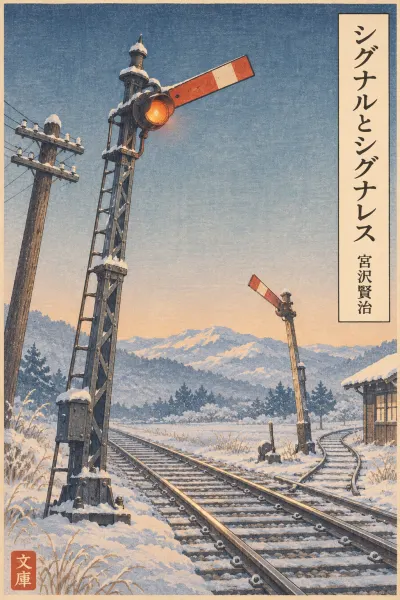
This is a fairy tale about railway equipment. Signal, a modern metal signal post on the main line, falls in love with Signaless, a shy wooden signal post on the small light railway that runs toward the Tōno basin. Signal's fat telegraph-pole guardian disapproves of the match and sets out to stop it, and a joking warehouse roof becomes the couple's unlikely ally. Miyazawa Kenji brings the whole wintry railway yard to life: trains sing as they arrive, the wind roars, and the signals pray to the stars, to Santa Maria and to the railway pioneer George Stephenson. The narrator is warm and playful, speaks in polite です/ます style and sometimes addresses the reader directly as 諸君. For a learner, the main reward and the main challenge are the same thing: each character speaks in a sharply different register. Signal's earnest boyish 僕 and Signaless's soft feminine ございます are easy to follow. The telegraph pole's stiff, archaic servant language (手前, やつがれ, ござりまする) and the roof's rough おれ/てめえ slang take more effort. Onomatopoeia, songs and loanwords appear throughout.
Contents
Easier versions
This story is also retold in simpler Japanese. Reading an easier version first makes the original much more approachable.
Before you read
- Identify the speaker by register before decoding each line. 僕 with earnest です/ます means Signal. わ and ございます mean Signaless. 手前, やつがれ and ござりまする mean the telegraph pole. おれ, てめえ and plain imperatives such as 〜ろ or 〜け mean the warehouse roof or the pole in a rage.
- Treat the pole's archaic forms as fixed set phrases. ござりまする is an old, extra-humble version of ございます, and やつがれ and 手前 both mean a humble 'I'. You don't need to master them; just recognise them as over-formal servant speech.
- Watch for 〜ように used to mean 'as if' or 'like' in the narrator's descriptions. Also watch for 〜のをいいことにして ('taking advantage of the fact that…'), which explains why Signal speaks under cover of the wind in Parts 4–5.
- Learn a few railway and setting words first: 信号 / シグナル (signal), 電信柱 (telegraph pole), 軽便鉄道 (light railway), 本線 (main line), 腕 (the signal's arm), 倉庫 (warehouse) and 屋根 (roof).
- Don't get stuck on the sound effects, songs or the Greek-letter chant in Part 8. Read them aloud for rhythm and mood, and focus your effort on the surrounding narration, which carries the plot.
Words to know
The most useful words from the notes across the story.
| Word | Meaning | JLPT |
|---|---|---|
| 枕木まくらぎ | railway sleeper, crosstieLiterally 'pillow wood': the rails rest on it. | — |
| 軽便鉄道けいべんてつどう | light railway, narrow-gauge local lineShortened to 軽便 in the next sentence. | — |
| 凍えたこごえる | to freeze, be chilled stiffdictionary form: 凍えるUsually said of bodies and hands; 凍る (こおる) is the plain word for water turning to ice. | N2 |
| 風下かざしも | downwind sideThe opposite is 風上 (かざかみ). 風 is read かざ in compounds. | — |
| かいかい | worth, point (of doing something)dictionary form: 甲斐〜かいもない = there is no point in ~. Often written in kana. | — |
| しょんぼりしょんぼり | dejectedly, forlornlyMimetic word for a lonely, downcast look. | — |
| 電報でんぽう | telegram電報をかける = to send a telegram. | N4 |
| 霜しも | frost霜ぐもり in the song is a frosty, overcast day. | N3 |
| しきりにしきりに | repeatedly, eagerly, over and over | N3 |
| 吼えほえる | to roar, to howldictionary form: 吼えるUsually written 吠える. Used for animals barking or roaring, and for the wind. | N3 |
| 決心けっしん | resolve, determination決心する means 'to make up one's mind'. | N3 |
| 霧きり | mist, fogHere the bluish glow of distant stars is pictured as fire burning in mist. | N3 |
| きのどくきのどく | pitiable, unfortunate; I feel sorry for youdictionary form: 気の毒Expresses sympathy for someone else's bad luck. | N3 |
| かあいそうかわいそう | poor thing, pitiabledictionary form: 可哀想かあいそう is an old-fashioned spelling/pronunciation of かわいそう. | N3 |
| 盆地ぼんち | basin (low land surrounded by mountains)盆 is a tray, so the image is land shaped like a tray. | N2 |
Plot summary
Show the full summary (contains spoilers)
On a frosty morning, the main-line signal post Signal greets Signaless, the wooden signal of the light railway. His telegraph-pole guardian scolds him for speaking to such a lowly thing. Signal declares his love anyway. When Signaless stays silent, each believes the other is hurt or angry, until Signal overhears her praying to share his fate. They promise to marry in spring, and Signal offers her the Ring Nebula as a ring. In a strong wind he cheekily tells the pole of the engagement. Furious, the pole learns everything by telegraph and asks his uncle, the Railway Superintendent, to block the marriage. The signals pray together and wish they could escape. On a foggy night the warehouse roof leads them in a chant of Greek letters. They find themselves side by side on a starry seashore and in burning star-mist. Then they wake to find it was a shared dream, while the roof laughs under the clear stars.
About the author
Miyazawa Kenji was a poet and writer of children's stories from Hanamaki in Iwate Prefecture. He studied agricultural science in Morioka and later taught at an agricultural school. He devoted much of his life to helping local farmers improve their methods and their cultural lives. He was a devout Buddhist, and his faith, love of nature and interest in science run through his writing. His fame came after his death, with works such as 銀河鉄道の夜, 風の又三郎 and the poem 雨ニモマケズ.