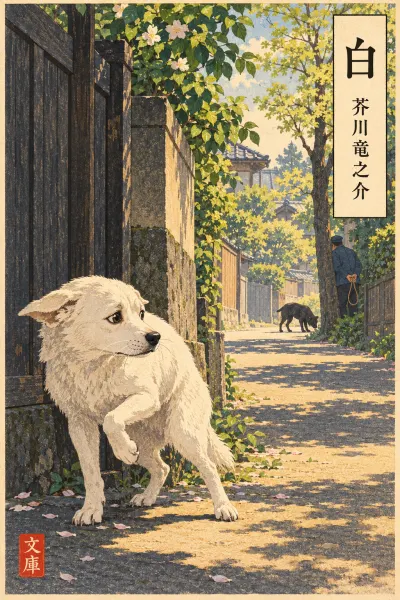
Part 6 of 6 · JLPT N2
白(五) Shiro, part 6: Shiro Comes Home at Last
In this part
Worn out, Shiro returns at midnight to his old kennel and tells the moon that he has fought every danger, partly out of shame at his own cowardice, and now only wants to see his family once before he dies. When the children find him, Haruo cries out that Shiro has come back. In the girl's eyes Shiro sees himself reflected as a small white dog again, and the girl is moved to tears while Haruo tries to act tough.
AI translation · independently checked
ある秋の真夜中です。It is the middle of the night, one autumn.
体も心も疲れ切った白は主人の家へ帰って来ました。Shiro, worn out in body and in spirit, came back to his master's house.
勿論お嬢さんや坊ちゃんはとうに床へはいっています。Of course the young lady and the young master had long since gone to bed.
いや、今は誰一人起きているものもありますまい。No, by now there was probably not a single person in the house still awake.
ひっそりした裏庭の芝生の上にも、ただ高い棕櫚の木の梢に白い月が一輪浮んでいるだけです。On the silent lawn of the back garden, too, there was nothing but a single white moon floating above the top of the tall hemp palm.
白は昔の犬小屋の前に、露に濡れた体を休めました。Shiro rested his dew-soaked body in front of his old kennel.
それから寂しい月を相手に、こういう独語を始めました。Then, with only the lonely moon to talk to, he began to speak to himself like this.
「お月様! お月様! わたしは黒君を見殺しにしました。わたしの体のまっ黒になったのも、大かたそのせいかと思っています。"Moon! Dear Moon! I left Kuro to die. I think that is most likely why my body turned completely black.
しかしわたしはお嬢さんや坊ちゃんにお別れ申してから、あらゆる危険と戦って来ました。But ever since I said goodbye to the young lady and the young master, I have fought against every kind of danger.
それは一つには何かの拍子に煤よりも黒い体を見ると、臆病を恥じる気が起ったからです。One reason was that whenever I happened to catch sight of my body, blacker than soot, I felt ashamed of my cowardice.
けれどもしまいには黒いのがいやさに、――この黒いわたしを殺したさに、あるいは火の中へ飛びこんだり、あるいはまた狼と戦ったりしました。But in the end, because I hated being black—because I wanted to kill this black self of mine—I would sometimes leap into fire, and at other times fight wolves.
が、不思議にもわたしの命はどんな強敵にも奪われません。死もわたしの顔を見ると、どこかへ逃げ去ってしまうのです。And yet, strangely, no enemy, however strong, can take my life. Even Death, when it sees my face, runs off somewhere.
わたしはとうとう苦しさの余り、自殺しようと決心しました。ただ自殺をするにつけても、ただ一目会いたいのは可愛がって下すった御主人です。At last, in my misery, I made up my mind to kill myself. But even so, before I do, the ones I long to see just once more are the masters who were so kind to me.
勿論お嬢さんや坊ちゃんはあしたにもわたしの姿を見ると、きっとまた野良犬と思うでしょう。Of course, if the young lady and the young master see me tomorrow, they will surely think I am a stray dog again.
ことによれば坊ちゃんのバットに打ち殺されてしまうかも知れません。しかしそれでも本望です。Perhaps the young master will even beat me to death with his bat. But even then, I will have my wish.
お月様! お月様! わたしは御主人の顔を見るほかに、何も願うことはありません。そのため今夜ははるばるともう一度ここへ帰って来ました。Moon! Dear Moon! I wish for nothing except to see my masters' faces. That is why I have come all this long way back here once more tonight.
どうか夜の明け次第、お嬢さんや坊ちゃんに会わして下さい。」Please, as soon as dawn breaks, let me see the young lady and the young master."
白は独語を云い終ると、芝生に腭をさしのべたなり、いつかぐっすり寝入ってしまいました。When Shiro had finished talking to himself, he lay with his chin stretched out on the grass, and before he knew it he had fallen fast asleep.
× × ×× × ×
「驚いたわねえ、春夫さん。」"What a surprise, Haruo!"
「どうしたんだろう? 姉さん。」"What could have happened? Sister?"
白は小さい主人の声に、はっきりと目を開きました。At the voices of his little masters, Shiro opened his eyes wide.
見ればお嬢さんや坊ちゃんは犬小屋の前に佇んだまま、不思議そうに顔を見合せています。He looked and saw the young lady and the young master standing still in front of the kennel, exchanging puzzled glances.
白は一度挙げた目をまた芝生の上へ伏せてしまいました。Shiro, who had raised his eyes for a moment, lowered them to the grass again.
お嬢さんや坊ちゃんは白がまっ黒に変った時にも、やはり今のように驚いたものです。When Shiro had turned completely black, the children had been startled just like this.
あの時の悲しさを考えると、――白は今では帰って来たことを後悔する気さえ起りました。When he remembered the sadness of that time—Shiro even began to regret having come back.
するとその途端です。And then, at that very moment—
坊ちゃんは突然飛び上ると、大声にこう叫びました。The young master suddenly jumped up and shouted at the top of his voice:
「お父さん! お母さん! 白がまた帰って来ましたよ!」"Father! Mother! Shiro's come back again!"
白が!Shiro, he had said!
白は思わず飛び起きました。Shiro sprang to his feet without thinking.
すると逃げるとでも思ったのでしょう。The young lady must have thought he was about to run away.
お嬢さんは両手を延ばしながら、しっかり白の頸を押えました。She stretched out both arms and held Shiro tightly by the neck.
同時に白はお嬢さんの目へ、じっと彼の目を移しました。At the same moment Shiro turned his gaze and looked steadily into her eyes.
お嬢さんの目には黒い瞳にありありと犬小屋が映っています。In the black pupils of the young lady's eyes the kennel was clearly reflected.
高い棕櫚の木のかげになったクリイム色の犬小屋が、――そんなことは当然に違いありません。The cream-coloured kennel in the shade of the tall hemp palm—that, of course, was only natural.
しかしその犬小屋の前には米粒ほどの小ささに、白い犬が一匹坐っているのです。But in front of that kennel, no bigger than a grain of rice, sat a white dog.
清らかに、ほっそりと。Pure and slender.
――白はただ恍惚とこの犬の姿に見入りました。—Shiro simply gazed at that dog, lost in rapture.
「あら、白は泣いているわよ。」"Oh, look, Shiro's crying!"
お嬢さんは白を抱きしめたまま、坊ちゃんの顔を見上げました。Still hugging Shiro tightly, the young lady looked up at the young master's face.
坊ちゃんは――御覧なさい、坊ちゃんの威張っているのを!And the young master—just look how proud of himself he is!
「へっ、姉さんだって泣いている癖に!」"Hah! You're crying too, Sister!"
(大正十二年七月)(July 1923)
Vocabulary
| Word | Meaning | JLPT |
|---|---|---|
| 疲れ切ったつかれきる | to be utterly exhausteddictionary form: 疲れ切る〜切る after a verb stem means 'completely, to the limit'. | — |
| 梢こずえ | treetop; the tips of the branchesLiterary word, common in descriptive writing. | N1 |
| 独語ひとりごと | talking to oneself; monologueUsually written 独り言; here read ひとりごと, not どくご ('German language'). | — |
| 見殺しみごろし | leaving someone to die without helpingUsually 見殺しにする: to watch someone die and do nothing. | — |
| 拍子ひょうし | chance moment; instant何かの拍子に = 'by some chance, at some moment'. Also means 'rhythm, beat'. | — |
| 臆病おくびょう | cowardice; timidity臆病者 = a coward. | N1 |
| 強敵きょうてき | a powerful enemy強 (strong) + 敵 (enemy). | — |
| 野良犬のらいぬ | stray dog野良猫 = stray cat. | — |
| 本望ほんもう | one's long-held wish; complete satisfaction〜なら本望だ = 'if so, I would have no regrets'. | — |
| 寝入ってねいる | to fall asleepdictionary form: 寝入るOften with ぐっすり: to fall sound asleep. | — |
| 佇んだたたずむ | to stand still; to lingerdictionary form: 佇むLiterary verb for standing quietly in one place. | — |
| 後悔こうかい | regret後悔する = to regret something done. | N1 |
| 恍惚こうこつ | rapture; entranced恍惚と = in a trance of delight; literary. | — |
| 威張っているいばる | to act proud; to show offdictionary form: 威張るOften negative ('to be bossy'), but here it is affectionate. | N2 |
Grammar
〜まい N1 probably not; surely not
まい expresses a negative guess ('probably not'). Here it follows the polite ます form: ありますまい is a polite, slightly old-fashioned way of saying 'there is probably no one'.
いや、今は誰一人起きているものもありますまい。
No, by now there was probably not a single person in the house still awake.
〜さに N1 out of (a feeling); because one wants/hates so much
The noun form of an adjective or a たい form (いやさ, 殺したさ) plus に gives the emotional motive for an action. Here it shows Shiro acted out of hatred for his blackness and a wish to destroy himself.
けれどもしまいには黒いのがいやさに、――この黒いわたしを殺したさに
But in the end, because I hated being black—because I wanted to kill this black self of mine
〜の余り N2 out of an excess of; so … that
Noun + の余り shows that an extreme feeling drove someone to act. Here Shiro's suffering became so great that he decided to die.
わたしはとうとう苦しさの余り、自殺しようと決心しました。
At last, in my misery, I made up my mind to kill myself.
〜次第 N2 as soon as
Verb stem or noun + 次第 means 'immediately after'. 夜の明け次第 means 'as soon as night ends', that is, at dawn.
どうか夜の明け次第、お嬢さんや坊ちゃんに会わして下さい。
Please, as soon as dawn breaks, let me see the young lady and the young master.
〜たなり N1 remaining in that state; just as it was
Past form + なり means the same as 〜たまま: the state continues while something else happens. Shiro falls asleep still lying with his chin stretched out.
芝生に腭をさしのべたなり、いつかぐっすり寝入ってしまいました。
He lay with his chin stretched out on the grass, and before he knew it he had fallen fast asleep.
〜癖に N3 even though (critical)
くせに criticises someone for doing or saying something that does not fit the facts. Haruo teases his sister for remarking on Shiro's tears while she is crying too.
へっ、姉さんだって泣いている癖に!
Hah! You're crying too, Sister!