 N4 · easy
Simplified retelling · JLPT N4
ツェねずみ Tsuenezumi in easy Japanese (N4)
This is our own simplified retelling of Tse the Mouse Wants Amends, written for N4 learners and checked word by word against the N4 vocabulary list. A few story words and grammar patterns go beyond N4; the notes below give each one's level. It keeps the characters, events and ending of the original. When it feels easy, move on to the N3 version or the original text.
The story in brief
Tse the mouse blames the weasel, the pillar, the dustpan and the bucket for his troubles, and keeps demanding that they make amends, until no one will speak to him. Only the lonely mousetrap, which actually likes mice, befriends him and gives him bait, but Tse's rudeness and complaints make it so angry that it shakes and its door snaps shut. In the morning the red-faced man who works in the house is delighted to find a mouse caught at last.
AI translation · independently checked
古い家の上のほうの、くらいところに、ツェという名前のねずみが住んでいました。In a dark place high up in an old house, there lived a mouse named Tse.
ある日、ツェねずみが家の下を歩いていると、むこうからいたちが風のように走って来ました。One day, as Tse the mouse was walking along under the house, a weasel came running toward him like the wind.
いたちは止まって、こう話しました。The weasel stopped and spoke to him like this.
「ツェねずみ、おまえの家のたなから、こんぺいとうがおちているよ。早く行って、ひろって来なさい。」"Tse, some sugar candies have fallen off the shelf in your house. Hurry along and pick them up."
ツェねずみは大よろこびで、おれいもしないで走って行きました。Tse was overjoyed, and off he ran without so much as a thank-you.
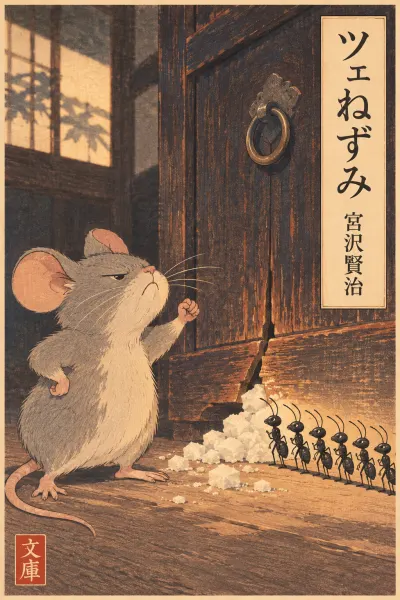
でも、たなの下には、強いありがたくさんいました。But under the shelf there were a great many strong ants.
ありたちはこんぺいとうのまわりに立って、「ここに入ってはだめだ。帰れ、帰れ。」と大きなこえで話しました。The ants stood all around the sugar candies and said in loud voices, "You can't come in here. Go home, go home!"
ツェねずみはこわくて、急いで家へ帰りました。Tse was frightened and hurried back home.
ツェねずみは、おもしろくありませんでした。Tse was not at all pleased.
そして、いたちの家へ行きました。So he went to the weasel's house.
「いたちさん、ひどいですね。わたしのようなよわいねずみに、うそを教えるなんて。」"Mr. Weasel, how cruel of you! Telling lies to a weak little mouse like me!"
「うそじゃない。ほんとうにあったよ。」"That was no lie. They really were there."
「でも、ありがみんなとりました。つぐなってください。つぐなってください。」"But the ants took them all. Please make amends. Please make amends."
「おまえが行くのが、おそかったんだよ。」"You were too slow getting there, that's all."
「つぐなってください。つぐなってください。」"Please make amends. Please make amends."
いたちはおこって、じぶんのこんぺいとうをなげました。The weasel lost his temper and threw down his own sugar candies.
「さあ、持って行け。おまえのかおは、もう見たくない。」ツェねずみはこんぺいとうをたくさんひろって、家へ帰って食べました。"There, take them away. I don't want to see your face ever again." Tse picked up a great many sugar candies, went home and ate them.
こうして、みんなはツェねずみがきらいになりました。And that is how everyone came to dislike Tse.
それで、ツェねずみは、はしらや、古いちりとりや、バケツなどと友だちになりました。So Tse made friends with a pillar, an old dustpan, a bucket and the like.
いちばんよく話したのは、はしらでした。The one he talked with most was the pillar.
ある日、はしらが話しました。One day, the pillar spoke to him.
「ツェねずみさん、もうすぐ冬ですね。今のうちに、あたたかいふとんの用意をしたほうがいいですよ。ぼくのあたまの上に、春に小鳥が持って来た鳥のけが、たくさんあります。少し運んだらどうですか。」"Tse, it will soon be winter, you know. You'd better get a warm bed ready while you still can. On top of my head there are lots of feathers that the little birds brought up here in the spring. Why don't you carry some of them away?"
ツェねずみは、その日からけを運びはじめました。From that day on, Tse began carrying the feathers.
でも、とちゅうに急なさかがありました。But along the way there was a steep slope.
三度目に、ツェねずみはさかからおちました。On his third trip, Tse fell off the slope.
はしらはびっくりして、「ねずみさん、けがはありませんか。」と聞きました。The pillar was startled and asked, "Mouse, you're not hurt, are you?"
ツェねずみは、いたそうなかおで答えました。Tse answered with a pained look on his face.
「はしらさん、ひどいですね。わたしのようなよわいねずみに、けがをさせるなんて。」"Mr. Pillar, how cruel of you! Letting a weak little mouse like me get hurt!"
はしらは「ごめんなさい。」とあやまりました。"I'm sorry," the pillar apologised.
でもツェねずみは、「つぐなってください。つぐなってください。」とやめませんでした。But Tse would not stop: "Please make amends. Please make amends."
はしらはこまって、おいおいなきました。The pillar did not know what to do, and it wept and wept.
それから、はしらはこわがって、もうツェねずみと話しませんでした。After that, the pillar was afraid of Tse and never talked with him again.
ある日、ちりとりはツェねずみに、はんぶんのおかしをあげました。One day, the dustpan gave Tse half of its sweets.
つぎの日、ツェねずみはおなかがいたくなりました。The next day, Tse got a stomachache.
ツェねずみはちりとりのところへ行って、「つぐなってください。」と百ぐらい話しました。Tse went over to the dustpan and said "Please make amends" about a hundred times.
ちりとりも、もうツェねずみと話さなくなりました。The dustpan, too, stopped talking with Tse.
また、ある日、バケツはツェねずみにせっけんを少しあげて、「これで毎朝かおをあらいなさい。」と話しました。Then, on another day, the bucket gave Tse a little soap and said, "Wash your face with this every morning."
ツェねずみはよろこんで、毎朝あらいました。Tse was delighted, and washed every morning.
でも、ひげが十本ぐらいなくなりました。But about ten of his whiskers fell out.
ツェねずみはバケツのところへ来て、「つぐなってください。」と二百五十ぐらい話しました。Tse came to the bucket and said "Please make amends" about two hundred and fifty times.
でも、バケツにはひげがありません。But a bucket has no whiskers to give.
バケツはこまって、ないてあやまりました。The bucket did not know what to do, and it cried and apologised.
そして、もうツェねずみと話しませんでした。And it never talked with Tse again.
どうぐたちは、みんなこうなって、ツェねずみのかおを見ると、急いでほかのほうを見るようになりました。Every one of the household things ended up like this, and whenever they saw Tse's face, they would quickly look the other way.
でも、一つだけ、まだツェねずみと話したことがないどうぐがありました。But there was just one thing that had never yet spoken with Tse.
それは、ねずみとりでした。That was the mousetrap.
ねずみとりは、人間のためのどうぐです。A mousetrap is a tool made for people.
でも、人間はねずみとりを大切にしません。But people do not take good care of their mousetraps.
みんな、ねずみとりはきたないと思っています。Everyone thinks a mousetrap is a dirty thing.
だから、ねずみとりは、ほんとうは人間よりねずみのほうが好きでした。So, truth be told, the mousetrap liked mice better than people.
毎ばん、やさしいこえでよびます。Every night it calls out in a gentle voice.
「ねずみさん、おいで。今夜のごちそうは魚のあたまだよ。入口をしめたりしないから、安心しておいで。」"Little mice, come along. Tonight's treat is a fish head. I won't go shutting the door on you or anything, so come along and don't be afraid."
でも、ねずみたちはこわがって、だれも来ません。But the mice are frightened, and not a single one comes.
朝になると、家ではたらく、かおの赤い男が来て、「また入っていない。」と話して、新しいえさにとりかえました。When morning came, a red-faced man who worked in the house would come, say "Nothing in it again," and change the bait for fresh.
ある夜、ねずみとりは「今夜はやわらかいはんぺんだよ。えさだけあげるよ。」とよびました。One night, the mousetrap called out, "Tonight it's soft fishcake. I'll give you just the bait."
ちょうどツェねずみが通りました。Just then, Tse happened to pass by.
「ほんとうに、えさだけくれますか。」"Will you really give me just the bait?"
「そうだよ。早くお食べ。」"That's right. Hurry up and eat it."
ツェねずみは中に入って、はんぺんを食べて、外へ出ました。Tse went inside, ate the fishcake, and came back out.
「おいしかったです。ありがとう。」"That was delicious. Thank you."
「よかったね。明日の夜もおいで。」"I'm glad. Come again tomorrow night."
つぎの朝、男は「えさだけとって行ったな。」とおこって、いわしをはんぶんつけました。The next morning the man grumbled angrily, "So it took the bait and nothing else, eh?" and he put on half a sardine.
夜、ツェねずみが来て、「やくそくですから、来てあげましたよ。」と話しました。That night Tse came and said, "A promise is a promise, so I've come, just for you."
ねずみとりは少しおこりましたが、「さあ、食べなさい。」とだけ答えました。The mousetrap was a little annoyed, but all it answered was, "Well then, eat."
ツェねずみは食べて、「じゃ、明日も来て食べてあげますよ。」と話して、帰りました。Tse ate, said, "Well, I'll do you the favour of coming to eat tomorrow too," and went home.
つぎの朝、男はもっとおこりました。The next morning the man was even angrier.
「毎ばんえさだけとられるのは、おかしい。このねずみとりは、ねずみからお金をもらっているんだな。」"The bait taken every single night and nothing caught? That's not right. This trap must be getting money from the mice."
「もらっていない。」とねずみとりは大きなこえで答えましたが、男のみみには聞こえません。"I'm not!" the mousetrap answered in a loud voice, but the man's ears could not hear it.
男は古くなったはんぺんをつけて行きました。The man put on a piece of fishcake that had gone stale, and left.
ねずみとりは一日中おこっていました。The mousetrap was angry all day long.
夜、ツェねずみが来て、「毎日ここまで来るのは大へんだ。ごちそうも魚のあたまぐらいだ。でも、来たから食べてあげよう。」と話しました。That night Tse came and said, "Coming all the way here every day is a real bother. And the treat is hardly better than a fish head. Still, since I've come, I'll eat it for you."
ねずみとりはおこって、「お食べ。」とだけ答えました。The mousetrap was angry, and all it answered was, "Eat."
ツェねずみは中に入りましたが、はんぺんが古くなっているのを見て、おこりました。Tse went inside, but when he saw that the fishcake had gone stale, he got angry.
「ねずみとりさん、ひどいです。このはんぺんは古いです。わたしのようなよわいねずみに、こんなことをするなんて。つぐなってください。つぐなってください。」"Mousetrap, how cruel of you! This fishcake is stale. Doing a thing like this to a weak little mouse like me! Please make amends. Please make amends."
ねずみとりは、とてもおこって、体がガタガタゆれました。The mousetrap grew so furious that its whole body rattled and shook.
それが悪かったのです。That was the mistake.
えさについていたかぎが動いて、入口がしまりました。The hook that held the bait moved, and the door snapped shut.
ツェねずみは「ひどい、ひどい。」となきながら、ねずみとりをかんだり、中をぐるぐる走ったり、大きなこえでないたりしました。Crying "How cruel, how cruel!", Tse bit at the mousetrap, ran round and round inside it, and wailed at the top of his voice.
でも、「つぐなってください」と話す力は、もうありませんでした。But he no longer had the strength to say "Please make amends."
ねずみとりもいたくて、おこって、ガタガタゆれました。The mousetrap was hurting too, and in its anger it rattled and shook.
こうして、朝になりました。And so morning came.
かおの赤い男が来て、とてもよろこびました。The red-faced man came and was overjoyed.
「よし、よし。とうとう入ったな。悪そうなねずみだ。さあ、出て来い。」"Good, good. Got in at last, did you? A nasty-looking mouse, this one. Come on, out you come."
Vocabulary
| Word | Meaning | JLPT |
|---|---|---|
| いたちいたち | weaseldictionary form: 鼬Usually written in kana. In Japanese folklore the weasel is often a sly animal. | — |
| こんぺいとうこんぺいとう | konpeitō, small star-shaped sugar candiesdictionary form: 金平糖A traditional sweet originally brought by the Portuguese; the word comes from Portuguese confeito. | — |
| おれいおれい | thanks; a thank-youdictionary form: お礼お礼をする / お礼を言う = to thank someone. | N4 |
| つぐなってつぐなう | to make amends; to compensatedictionary form: 償うTse's refrain. A rather formal word, which makes his whining sound comically stiff. | — |
| ちりとりちりとり | dustpandictionary form: 塵取りFrom ちり (dust) + とる (to take up). | N1 |
| 用意ようい | preparation; getting something ready〜の用意をする = to get ~ ready. | N4 |
| とちゅうとちゅう | on the way; partwaydictionary form: 途中Often written 途中. | N4 |
| あやまりましたあやまる | to apologisedictionary form: 謝るDo not confuse it with 誤る (to make a mistake), which has the same reading. | N4 |
| ひげひげ | whiskers (of an animal); beard, moustachedictionary form: 髭 | N4 |
| ねずみとりねずみとり | mousetrapdictionary form: 鼠取りFrom ねずみ (mouse) + とる (to catch). | — |
| ごちそうごちそう | a treat; a feastdictionary form: ご馳走Also in ごちそうさまでした, which is said after a meal. | N4 |
| 安心あんしん | feeling safe; not worrying安心して〜 = to do ~ without worrying. | N4 |
| えさえさ | bait; animal feeddictionary form: 餌 | N3 |
| はんぺんはんぺん | hanpen, a soft white fishcakedictionary form: 半片Made from ground fish and yam. It is a common ingredient in oden. | — |
Grammar
〜なんて N3 to think that someone would ~! (shock or outrage)
なんて after a plain-form clause expresses shock or indignation at an action. Tse uses it to accuse each helper. The sentence is left unfinished, with something like ひどい implied.
わたしのようなよわいねずみに、うそを教えるなんて。
Telling lies to a weak little mouse like me!
〜たほうがいい N4 you had better ~; you should ~
The past form of a verb + ほうがいい gives friendly advice. The pillar uses it to advise Tse to get ready for winter.
今のうちに、あたたかいふとんの用意をしたほうがいいですよ。
You'd better get a warm bed ready while you still can.
〜たらどうですか N4 why don't you ~?
The conditional たら + どうですか makes a polite suggestion. It literally means "how would it be if you ~?"
少し運んだらどうですか。
Why don't you carry some of them away?
〜ようになる N4 to come to ~; to start ~ (as a new habit)
The dictionary form + ようになる shows a change that becomes a regular pattern. Here, looking away from Tse has become a habit for all the household things.
ツェねずみのかおを見ると、急いでほかのほうを見るようになりました。
Whenever they saw Tse's face, they would quickly look the other way.
〜てあげる N4 to do ~ for someone (as a favour)
The て-form + あげる means doing something for someone else's benefit. Tse uses it rudely, as if eating the trap's free bait were a kindness to the trap.
じゃ、明日も来て食べてあげますよ。
Well, I'll do you the favour of coming to eat tomorrow too.
〜たり〜たりする N4 doing things such as ~ and ~
Two or more verbs in the たり form, ending with する, list several actions as examples. Here they describe Tse's frantic behaviour inside the trap.
ねずみとりをかんだり、中をぐるぐる走ったり、大きなこえでないたりしました。
He bit at the mousetrap, ran round and round inside it, and wailed at the top of his voice.