Upper intermediate · JLPT N2
高瀬舟Takasebune — Night Boat on the Takase River
- JLPT N2
- 8,723 characters
- 6 parts
- about 73 minutes
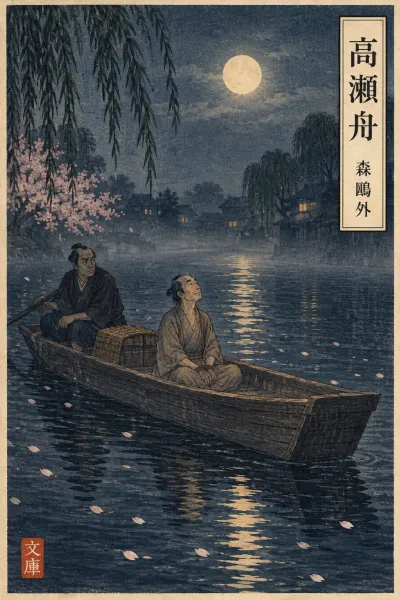
高瀬舟 is a short historical story by Mori Ōgai, first published in 1916. It is set in Kyōto during the Tokugawa period, when criminals sentenced to exile were sent downriver to Ōsaka by boat. On one hazy spring night, the constable Haneda Shōbē escorts a prisoner named Kisuke, who has been convicted of killing his own brother. Shōbē is unsettled because Kisuke seems calm, even content. The story is mostly a quiet conversation between the two men on the drifting boat. Through it, Ōgai raises two questions he also discussed in a separate essay: what it means to be satisfied with what one has, and whether ending the suffering of a dying person is a crime. The narration is restrained and formal, with classical negatives in -ぬ and some kanbun-style phrasing. The two speakers sound very different: Shōbē's speech is plain and authoritative, while Kisuke's is humble and old-fashioned. For a learner, the long, carefully built sentences and the period vocabulary are the main challenge. In return, the story is short, has only two characters and a single setting, and is a widely read classic of modern Japanese literature.
Contents
Before you read
- Learn Kisuke's speech patterns early. He uses わたくし, ございます and the old negative ませぬ (= ません) almost every time he speaks. Once these feel familiar, his long explanations in Parts 2–5 become much easier to follow.
- The narrator uses classical negatives such as 〜ぬ and 禁じ得ぬ (= 禁じ得ない, 'cannot help but…'). Read 〜ぬ as 〜ない. Watch for 〜てならない ('cannot help feeling…'), which marks Shōbē's growing unease and wonder.
- Pre-learn the period vocabulary of crime and money: 罪人 (criminal), 遠島 (exile to an island), 同心 (constable), お上 (the authorities), and 文 (a small coin, as in 二百文). In Part 5, 剃刀 (razor) is the key word.
- Track the point of view. The story is told largely through Shōbē's thoughts. Many sentences ending in 〜のではあるまいか or 〜かと思えば show him reasoning with himself rather than reporting facts.
- Expect long sentences linked by 〜つつ, 〜ばかりでなく and 〜ば〜ほど. Before translating, find the main verb at the end, then work backwards through the clauses.
Words to know
The most useful words from the notes across the story.
| Word | Meaning | JLPT |
|---|---|---|
| 剃刀かみそり | razorA special reading. The two kanji are read together as one word. | N2 |
| 遠島えんとう | exile to a distant island (an Edo-period punishment)Literally 'far island'. Here it is used with 申し渡す, 'to sentence'. | — |
| 心得違いこころえちがい | error of judgement; misguided actFrom 心得 'understanding' and 違い 'mistake'. | — |
| お上おかみ | the authorities, the governmentA respectful old term for those in power. | — |
| 扶持米ふちまい | rice stipend paid to retainersSamurai and officials were paid in rice rather than in coin. | — |
| 留守るす | absence from home留守の間 means 'while (I was) out'. | N4 |
| 笛ふえ | windpipeNormally 'flute' or 'whistle'. Here it is short for 喉笛 (のどぶえ), the windpipe. | N3 |
| 柄え | handle (of a blade or tool)The same kanji read がら means 'pattern' or 'build'. When it means 'handle', it is read え. | N3 |
| 用心ようじん | care, caution | N3 |
| 境界きょうがい | circumstances, one's lot in lifeIn this Buddhist-derived sense it is read きょうがい; read きょうかい it means 'boundary'. | N2 |
| 催促さいそく | urging, pressing (someone to act)Often used for demanding payment or a reply. | N2 |
| 険しくけわしい | harsh, fierce (of a look); steepdictionary form: 険しいUsed for steep mountains as well as stern faces. | N2 |
| ふけてふける | (of night) to grow late, to deependictionary form: 更ける夜が更ける: the night wears on. | N2 |
| 科とが | offence; crime; faultOld-fashioned. In modern Japanese this kanji is usually read か, as in 科学. | N1 |
| 仰いであおぐ | to look up atdictionary form: 仰ぐAlso means 'to look up to' or 'to respect'. The same kanji appears in 仰せ, 'a command from a superior'. | N1 |
Plot summary
Show the full summary (contains spoilers)
The constable Haneda Shōbē escorts the prisoner Kisuke, who has no family, on the night boat from Kyōto toward Ōsaka. Puzzled by his calm, Shōbē asks how he feels. Kisuke explains that life in Kyōto was so hard that exile, with a place he may live and two hundred mon from the authorities, seems a blessing. He has never had money of his own before. Shōbē compares this with his own anxious household and realises Kisuke knows how to be content, which fills him with awe. Kisuke then tells his story. His sick younger brother tried to kill himself with a razor so he would no longer be a burden, but failed. He begged Kisuke to pull the blade out, and when Kisuke did, he died. Shōbē wonders whether this was truly murder. He finally defers to the magistrate's judgement, though some doubt remains as the boat glides on.
About the author
Mori Ōgai was one of the leading writers of Meiji and Taishō Japan. As a young doctor he studied in Germany, and that experience shaped his early fiction, including 舞姫 (The Dancing Girl). He was an important translator of European literature; his translations include Goethe's Faust and Andersen's The Improvisatore. In his later years he turned to historical fiction and biography based on Edo-period sources. Works such as 阿部一族 and 山椒大夫 belong to this period, as does 高瀬舟. His other well-known works include 雁 (The Wild Geese).