Part 6 of 6 · JLPT N2
高瀬舟 Takasebune, part 6: A Doubt That Will Not Be Resolved
In this part
Kisuke finishes his story, which is almost too orderly after months of retelling. Shōbē wonders whether ending a dying brother's suffering is truly murder, and he cannot settle the question. He decides to defer to the magistrate's judgement, yet some unease remains as the boat glides on into the night.
AI translation · independently checked
少しうつ向きかげんになって庄兵衛の顔を下から見上げて話していた喜助は、こう言ってしまって視線をひざの上に落とした。Kisuke had been speaking with his head slightly bowed, looking up into Shōbē's face from below. Having said this, he lowered his gaze to his knees.
喜助の話はよく条理が立っている。Kisuke's account hung together very well.
ほとんど条理が立ち過ぎていると言ってもいいくらいである。One could almost say it hung together too well.
これは半年ほどの間、当時の事を幾たびも思い浮かべてみたのと、役場で問われ、町奉行所で調べられるそのたびごとに、注意に注意を加えてさらってみさせられたのとのためである。This was because for half a year or so he had called those events to mind again and again, and because each time he was questioned at the local office and examined at the magistrate's court, he had been made to go over them with the greatest possible care.
庄兵衛はその場の様子を目のあたり見るような思いをして聞いていたが、これがはたして弟殺しというものだろうか、人殺しというものだろうかという疑いが、話を半分聞いた時から起こって来て、聞いてしまっても、その疑いを解くことができなかった。Shōbē listened as though he were seeing the scene before his very eyes. From the moment he had heard half the story, a doubt had arisen in him: could this really be called killing one's brother, could this be called murder? Even when he had heard it all, he could not resolve that doubt.
弟は剃刀を抜いてくれたら死なれるだろうから、抜いてくれと言った。The brother had said that if the razor were pulled out he would probably be able to die, and asked Kisuke to pull it out.
それを抜いてやって死なせたのだ、殺したのだとは言われる。He pulled it out and let him die; it can be said that he killed him.
しかしそのままにしておいても、どうせ死ななくてはならぬ弟であったらしい。Yet it seemed that the brother would have had to die in any case, even if he had been left as he was.
それが早く死にたいと言ったのは、苦しさに耐えなかったからである。If he said he wanted to die quickly, it was because he could not endure the pain.
喜助はその苦を見ているに忍びなかった。Kisuke could not bear to watch his suffering.
苦から救ってやろうと思って命を絶った。Meaning to deliver him from that suffering, he ended his life.
それが罪であろうか。Was that a crime?
殺したのは罪に相違ない。To kill was, without doubt, a crime.
しかしそれが苦から救うためであったと思うと、そこに疑いが生じて、どうしても解けぬのである。But when Shōbē considered that it had been done to deliver the brother from suffering, a doubt arose there that would not be resolved, try as he might.
庄兵衛の心の中には、いろいろに考えてみた末に、自分よりも上のものの判断に任すほかないという念、オオトリテエに従うほかないという念が生じた。After turning the matter over in many ways, a feeling took shape in Shōbē's mind that there was nothing to do but leave it to the judgement of those above him, nothing to do but defer to authority.
庄兵衛はお奉行様の判断を、そのまま自分の判断にしようと思ったのである。Shōbē resolved to take the magistrate's judgement just as it stood and make it his own.
そうは思っても、庄兵衛はまだどこやらにふに落ちぬものが残っているので、なんだかお奉行様に聞いてみたくてならなかった。Even so, something somewhere still did not sit right with him, and he could not help wishing he could ask the magistrate about it.
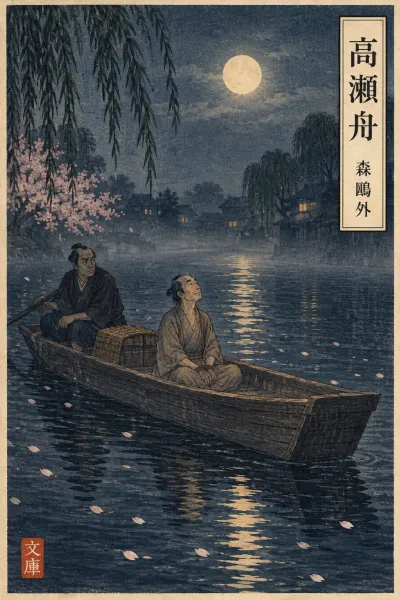
次第にふけてゆくおぼろ夜に、沈黙の人二人を載せた高瀬舟は、黒い水の面をすべって行った。Through the hazy spring night that grew ever deeper, the Takase boat, bearing its two silent passengers, glided over the black surface of the water.
Vocabulary
| Word | Meaning | JLPT |
|---|---|---|
| 視線しせん | gaze, line of sight視線を落とす: to lower one's eyes. | — |
| 条理じょうり | logic, coherence条理が立つ: to be logical, to hang together. | — |
| 町奉行所まちぶぎょうしょ | city magistrate's office (Edo period)The 奉行 (magistrate) handled trials and administration in a city. | — |
| さらってさらう | to go over, to reviewdictionary form: さらうHere, to rehearse or go back over something learned or remembered; usually written in kana in this sense. | N1 |
| 目のあたりまのあたり | right before one's eyes目 is read ま here, an old reading; also written 目の当たり. | — |
| 剃刀かみそり | razorIrregular reading of the whole word. | N2 |
| 苦く | suffering, painA literary single-kanji noun; compare 苦しさ (painfulness). | — |
| 忍びなかったしのびない | cannot bear (to do)dictionary form: 忍びないUsed as 〜に忍びない for something too painful to do or watch. | — |
| 絶ったたつ | to cut off, to enddictionary form: 絶つ命を絶つ: to take a life. Compare 断つ and 裁つ, which have the same reading. | N1 |
| 任すまかす | to leave (a matter) to someoneA variant of the more common 任せる. | N1 |
| オオトリテエおおとりてえ | authorityAn old Meiji-era rendering of the French word autorité; today it would be written オーソリティー. | — |
| ふに落ちぬふにおちる | to be convinced, to make sense (here: not quite convinced)dictionary form: 腑に落ちるUsually used in the negative: 腑に落ちない. Here it has the literary negative ぬ. | — |
| ふけてふける | (of night) to grow late, to deependictionary form: 更ける夜が更ける: the night wears on. | N2 |
| おぼろ夜おぼろよ | hazy, misty (spring) nightdictionary form: 朧夜A poetic word for a night when the moon is hazy; associated with spring. | — |
Grammar
〜過ぎる N4 too much, excessively
Attached to the verb stem 立ち, it means "to be too coherent." The narrator hints that Kisuke's story is almost suspiciously polished.
ほとんど条理が立ち過ぎていると言ってもいいくらいである。
One could almost say it hung together too well.
〜させられる (causative-passive) N3 to be made to do
みさせられた is the causative-passive of みる after a te-form. It shows that Kisuke was forced by the officials to go over his story again and again.
注意に注意を加えてさらってみさせられたのとのためである
because he had been made to go over it with the greatest possible care
〜に忍びない N1 cannot bear to
The plain form of a verb plus に忍びない expresses that something is too painful to do or witness. Here the verb phrase is 見ている.
喜助はその苦を見ているに忍びなかった。
Kisuke could not bear to watch his suffering.
〜に相違ない N2 there is no doubt that, must be
This is a formal, written equivalent of 〜に違いない. It states something with strong certainty.
殺したのは罪に相違ない。
To kill was, without doubt, a crime.
〜ほかない N2 have no choice but to
The dictionary form plus ほかない means there is no other option. Here the pattern is repeated twice to show Shōbē's resignation.
自分よりも上のものの判断に任すほかないという念
the feeling that there was nothing to do but leave it to the judgement of those above him
〜てならない N2 can't help (feeling), terribly
Attached to the te-form of a feeling word, here たくて, it shows an urge so strong it cannot be suppressed.
なんだかお奉行様に聞いてみたくてならなかった
he could not help wishing he could ask the magistrate about it