Part 4 of 6 · JLPT N2
高瀬舟 Takasebune, part 4: The Contented Prisoner and His Confession
In this part
Shōbē compares his own anxious, never-satisfied life with Kisuke's contentment. He realizes that Kisuke can stop wanting more in a way most people cannot, and is filled with awe. Without quite meaning to, he addresses Kisuke politely and asks him to explain the killing. Kisuke begins his story: he and his brother were orphans, and one day he came home to find his sick brother covered in blood, begging forgiveness for trying to die so as to ease Kisuke's burden.
AI translation · independently checked
さて桁を違えて考えてみれば、鳥目二百文をでも、喜助がそれを貯蓄と見て喜んでいるのに無理はない。Now, if one adjusts the scale of things in one's mind, it is no wonder that Kisuke should look on even two hundred copper coins as savings and be glad of them.
その心持ちはこっちから察してやることができる。From our side, we can well imagine how he feels.
しかしいかに桁を違えて考えてみても、不思議なのは喜助の欲のないこと、足ることを知っていることである。And yet, however one adjusts the scale, what remains strange is Kisuke's lack of greed, the fact that he knows what it is to have enough.
喜助は世間で仕事を見つけるのに苦しんだ。Out in the world, Kisuke had struggled to find work.
それを見つけさえすれば、骨を惜しまずに働いて、ようよう口を糊することのできるだけで満足した。As long as he found work, he worked without sparing himself, and was content if he could just barely keep himself fed.
そこで牢に入ってからは、今まで得がたかった食が、ほとんど天から授けられるように、働かずに得られるのに驚いて、生まれてから知らぬ満足を覚えたのである。So once he was in prison, he was astonished that food, always so hard to come by, could now be had without working, almost as if it were bestowed by Heaven, and he felt a contentment he had never known in all his life.
庄兵衛はいかに桁を違えて考えてみても、ここに彼と我れとの間に、大いなる懸隔のあることを知った。However Shōbē adjusted the scale, he saw that here there lay a great gulf between that man and himself.
自分の扶持米で立ててゆく暮らしは、おりおり足らぬことがあるにしても、たいてい出納が合っている。The household he kept on his stipend of rice did at times fall short, but on the whole its income and outgoings balanced.
手いっぱいの生活である。It was a life stretched to its limit.
しかるにそこに満足を覚えたことはほとんどない。Yet he had hardly ever felt contented with it.
常は幸いとも不幸とも感ぜずに過ごしている。Ordinarily he went through his days feeling neither fortunate nor unfortunate.
しかし心の奥には、こうして暮らしていて、ふいとお役が御免になったらどうしよう、大病にでもなったらどうしようという疑懼が潜んでいて、おりおり妻が里方から金を取り出して来て穴うめをしたことなどがわかると、この疑懼が意識の閾の上に頭をもたげて来るのである。But deep in his heart there lurked a dread: what would he do if, living as he did, he were suddenly dismissed from his post, or fell seriously ill? And whenever he found out that his wife had now and then brought money from her parents' home to cover a shortfall, this dread would raise its head above the threshold of consciousness.
いったいこの懸隔はどうして生じて来るだろう。Where, after all, did this gulf come from?
ただ上べだけを見て、それは喜助には身に係累がないのに、こっちにはあるからだと言ってしまえばそれまでである。If one looked only at the surface and said it was simply because Kisuke had no one depending on him while Shōbē did, there would be nothing more to say.
しかしそれはうそである。But that was not the truth.
よしや自分が一人者であったとしても、どうも喜助のような心持ちにはなられそうにない。Even if he had been a single man, it seemed he could never come to feel as Kisuke did.
この根底はもっと深いところにあるようだと、庄兵衛は思った。The root of it, Shōbē thought, seemed to lie somewhere deeper.
庄兵衛はただ漠然と、人の一生というような事を思ってみた。Shōbē let his thoughts turn, vaguely, to such things as the course of a human life.
人は身に病があると、この病がなかったらと思う。When a person is ill, he thinks, "If only I were free of this illness."
その日その日の食がないと、食ってゆかれたらと思う。When he has no food from one day to the next, he thinks, "If only I could get enough to eat."
万一の時に備えるたくわえがないと、少しでもたくわえがあったらと思う。When he has no savings put by against an emergency, he thinks, "If only I had even a little saved."
たくわえがあっても、またそのたくわえがもっと多かったらと思う。Even when he has savings, he thinks, "If only those savings were larger."
かくのごとくに先から先へと考えてみれば、人はどこまで行って踏み止まることができるものやらわからない。If one follows thoughts like these on and on, one thing after another, there is no knowing how far a person must go before he can stop.
それを今目の前で踏み止まって見せてくれるのがこの喜助だと、庄兵衛は気がついた。And here, Shōbē realized, was Kisuke, showing him, right before his eyes, how to stop.
庄兵衛は今さらのように驚異の目をみはって喜助を見た。Shōbē looked at Kisuke with eyes wide in wonder, as though seeing him for the first time.
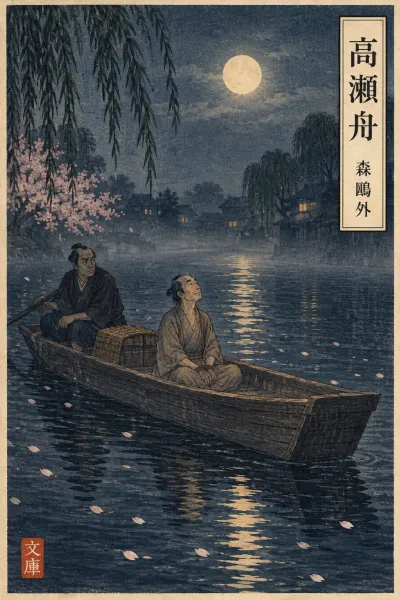
この時庄兵衛は空を仰いでいる喜助の頭から毫光がさすように思った。At that moment it seemed to Shōbē that a halo of light was shining from the head of Kisuke as he gazed up at the sky.
――――――――――――――――――――――――――――――――
庄兵衛は喜助の顔をまもりつつまた、「喜助さん」と呼びかけた。Keeping his eyes on Kisuke's face, Shōbē called to him again: "Kisuke-san."
今度は「さん」と言ったが、これは充分の意識をもって称呼を改めたわけではない。This time he had said "-san," but it was not that he had changed his form of address with any real awareness.
その声がわが口から出てわが耳に入るや否や、庄兵衛はこの称呼の不穏当なのに気がついたが、今さらすでに出たことばを取り返すこともできなかった。No sooner had the word left his mouth and reached his own ears than Shōbē realized how improper this form of address was, but it was too late now to take back what had already been said.
「はい」と答えた喜助も、「さん」と呼ばれたのを不審に思うらしく、おそるおそる庄兵衛の気色をうかがった。Kisuke, answering "Yes, sir," also seemed puzzled at being called "-san," and timidly searched Shōbē's face.
庄兵衛は少し間の悪いのをこらえて言った。Putting up with a slight awkwardness, Shōbē said:
「いろいろの事を聞くようだが、お前が今度島へやられるのは、人をあやめたからだという事だ。おれについでにそのわけを話して聞せてくれぬか。」"I seem to be asking you all sorts of things, but I hear you are being sent to the island because you killed a man. While we're at it, won't you tell me how it happened?"
喜助はひどく恐れ入った様子で、「かしこまりました」と言って、小声で話し出した。Looking deeply abashed, Kisuke said, "Certainly, sir," and began to speak in a low voice.
「どうも飛んだ心得違いで、恐ろしい事をいたしまして、なんとも申し上げようがございませぬ。"It was a terrible error of judgement, sir. I did a dreadful thing, and I have no words to answer for it.
あとで思ってみますと、どうしてあんな事ができたかと、自分ながら不思議でなりませぬ。When I think back on it afterwards, I cannot stop wondering, though it was I who did it, how I could ever have done such a thing.
全く夢中でいたしましたのでございます。わたくしは小さい時に二親が時疫でなくなりまして、弟と二人あとに残りました。I did it in a complete daze, sir. When I was small, both my parents died in an epidemic, and my younger brother and I were left behind, just the two of us.
初めはちょうど軒下に生まれた犬の子にふびんを掛けるように町内の人たちがお恵みくださいますので、近所じゅうの走り使いなどをいたして、飢え凍えもせずに、育ちました。At first the people of our neighbourhood took pity on us, the way one might on puppies born under the eaves, and gave us charity, so by running errands for everyone round about we grew up without going hungry or cold.
次第に大きくなりまして職を捜しますにも、なるたけ二人が離れないようにいたして、いっしょにいて、助け合って働きました。As we gradually grew older and looked for work, we did all we could not to be separated; we stayed together and helped each other as we worked.
去年の秋の事でございます。わたくしは弟といっしょに、西陣の織場にはいりまして、空引きということをいたすことになりました。It was last autumn, sir. My brother and I went together into a weaving shop in Nishijin and were taken on as drawboys at the looms.
そのうち弟が病気で働けなくなったのでございます。そのころわたくしどもは北山の掘立小屋同様の所に寝起きをいたして、紙屋川の橋を渡って織場へ通っておりましたが、わたくしが暮れてから、食べ物などを買って帰ると、弟は待ち受けていて、わたくしを一人でかせがせてはすまないすまないと申しておりました。Before long my brother fell ill and could no longer work. In those days we slept in a place no better than a hut up in Kitayama and went across the bridge over the Kamiya River to the weaving shop. When I came home after dark with food I had bought, my brother would be waiting for me and would keep saying, 'I'm sorry, I'm sorry, leaving you to earn for us both.'
ある日いつものように何心なく帰って見ますと、弟はふとんの上に突っ伏していまして、周囲は血だらけなのでございます。One day I came home as usual, thinking nothing of it, and found my brother lying face down on his bedding, with blood everywhere around him.
わたくしはびっくりいたして、手に持っていた竹の皮包みや何かを、そこへおっぽり出して、そばへ行って『どうしたどうした』と申しました。I was so startled that I flung down the bamboo-sheath parcel and whatever else I was holding, went to his side and said, 'What is it? What's the matter?'
すると弟はまっ青な顔の、両方の頬からあごへかけて血に染まったのをあげて、わたくしを見ましたが、物を言うことができませぬ。Then my brother raised his face, deathly pale and stained with blood from both cheeks down to the chin, and looked at me, but he could not speak.
息をいたすたびに、傷口でひゅうひゅうという音がいたすだけでございます。わたくしにはどうも様子がわかりませんので、『どうしたのだい、血を吐いたのかい』と言って、そばへ寄ろうといたすと、弟は右の手を床に突いて、少しからだを起こしました。Each time he breathed, there was only a whistling sound from the wound. I couldn't make out what had happened, so I said, 'What's wrong? Have you been coughing up blood?' and started to go to him, but my brother propped his right hand on the bedding and raised himself a little.
左の手はしっかりあごの下の所を押えていますが、その指の間から黒血の固まりがはみ出しています。His left hand was pressed hard against the place under his jaw, but clots of dark blood were oozing out between his fingers.
弟は目でわたくしのそばへ寄るのを留めるようにして口をききました。ようよう物が言えるようになったのでございます。With his eyes he stopped me from coming nearer, and he spoke. He had at last managed to get words out.
『すまない。どうぞ堪忍してくれ。どうせなおりそうにもない病気だから、早く死んで少しでも兄きにらくがさせたいと思ったのだ。'I'm sorry. Please forgive me. It's an illness that won't ever get better anyway, so I thought I'd die quickly and make things even a little easier for you, brother.
Vocabulary
| Word | Meaning | JLPT |
|---|---|---|
| 桁を違えてけたをちがえる | to think on a different scale; to view amounts in a different order of magnitude (here, scaled to Kisuke's circumstances)dictionary form: 桁を違える桁 is a digit place; literally 'to move the decimal point', i.e. to put Kisuke's tiny sums on the same footing as one's own. | — |
| 貯蓄ちょちく | savingsA formal word; たくわえ (used later) is the native equivalent. | N1 |
| 口を糊するくちをのりする | to scrape a bare livingLiterary idiom: to put just enough thin rice paste (糊) in one's mouth to survive. | — |
| 懸隔けんかく | gulf, wide gapLiterary; a key word in this passage for the difference between Shōbē and Kisuke. | — |
| 扶持米ふちまい | rice stipend paid to a retainerEdo-period samurai and officials were paid in rice rather than money. | — |
| 出納すいとう | income and expenditureNote the irregular reading すいとう, not しゅつのう. | — |
| 疑懼ぎく | dread, anxious fearRare literary compound of 疑 'doubt' and 懼 'fear'. | — |
| 係累けいるい | dependants; family ties that burden one | — |
| 踏み止まるふみとどまる | to stop (and go no further); to hold back at a certain pointHere: to stop wanting more. | — |
| 毫光ごうこう | halo; rays of light from a Buddha's browA Buddhist term, suggesting that Kisuke seems saintly to Shōbē. | — |
| 称呼しょうこ | form of address-san is a polite suffix added to names. A constable would not normally use it for a prisoner, which is why the word seems improper. | — |
| 恐れ入ったおそれいる | to be overawed, humbled, abasheddictionary form: 恐れ入るAlso a set phrase for 'thank you / I'm sorry' in polite speech. | N1 |
| 心得違いこころえちがい | error of judgement; wrongdoing | — |
| ふびんふびん | pity, compassiondictionary form: 不憫ふびんを掛ける: to take pity on someone. | N1 |
Grammar
〜さえ〜ば N3 if only…; as long as…
さえ attached to a verb stem plus すれば marks the single condition that is enough. Here, finding work was all Kisuke needed in order to be satisfied.
それを見つけさえすれば、骨を惜しまずに働いて
Whenever he did find it, he worked without sparing himself
〜たら(と思う) N4 if only…
A たら clause followed by と思う, with the main clause left out, expresses a wish. The unstated ending is something like いいのに ('it would be good').
この病がなかったらと思う。
he thinks, "If only I were free of this illness."
〜や否や N1 no sooner… than; the moment…
Attached to a dictionary-form verb, や否や means the second event follows immediately on the first. Here Shōbē notices his slip the instant he hears himself say it.
その声がわが口から出てわが耳に入るや否や、庄兵衛はこの称呼の不穏当なのに気がついた
No sooner had the word left his mouth and reached his own ears than Shōbē realized how improper this form of address was
〜てならない N2 cannot help feeling…; extremely…
〜てならない / 〜でならない: cannot help feeling …. Attached to the て-form of a feeling verb or i-adjective (for na-adjectives, 〜でならない), it shows a feeling too strong to hold back. Here 不思議でなりませぬ uses the old polite negative ませぬ.
自分ながら不思議でなりませぬ。
though it was I who did it, I cannot stop wondering.
〜にしても N2 even if…; granted that…
This concedes one point before stating the main point. The household sometimes falls short, but it still mostly balances.
おりおり足らぬことがあるにしても、たいてい出納が合っている。
it did at times fall short, but on the whole its income and outgoings balanced.
〜ぬ (classical negative) N1 not (= ない)
ぬ is the literary negative (= ない), attached to the 未然形 of a verb (note する → せぬ). In the narration it is plain (知らぬ, 足らぬ); in Kisuke's speech, ませぬ is the polite negative (= ません).
生まれてから知らぬ満足を覚えたのである。
he felt a contentment he had never known in all his life.