Part 2 of 6 · JLPT N2
高瀬舟 Takasebune, part 2: A Prisoner Who Seems Content
In this part
On the night boat, Shōbē cannot understand why Kisuke, a man convicted of killing his brother, looks so calm and almost cheerful. At last Shōbē asks him how he feels about exile. Kisuke politely explains that his life in Kyōto was so hard that being sent to the island, with a place he is allowed to stay and two hundred mon from the authorities, feels like a blessing.
AI translation · independently checked
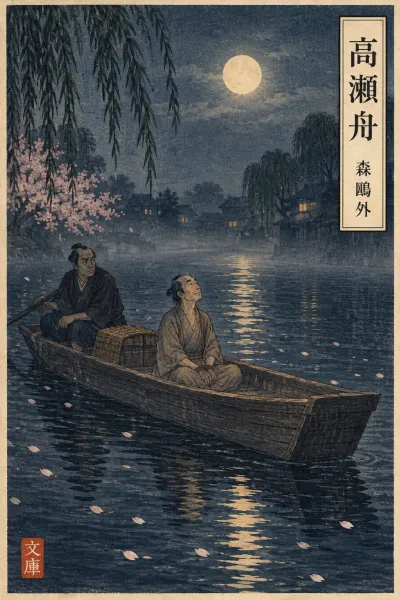
夜舟で寝ることは、罪人にも許されているのに、喜助は横になろうともせず、雲の濃淡に従って、光の増したり減じたりする月を仰いで、黙っている。Prisoners were allowed to sleep on the night boat, yet Kisuke made no attempt to lie down; he kept silent, gazing up at the moon, whose light grew stronger and weaker as the clouds thickened and thinned.
その額は晴れやかで目にはかすかなかがやきがある。His brow was untroubled, and there was a faint gleam in his eyes.
庄兵衛はまともには見ていぬが、始終喜助の顔から目を離さずにいる。Shōbē did not look at him directly, but he never once took his eyes off Kisuke's face.
そして不思議だ、不思議だと、心の内で繰り返している。And in his heart he kept repeating: how strange, how strange.
それは喜助の顔が縦から見ても、横から見ても、いかにも楽しそうで、もし役人に対する気がねがなかったなら、口笛を吹きはじめるとか、鼻歌を歌い出すとかしそうに思われたからである。For however one looked at Kisuke's face, from every angle he seemed truly cheerful. Had he not felt some restraint before the officer, he looked as if he might start whistling or begin humming a tune.
庄兵衛は心の内に思った。Shōbē thought to himself.
これまでこの高瀬舟の宰領をしたことは幾たびだか知れない。He could not count how many times he had been in charge of this Takase boat.
しかし載せてゆく罪人は、いつもほとんど同じように、目も当てられぬ気の毒な様子をしていた。But the prisoners it carried had almost always looked the same: so wretched it was painful to look at them.
それにこの男はどうしたのだろう。So what was the matter with this man?
遊山船にでも乗ったような顔をしている。He had the look of someone aboard a pleasure boat.
罪は弟を殺したのだそうだが、よしやその弟が悪いやつで、それをどんなゆきがかりになって殺したにせよ、人の情としていい心持ちはせぬはずである。His crime, it was said, was killing his younger brother. Yet even if that brother had been a scoundrel, and however things had led to the killing, no one with ordinary human feeling could be at ease about it.
この色の青いやせ男が、その人の情というものが全く欠けているほどの、世にもまれな悪人であろうか。Could this pale, thin man be a villain so rare in this world that he lacked all such human feeling?
どうもそうは思われない。Somehow he could not bring himself to think so.
ひょっと気でも狂っているのではあるまいか。Might he perhaps have lost his mind?
いやいや。No, no.
それにしては何一つつじつまの合わぬことばや挙動がない。If that were the case, there would be something incoherent in his words or his behaviour, but there was nothing of the kind.
この男はどうしたのだろう。What was the matter with this man?
庄兵衛がためには喜助の態度が考えれば考えるほどわからなくなるのである。For Shōbē, the more he thought about Kisuke's manner, the less he understood it.
――――――――――――――――――――――――――――――――
しばらくして、庄兵衛はこらえ切れなくなって呼びかけた。After a while, Shōbē could hold back no longer and called out to him.
「喜助。お前何を思っているのか。」"Kisuke. What are you thinking about?"
「はい」と言ってあたりを見回した喜助は、何事をかお役人に見とがめられたのではないかと気づかうらしく、居ずまいを直して庄兵衛の気色を伺った。"Yes, sir," said Kisuke, and he glanced about him. Apparently anxious that the officer had found fault with something, he straightened himself and studied Shōbē's face.
庄兵衛は自分が突然問いを発した動機を明かして、役目を離れた応対を求める言いわけをしなくてはならぬように感じた。Shōbē felt he had to explain what had prompted his sudden question, and to excuse himself for seeking a conversation that went beyond his duties.
そこでこう言った。So he said:
「いや。別にわけがあって聞いたのではない。実はな、おれはさっきからお前の島へゆく心持ちが聞いてみたかったのだ。"No, I didn't ask for any particular reason. The truth is, I've been wanting for some time to hear how you feel about going to the island.
おれはこれまでこの舟でおおぜいの人を島へ送った。それはずいぶんいろいろな身の上の人だったが、どれもどれも島へゆくのを悲しがって、見送りに来て、いっしょに舟に乗る親類のものと、夜どおし泣くにきまっていた。I've taken a great many people to the island on this boat before now. They came from all sorts of circumstances, but every one of them grieved at going, and they always wept the whole night through with the relatives who came to see them off and rode in the boat with them.
それにお前の様子を見れば、どうも島へゆくのを苦にしてはいないようだ。いったいお前はどう思っているのだい。」But looking at you, you don't seem troubled at all about going to the island. Tell me, what are you thinking?"
喜助はにっこり笑った。Kisuke smiled warmly.
「御親切におっしゃってくだすって、ありがとうございます。なるほど島へゆくということは、ほかの人には悲しい事でございましょう。"It is most kind of you to ask, sir, and I thank you. Indeed, being sent to an island must be a sad thing for other people.
その心持ちはわたくしにも思いやってみることができます。しかしそれは世間でらくをしていた人だからでございます。I can imagine that feeling myself. But that is because they are people who lived in comfort out in the world.
京都は結構な土地ではございますが、その結構な土地で、これまでわたくしのいたして参ったような苦しみは、どこへ参ってもなかろうと存じます。Kyōto is a fine place, but I do not believe one could go anywhere and find hardship like that I have known until now in this fine place.
お上のお慈悲で、命を助けて島へやってくださいます。島はよしやつらい所でも、鬼のすむ所ではございますまい。By the mercy of the authorities, my life has been spared and I am being sent to the island. However hard the island may be, surely it is not a place where demons live.
わたくしはこれまで、どこといって自分のいていい所というものがございませんでした。Until now I have never had anywhere I could call a place where I was allowed to be.
こん度お上で島にいろとおっしゃってくださいます。そのいろとおっしゃる所に落ち着いていることができますのが、まず何よりもありがたい事でございます。This time the authorities have been good enough to tell me to stay on the island. To be able to settle down in the place where I am told to stay is, above all else, something I am thankful for.
それにわたくしはこんなにかよわいからだではございますが、ついぞ病気をいたしたことはございませんから、島へ行ってから、どんなつらい仕事をしたって、からだを痛めるようなことはあるまいと存じます。Besides, frail as I am, I have never once been ill, so I do not think that I shall harm my body, however hard the work I do once I reach the island.
それからこん度島へおやりくださるにつきまして、二百文の鳥目をいただきました。それをここに持っております。And then, on being sent to the island this time, I was given two hundred mon in coin. I have it here with me."
」こう言いかけて、喜助は胸に手を当てた。As he said this, Kisuke laid his hand on his chest.
遠島を仰せつけられるものには、鳥目二百銅をつかわすというのは、当時の掟であった。It was the law in those days that anyone sentenced to exile on an island was to be given two hundred copper coins.
Vocabulary
| Word | Meaning | JLPT |
|---|---|---|
| 罪人ざいにん | criminal, convictFormal word. In religious contexts it is also read つみびと. | — |
| 仰いであおぐ | to look up atdictionary form: 仰ぐAlso means 'to look up to' or 'to respect'. The same kanji appears in 仰せ, 'a command from a superior'. | N1 |
| 晴れやかはれやか | clear, cheerful, untroubledA な-adjective from 晴れる, 'to clear up'; used for a bright face or mood. | — |
| 宰領さいりょう | being in charge of (an escort or transport)Old-fashioned word. Here it means escorting the prisoner on the boat. | — |
| 目も当てられぬめもあてられない | too pitiful to look atdictionary form: 目も当てられないFixed expression; ぬ is the literary form of ない. | — |
| 遊山船ゆさんぶね | pleasure boat遊山 means an outing for pleasure; 船 is voiced to ぶね in compounds (rendaku). | — |
| ゆきがかりゆきがかり | the way things happen to turn out; circumstancesdictionary form: 行きがかりAlso いきがかり. It suggests events taking their own course. | — |
| つじつまつじつま | coherence, consistencydictionary form: 辻褄Usually used as つじつまが合う, 'to make sense, add up'. | N1 |
| 居ずまいを直していずまいをなおす | to straighten one's posture (when seated)dictionary form: 居住まいを直すA polite gesture before a superior. | — |
| 気色けしき | a person's mood as shown on the faceThe phrase 気色を伺う means 'to read someone's mood'. Pronounced the same as 景色, 'scenery'. | — |
| 苦にしてくにする | to be troubled by, to worry aboutdictionary form: 苦にするUsually appears in the negative: 苦にしない, 'not to mind'. | — |
| お上おかみ | the authorities, the governmentA respectful old term for those in power. | — |
| 鳥目ちょうもく | coins, moneyOld word for money. Coins with a square hole were said to look like a bird's eye. 文 (mon) was a small coin unit of the Edo period. | — |
| 遠島えんとう | exile to a distant islandAn Edo-period punishment; 島 in the dialogue refers to this. | — |
Grammar
〜(よ)うともせず N2 without even trying to ~
The volitional form plus ともしない means someone makes no attempt at all. せず is the literary form of しないで.
喜助は横になろうともせず
Kisuke made no attempt to lie down
よしや〜にせよ N2 even if ~, whatever ~
にせよ means 'even if' or 'whatever the case'. よしや is an old word for 'even supposing'. Together they grant a point but deny that it changes the result.
よしやその弟が悪いやつで、それをどんなゆきがかりになって殺したにせよ
even if that brother had been a scoundrel, and however things had led to the killing
〜のではあるまいか N2 could it be that ~? / perhaps ~
まい is a literary negative of guess or intention. ではあるまいか expresses a hesitant suspicion, like ではないだろうか.
ひょっと気でも狂っているのではあるまいか。
Might he perhaps have lost his mind?
〜ば〜ほど N3 the more ~, the more ~
The same verb is repeated in the ば-form and the dictionary form plus ほど. As one thing increases, so does the other.
喜助の態度が考えれば考えるほどわからなくなるのである
the more he thought about Kisuke's manner, the less he understood it
〜にきまっていた N3 always / without fail ~
にきまっている usually means 'is certain to'. In the past tense it describes something that happened every time.
夜どおし泣くにきまっていた
they always wept the whole night through
〜ではございますまい N1 surely it is not ~
This is the humble ございます combined with negative まい, a very polite guess. It is the courteous form of ではないだろう.
鬼のすむ所ではございますまい
surely it is not a place where demons live