Part 1 of 6 · JLPT N2
高瀬舟 Takasebune, part 1: An Unusual Prisoner on the Takase Boat
In this part
The narrator explains the Takase boat, which took Kyōto criminals sentenced to exile down to Ōsaka. Their relatives could ride with them, and the escorting constables often heard their sad stories. One spring evening, the constable Haneda Shōbē escorts Kisuke, a man with no relatives who has killed his younger brother, and is puzzled by his calm and humble manner.
AI translation · independently checked
高瀬舟は京都の高瀬川を上下する小舟である。The Takase boat is a small boat that travels up and down the Takase River in Kyōto.
徳川時代に京都の罪人が遠島を申し渡されると、本人の親類が牢屋敷へ呼び出されて、そこで暇乞いをすることを許された。In the Tokugawa period, when a criminal in Kyōto was sentenced to exile on a distant island, his relatives were summoned to the prison compound and allowed to take their leave of him there.
それから罪人は高瀬舟に載せられて、大阪へ回されることであった。After that, the criminal would be put aboard a Takase boat and sent on to Ōsaka.
それを護送するのは、京都町奉行の配下にいる同心で、この同心は罪人の親類の中で、おも立った一人を大阪まで同船させることを許す慣例であった。His escort was a constable serving under the Kyōto town magistrate. By custom, this constable allowed one of the chief relatives to travel with the criminal on the boat as far as Ōsaka.
これは上へ通った事ではないが、いわゆる大目に見るのであった、黙許であった。This was not something sanctioned by those above. It was what is called turning a blind eye: a tacit permission.
当時遠島を申し渡された罪人は、もちろん重い科を犯したものと認められた人ではあるが、決して盗みをするために、人を殺し火を放ったというような、獰悪な人物が多数を占めていたわけではない。The criminals sentenced to exile at that time had, of course, been judged guilty of grave offences. Even so, it was by no means the case that most of them were brutal men who had killed or set fires in order to steal.
高瀬舟に乗る罪人の過半は、いわゆる心得違いのために、思わぬ科を犯した人であった。More than half of the criminals who rode the Takase boat were people who had committed an offence they never intended, through what one might call an error of judgement.
有りふれた例をあげてみれば、当時相対死と言った情死をはかって、相手の女を殺して、自分だけ生き残った男というような類である。To give a common example, there was the sort of man who attempted a lovers' suicide, which in those days was called "dying together," killed the woman, and alone survived.
そういう罪人を載せて、入相の鐘の鳴るころにこぎ出された高瀬舟は、黒ずんだ京都の町の家々を両岸に見つつ、東へ走って、加茂川を横ぎって下るのであった。Carrying such criminals, the Takase boat was rowed out at about the time the evening bell rang. With the darkened houses of Kyōto's streets on both banks, it ran east, crossed the Kamo River and went on downstream.
この舟の中で、罪人とその親類の者とは夜どおし身の上を語り合う。Inside this boat, the criminal and his relative would talk all night long about their lot in life.
いつもいつも悔やんでも返らぬ繰り言である。It was always the same useless lament, regret that could undo nothing.
護送の役をする同心は、そばでそれを聞いて、罪人を出した親戚眷族の悲惨な境遇を細かに知ることができた。The constable who served as escort listened close by, and so he could learn in detail the wretched circumstances of the family that had produced the criminal.
所詮町奉行の白州で、表向きの口供を聞いたり、役所の机の上で、口書を読んだりする役人の夢にもうかがうことのできぬ境遇である。These were circumstances that officials could never glimpse, not even in their dreams. Such officials heard only formal testimony at the magistrate's white-sand court, or read written statements at their office desks.
同心を勤める人にも、いろいろの性質があるから、この時ただうるさいと思って、耳をおおいたく思う冷淡な同心があるかと思えば、またしみじみと人の哀れを身に引き受けて、役がらゆえ気色には見せぬながら、無言のうちにひそかに胸を痛める同心もあった。Those who served as constables had all sorts of natures. There were cold-hearted ones who simply found it tiresome at such times and wished to cover their ears. There were also others who took people's sorrow deeply to heart. Their position kept them from showing it on their faces, but in silence they secretly ached inside.
場合によって非常に悲惨な境遇に陥った罪人とその親類とを、特に心弱い、涙もろい同心が宰領してゆくことになると、その同心は不覚の涙を禁じ得ぬのであった。Sometimes a criminal and his relative who had fallen into truly pitiful circumstances were placed in the charge of a constable who was especially soft-hearted and easily moved. That constable could not hold back the tears that rose in spite of himself.
そこで高瀬舟の護送は、町奉行所の同心仲間で不快な職務としてきらわれていた。For this reason, escorting the Takase boat was disliked among the constables of the town magistrate's office as an unpleasant duty.
――――――――――――――――――――――――――――――――
いつのころであったか。When was it?
たぶん江戸で白河楽翁侯が政柄を執っていた寛政のころででもあっただろう。Perhaps it was in the Kansei era, when Lord Shirakawa Rakuō held the reins of government in Edo.
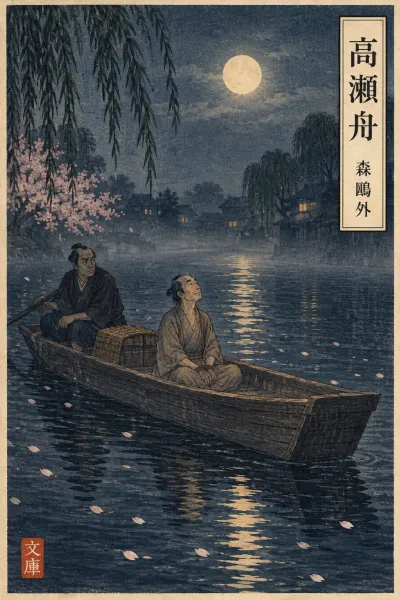
智恩院の桜が入相の鐘に散る春の夕べに、これまで類のない、珍しい罪人が高瀬舟に載せられた。On a spring evening, when the cherry blossoms of Chion-in were falling at the sound of the evening bell, a strange criminal unlike any before him was put aboard a Takase boat.
それは名を喜助と言って、三十歳ばかりになる、住所不定の男である。He was a man named Kisuke, about thirty years old, with no fixed home.
もとより牢屋敷に呼び出されるような親類はないので、舟にもただ一人で乗った。Naturally he had no relatives to be summoned to the prison compound, so he boarded the boat entirely alone.
護送を命ぜられて、いっしょに舟に乗り込んだ同心羽田庄兵衛は、ただ喜助が弟殺しの罪人だということだけを聞いていた。The constable Haneda Shōbē had been ordered to escort him and had boarded the boat with him. All he had been told was that Kisuke had killed his younger brother.
さて牢屋敷から棧橋まで連れて来る間、この痩肉の、色の青白い喜助の様子を見るに、いかにも神妙に、いかにもおとなしく、自分をば公儀の役人として敬って、何事につけても逆らわぬようにしている。Shōbē watched this thin, pale Kisuke on the way from the prison compound to the landing stage. Kisuke behaved most meekly and most quietly, respected Shōbē as an officer of the shogunate, and took care not to defy him in anything.
しかもそれが、罪人の間に往々見受けるような、温順を装って権勢に媚びる態度ではない。Moreover, it was not the manner often seen among criminals, who feign docility to curry favour with those in power.
庄兵衛は不思議に思った。Shōbē found this strange.
そして舟に乗ってからも、単に役目の表で見張っているばかりでなく、絶えず喜助の挙動に、細かい注意をしていた。And even after they had boarded the boat, he did not merely keep the watch his duty outwardly required. He paid close and constant attention to Kisuke's every movement.
その日は暮れ方から風がやんで、空一面をおおった薄い雲が、月の輪郭をかすませ、ようよう近寄って来る夏の温かさが、両岸の土からも、川床の土からも、もやになって立ちのぼるかと思われる夜であった。That day the wind had dropped at dusk, and a thin layer of cloud covering the whole sky blurred the outline of the moon. It was a night when the warmth of the slowly approaching summer seemed to rise as mist from the soil of both banks and from the riverbed.
下京の町を離れて、加茂川を横ぎったころからは、あたりがひっそりとして、ただ舳にさかれる水のささやきを聞くのみである。Once they had left the streets of Shimogyō behind and crossed the Kamo River, all around grew hushed. Nothing could be heard but the whisper of the water parted by the bow.
Vocabulary
| Word | Meaning | JLPT |
|---|---|---|
| 遠島えんとう | exile to a distant island (an Edo-period punishment)Literally 'far island'. Here it is used with 申し渡す, 'to sentence'. | — |
| 暇乞いいとまごい | taking one's leave; saying farewellOld-fashioned word. 暇 (いとま) means 'leave' or 'free time', and 乞う means 'to ask for'. | — |
| 同心どうしん | constable; a low-ranking Edo-period police officerConstables served under the town magistrate (町奉行). | — |
| 護送ごそう | escorting a prisoner under guardStill used today, e.g. 護送車 'prison van'. | — |
| 大目に見るおおめにみる | to overlook; to turn a blind eyeA common idiom for letting a small fault pass. | — |
| 科とが | offence; crime; faultOld-fashioned. In modern Japanese this kanji is usually read か, as in 科学. | N1 |
| 心得違いこころえちがい | error of judgement; misguided actFrom 心得 'understanding' and 違い 'mistake'. | — |
| 相対死あいたいじに | lovers' double suicide (Edo legal term)The official term for 心中 or 情死. A surviving partner was punished. | — |
| 入相いりあい | sunset; dusk入相の鐘 is the temple bell rung at dusk. | — |
| 繰り言くりごと | the same complaint repeated over and over; lamentFrom 繰る 'to reel in, repeat'. | — |
| 白州しらす | the white-sand court of a magistrate, where suspects were triedNamed after the white gravel on which the accused sat. | — |
| 涙もろいなみだもろい | easily moved to tearsもろい means 'fragile'. | — |
| 神妙しんびょう | meek; docile; well-behavedOften said of someone accepting punishment quietly. Usually read しんみょう today. | — |
| 媚びるこびる | to flatter; to curry favourHas a negative nuance of fawning. | — |
Grammar
〜わけではない N3 it is not the case that…
This pattern denies a conclusion the reader might naturally draw. With 決して it becomes emphatic: 'by no means'.
決して盗みをするために、人を殺し火を放ったというような、獰悪な人物が多数を占めていたわけではない。
It was by no means the case that most of them were brutal men who had killed or set fires in order to steal.
〜つつ N2 while doing…
Attached to the verb stem, つつ marks an action happening at the same time as the main one. It is a written, literary equivalent of 〜ながら.
黒ずんだ京都の町の家々を両岸に見つつ、東へ走って
with the darkened houses of Kyōto's streets on both banks, it ran east
〜かと思えば、また〜もある N2 there are some who…, and then again there are others who…
This pattern contrasts two opposite kinds of people or things side by side. Here it sets cold-hearted constables against compassionate ones.
耳をおおいたく思う冷淡な同心があるかと思えば、またしみじみと人の哀れを身に引き受けて
there were cold-hearted ones who wished to cover their ears, and also others who took people's sorrow deeply to heart
〜を禁じ得ない (禁じ得ぬ) N1 cannot help feeling…; cannot hold back…
This formal expression says that an emotion cannot be suppressed. 得ぬ uses the classical negative ぬ in place of modern ない.
その同心は不覚の涙を禁じ得ぬのであった。
That constable could not hold back the tears that rose in spite of himself.
〜ばかりでなく N2 not only…, but also…
The first clause states something expected, and the second adds something more. Here it is reinforced by 単に 'merely'.
単に役目の表で見張っているばかりでなく、絶えず喜助の挙動に、細かい注意をしていた。
He did not merely keep the watch his duty outwardly required; he paid close and constant attention to Kisuke's every movement.