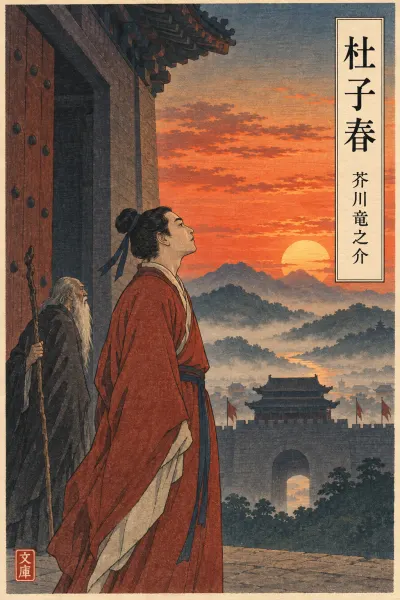
Part 3 of 7 · JLPT N2
杜子春(三) Toshishun, part 3: The Hermit Takes a Pupil
In this part
The one-eyed old man meets Toshishun at the west gate a third time. This time Toshishun refuses more gold, saying that people care only for money and he has lost faith in them, and he begs to become the hermit's pupil. The old man says he is Tekkanshi, a hermit of Mount Gabi, and agrees; the two ride off through the sky on a bamboo staff while the hermit sings.
AI translation · independently checked
「お前は何を考えているのだ」"What are you thinking about?"
片目眇の老人は、三度杜子春の前へ来て、同じことを問いかけました。The one-eyed old man came before Toshishun for the third time and put the same question to him.
勿論彼はその時も、洛陽の西の門の下に、ほそぼそと霞を破っている三日月の光を眺めながら、ぼんやり佇んでいたのです。Of course, this time too Toshishun was standing absent-mindedly beneath the west gate of Rakuyō, gazing at the light of the crescent moon as it broke faintly through the mist.
「私ですか。私は今夜寝る所もないので、どうしようかと思っているのです」"Me? I have nowhere to sleep tonight, and I am wondering what to do."
「そうか。それは可哀そうだな。ではおれが好いことを教えてやろう。今この夕日の中へ立って、お前の影が地に映ったら、その腹に当る所を、夜中に掘って見るが好い。きっと車に一ぱいの――」"I see. That's a pity. Well then, I'll tell you something good. Go and stand in this evening sun, and when your shadow falls on the ground, dig in the middle of the night at the spot where its belly lies. You're sure to find a whole cartload of—"
老人がここまで言いかけると、杜子春は急に手を挙げて、その言葉を遮りました。As soon as the old man had got this far, Toshishun suddenly raised his hand and cut him off.
「いや、お金はもういらないのです」"No, I don't want any more money."
「金はもういらない? ははあ、では贅沢をするにはとうとう飽きてしまったと見えるな」"You don't want any more money? Aha, so it seems you've finally grown tired of living in luxury."
老人は審しそうな眼つきをしながら、じっと杜子春の顔を見つめました。The old man gave him a puzzled look and stared hard into Toshishun's face.
「何、贅沢に飽きたのじゃありません。人間というものに愛想がつきたのです」"Oh no, it isn't that I'm tired of luxury. I've lost all patience with human beings."
杜子春は不平そうな顔をしながら、突慳貪にこう言いました。Toshishun said this curtly, with a sullen look on his face.
「それは面白いな。どうして又人間に愛想が尽きたのだ?」"Now that's interesting. And why have you lost patience with human beings?"
「人間は皆薄情です。私が大金持になった時には、世辞も追従もしますけれど、一旦貧乏になって御覧なさい。柔しい顔さえもして見せはしません。そんなことを考えると、たといもう一度大金持になったところが、何にもならないような気がするのです」"People are all heartless. When I became very rich, they flattered me and fawned on me, but just try becoming poor once. They won't even show you a kind face. When I think about that, I feel that even if I became very rich again, it would come to nothing."
老人は杜子春の言葉を聞くと、急ににやにや笑い出しました。When the old man heard Toshishun's words, he suddenly began to grin.
「そうか。いや、お前は若い者に似合わず、感心に物のわかる男だ。ではこれからは貧乏をしても、安らかに暮して行くつもりか」"I see. Well, for a young fellow, you are a man of admirable good sense. So from now on, even if you're poor, you mean to live quietly and contentedly?"
杜子春はちょいとためらいました。Toshishun hesitated a little.
が、すぐに思い切った眼を挙げると、訴えるように老人の顔を見ながら、But he soon raised his eyes with resolve, and looking pleadingly into the old man's face, he said:
「それも今の私には出来ません。ですから私はあなたの弟子になって、仙術の修業をしたいと思うのです。いいえ、隠してはいけません。あなたは道徳の高い仙人でしょう。仙人でなければ、一夜の内に私を天下第一の大金持にすることは出来ない筈です。どうか私の先生になって、不思議な仙術を教えて下さい」"I can't do that either, not as I am now. So I want to become your pupil and train in the arts of the hermits. No, you mustn't hide it. You are a hermit of great virtue, aren't you? If you weren't a hermit, you could never have made me the richest man in the land in a single night. Please, be my teacher and teach me your wondrous hermit arts."
老人は眉をひそめたまま、暫くは黙って、何事か考えているようでしたが、やがて又にっこり笑いながら、The old man, still frowning, stayed silent for a while and seemed to be thinking something over; but presently he smiled again and said,
「いかにもおれは峨眉山に棲んでいる、鉄冠子という仙人だ。始めお前の顔を見た時、どこか物わかりが好さそうだったから、二度まで大金持にしてやったのだが、それ程仙人になりたければ、おれの弟子にとり立ててやろう」と、快く願を容れてくれました。"You're quite right: I am a hermit called Tekkanshi, and I live on Mount Gabi. When I first saw your face, you seemed to have some good sense about you, so I made you a rich man twice over. But if you want so badly to become a hermit, I'll take you on as my pupil." And so he gladly granted Toshishun's wish.
杜子春は喜んだの、喜ばないのではありません。Toshishun was overjoyed beyond words.
老人の言葉がまだ終らない内に、彼は大地に額をつけて、何度も鉄冠子に御時宜をしました。Before the old man had even finished speaking, Toshishun pressed his forehead to the ground and bowed to Tekkanshi again and again.
「いや、そう御礼などは言って貰うまい。いくらおれの弟子にしたところが、立派な仙人になれるかなれないかは、お前次第で決まることだからな。――が、ともかくもまずおれと一しょに、峨眉山の奥へ来て見るが好い。おお、幸、ここに竹杖が一本落ちている。では早速これへ乗って、一飛びに空を渡るとしよう」"Now, now, I won't have you thanking me like that. Even if I make you my pupil, whether you can become a fine hermit or not is something that depends on you alone. —But in any case, first come with me deep into Mount Gabi and see. Ah, how lucky—here's a bamboo staff lying on the ground. Well then, let's ride on it at once and cross the sky in a single flight."
鉄冠子はそこにあった青竹を一本拾い上げると、口の中に咒文を唱えながら、杜子春と一しょにその竹へ、馬にでも乗るように跨りました。Tekkanshi picked up a green bamboo stick that was lying there, and, muttering a spell under his breath, he climbed astride it together with Toshishun, just as if they were mounting a horse.
すると不思議ではありませんか。And then—wasn't it a marvel?
竹杖は忽ち竜のように、勢よく大空へ舞い上って、晴れ渡った春の夕空を峨眉山の方角へ飛んで行きました。All at once the bamboo staff soared powerfully up into the sky like a dragon and flew off through the clear spring evening sky towards Mount Gabi.
杜子春は胆をつぶしながら、恐る恐る下を見下しました。Toshishun, frightened out of his wits, looked down very timidly.
が、下には唯青い山々が夕明りの底に見えるばかりで、あの洛陽の都の西の門は、(とうに霞に紛れたのでしょう)どこを探しても見当りません。But below him he could see only green mountains in the depths of the evening twilight; the west gate of the capital, Rakuyō, was nowhere to be found however hard he searched (it must long since have vanished into the mist).
その内に鉄冠子は、白い鬢の毛を風に吹かせて、高らかに歌を唱い出しました。Meanwhile, with the white hair at his temples streaming in the wind, Tekkanshi began to sing a song in a loud, clear voice.
朝に北海に遊び、暮には蒼梧。At dawn I wander by Hokkai, and at dusk I am in Sōgo.
袖裏の青蛇、胆気粗なり。A green snake in my sleeve, my spirit bold and free.
三たび岳陽に入れども、人識らず。Three times I have entered Gakuyō, yet no one knew me.
朗吟して、飛過す洞庭湖。Chanting aloud, I fly across Lake Dōtei.
Vocabulary
| Word | Meaning | JLPT |
|---|---|---|
| 佇んでたたずむ | to stand still, to lingerdictionary form: 佇むLiterary; suggests standing idle or lost in thought. | — |
| 遮りましたさえぎる | to interrupt, to cut off (speech); to blockdictionary form: 遮る | N1 |
| 飽きてあきる | to grow tired of, to be fed up withdictionary form: 飽きるTakes に: 贅沢に飽きる. | N3 |
| 愛想がつきたあいそがつきる | to lose all patience with, to be completely disillusioned withdictionary form: 愛想が尽きるSet phrase; literally 'one's goodwill runs out'. | — |
| 突慳貪つっけんどん | curt, blunt, brusqueUsually written in kana today. | — |
| 薄情はくじょう | heartless, cold-heartedKanji: 'thin feeling'. | — |
| 追従ついしょう | flattery, fawningRead ついじゅう, it means 'following, conforming'. | — |
| 仙人せんにん | hermit-sage, a Taoist immortal with magical powers | — |
| 修業しゅぎょう | training, discipline, apprenticeship | — |
| 次第しだい | depending onNoun + 次第: 'up to ~, depends on ~'. | N3 |
| 跨りましたまたがる | to sit astride, to straddledictionary form: 跨る | N1 |
| 咒文じゅもん | spell, incantationdictionary form: 呪文咒 is an old variant of 呪. | — |
| 胆をつぶしきもをつぶす | to be scared out of one's wits, to be astoundeddictionary form: 胆をつぶすLiterally 'to crush one's liver'. | — |
| 紛れたまぎれる | to be lost among, to blend into and disappeardictionary form: 紛れる | N1 |
Grammar
〜て見るが好い N1 you should try ~, go ahead and ~
Verb plain form + が好い(よい) is an old-fashioned, rather lordly way of giving advice or permission. Here it matches the hermit's brusque speech.
夜中に掘って見るが好い
you should dig there in the middle of the night
〜たところが N1 even if ~
Past form + ところが (or ところで) means 'even if ~ were to happen, the result would be the same'. It is often paired with たとい/いくら.
たといもう一度大金持になったところが、何にもならないような気がするのです
I feel that even if I became very rich again, it would come to nothing
〜筈です N4 it must be that ~; ~ should (by reasoning)
はず expresses a conclusion drawn from reasoning. With a negative (出来ない筈), it means 'cannot possibly'.
仙人でなければ、一夜の内に私を天下第一の大金持にすることは出来ない筈です
If you weren't a hermit, you could never have made me the richest man in the land in a single night
〜たの、〜ないのではない N1 extremely, beyond words
This is a literary idiom meaning literally 'it is not a question of whether he was glad or not'. It stresses that the feeling was overwhelming.
杜子春は喜んだの、喜ばないのではありません。
Toshishun was overjoyed beyond words.
〜まい N2 will not ~; don't need to ~
まい is a literary negative of intention or conjecture. In 言って貰うまい, the hermit declines the thanks: 'I won't have you thank me'.
そう御礼などは言って貰うまい
I won't have you thanking me like that
〜ながら N4 while ~ing
Verb stem + ながら joins two actions done by the same person at the same time. Here he gazes at the moon while standing there.
三日月の光を眺めながら、ぼんやり佇んでいたのです
he was standing there absent-mindedly, gazing at the light of the crescent moon