Part 7 of 7 · JLPT N2
杜子春(六) Toshishun, part 7: Waking at the West Gate
In this part
Toshishun finds himself back at the west gate of Rakuyō, as though nothing had happened. He tells Tekkanshi he is glad he failed to become a hermit, because he could not stay silent while his parents were beaten. Tekkanshi reveals he would have killed him if he had stayed silent, then gives him a house and fields at the foot of Mount Tai so he can live an honest, human life.
AI translation · independently checked
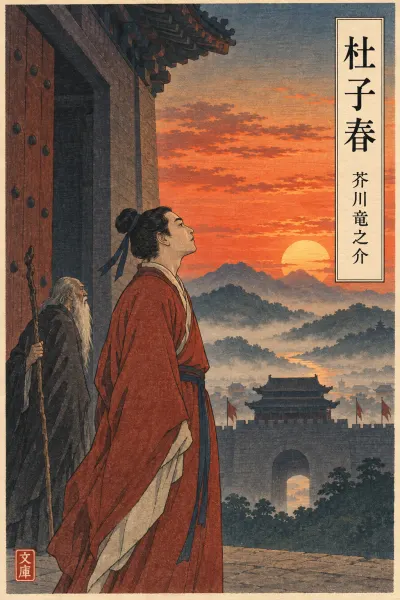
その声に気がついて見ると、杜子春はやはり夕日を浴びて、洛陽の西の門の下に、ぼんやり佇んでいるのでした。Roused by that voice, Toshishun looked about him and found that he was still standing in a daze beneath the west gate of Rakuyō, bathed in the light of the setting sun.
霞んだ空、白い三日月、絶え間ない人や車の波、――すべてがまだ峨眉山へ、行かない前と同じことです。The hazy sky, the pale crescent moon, the endless tide of people and carts: everything was just as it had been before he ever went to Mount Gabi.
「どうだな。おれの弟子になったところが、とても仙人にはなれはすまい」"Well now? Even if you became my disciple, you could never become a hermit, could you?"
片目眇の老人は微笑を含みながら言いました。The one-eyed old man said this with a smile.
「なれません。なれませんが、しかし私はなれなかったことも、反って嬉しい気がするのです」No, I can't. I can't, but even so, I feel, if anything, glad that I couldn't.
杜子春はまだ眼に涙を浮べたまま、思わず老人の手を握りました。With tears still in his eyes, Toshishun took hold of the old man's hand before he knew what he was doing.
「いくら仙人になれたところが、私はあの地獄の森羅殿の前に、鞭を受けている父母を見ては、黙っている訳には行きません」"Even if I could become a hermit, I could never stay silent when I saw my father and mother being whipped before Shinra Hall in Hell."
「もしお前が黙っていたら――」と鉄冠子は急に厳な顔になって、じっと杜子春を見つめました。"If you had stayed silent—" Tekkanshi said, his face suddenly grave, and he looked hard at Toshishun.
「もしお前が黙っていたら、おれは即座にお前の命を絶ってしまおうと思っていたのだ。――お前はもう仙人になりたいという望も持っていまい。大金持になることは、元より愛想がつきた筈だ。ではお前はこれから後、何になったら好いと思うな」"If you had stayed silent, I meant to take your life on the spot. You no longer wish to become a hermit, I am sure. And you must long since have had your fill of being a rich man. So tell me, what do you think you ought to become from now on?"
「何になっても、人間らしい、正直な暮しをするつもりです」"Whatever I become, I mean to live an honest life, as a human being should."
杜子春の声には今までにない晴れ晴れした調子が罩っていました。There was a brightness in Toshishun's voice that had never been there before.
「その言葉を忘れるなよ。ではおれは今日限り、二度とお前には遇わないから」"Don't forget those words. Now, after today I shall never see you again."
鉄冠子はこう言う内に、もう歩き出していましたが、急に又足を止めて、杜子春の方を振り返ると、Even as he said this, Tekkanshi had already started to walk away, but he suddenly stopped again, looked back toward Toshishun, and
「おお、幸、今思い出したが、おれは泰山の南の麓に一軒の家を持っている。その家を畑ごとお前にやるから、早速行って住まうが好い。今頃は丁度家のまわりに、桃の花が一面に咲いているだろう」と、さも愉快そうにつけ加えました。"Ah, that's lucky, I've just remembered: I own a house at the southern foot of Mount Tai. I'll give it to you, fields and all, so go there at once and live in it. Just now the peach trees all around the house should be in full bloom," he added, sounding very pleased indeed.
Vocabulary
| Word | Meaning | JLPT |
|---|---|---|
| 佇んでたたずむ | to stand still, to lingerdictionary form: 佇むLiterary; suggests standing quietly or absent-mindedly in one place. | — |
| 霞んだかすむ | to be hazy, mistydictionary form: 霞むTypical of spring evenings; the noun 霞 (かすみ) is spring haze. | N1 |
| 絶え間ないたえまない | ceaseless, unbrokenLiterally 'without a gap'. | — |
| 眇すがめ | blind in one eye; squintingOld-fashioned; 片目眇 describes the one-eyed old man. | — |
| 微笑びしょう | smile微笑を含む: to have a smile on one's face (written style). | N1 |
| 反ってかえって | on the contrary, ratherdictionary form: 却って/反ってSomething turns out opposite to what one would expect; now usually written 却って. | — |
| 厳おごそか | solemn, gravedictionary form: 厳かHere written without the okurigana か. | N1 |
| 即座そくざ | on the spot, immediatelyUsually 即座に. | — |
| 愛想がつきたあいそがつきる | to be fed up with, to lose all liking fordictionary form: 愛想が尽きるIdiom; the object is marked with に or は. | — |
| 晴れ晴れしたはればれする | to be bright, cheerful, refresheddictionary form: 晴れ晴れするDescribes a clear, unburdened mood, like a sky after rain. | — |
| 罩ってこもる | to be filled with (a feeling, tone)dictionary form: 籠もる/罩もるOld kanji; now written 籠もる or こもる. | — |
| 麓ふもと | foot (of a mountain) | N2 |
| 早速さっそく | at once, without delay | N2 |
| 一面いちめん | all over, the whole surface一面に咲く: to bloom everywhere. | N1 |
Grammar
〜たところが N1 even if ~; although ~
An older concessive form meaning 'even supposing ~ happened'. The expected result does not follow; here, becoming a disciple would not make him a hermit.
おれの弟子になったところが、とても仙人にはなれはすまい
Even if you became my disciple, you could never become a hermit.
〜まい N2 probably not; surely not
〜まい (N2–N1): a literary negative conjecture ("surely not / probably not") or negative intention. なれはすまい is なれ + は + す (classical form of する) + まい, the emphatic form of なれまい: "surely cannot become". After an ichidan verb such as いる it attaches to the stem: 持っていまい, "you surely don't have".
お前はもう仙人になりたいという望も持っていまい。
You no longer wish to become a hermit, I am sure.
〜訳には行かない N3 cannot (for moral or social reasons)
Something is not physically impossible, but one cannot bring oneself to do it. Toshishun could not stay silent while his parents suffered.
黙っている訳には行きません
I could never stay silent.
〜筈だ N4 should be; must be (a confident assumption)
The speaker reasons that something is surely the case. Tekkanshi assumes Toshishun is already sick of being rich.
大金持になることは、元より愛想がつきた筈だ。
And you must long since have had your fill of being a rich man.
〜ごと N2 together with; ~ and all
Attached to a noun, ごと means including that thing as a whole. The house is given together with its fields.
その家を畑ごとお前にやるから
I'll give you that house, fields and all.
〜が好い(よい) N2 you should ~; go ahead and ~
A dictionary-form verb + がよい gives advice or permission from a superior, and sounds old-fashioned and authoritative. It fits the hermit's brusque speech.
早速行って住まうが好い。
Go there at once and live in it.