 N3 · easy
Simplified retelling · JLPT N3
ツェねずみ Tsuenezumi in easy Japanese (N3)
This is our own simplified retelling of Tse the Mouse Wants Amends, written for N3 learners and checked word by word against the N3 vocabulary list. A few story words and grammar patterns go beyond N3; the notes below give each one's level. It keeps the characters, events and ending of the original. When it feels easy, move on to the original text.
The story in brief
Tse the mouse blames everyone who tries to help him, including a weasel, a pillar, a dustpan and a bucket, and demands that they make amends until none of them will speak to him. Only the wire mousetrap, which secretly likes mice, still befriends him and offers him bait every night. Tse's rudeness finally makes the trap shake with anger, its door snaps shut, and the red-faced man finds him caught in the morning.
AI translation · independently checked
ある古い家の暗いてんじょううらに、ツェという名前のねずみが住んでいました。In the dark space above the ceiling of a certain old house, there lived a mouse named Tse.
ある日、ツェねずみがゆかの下の道を歩いていると、いたちが走って来て言いました。One day, as Tse the mouse was walking along the path beneath the floor, a weasel came running up and spoke to him.
「おい、ツェねずみ。台所のたなのあなから、こんぺいとうが落ちているよ。早く行ってひろいな。」"Hey, Tse. There's sugar candy falling out of a hole in the kitchen shelf. Hurry along and pick some up."
ツェねずみはとても喜んで、お礼も言わずに走って行きました。Tse was delighted, and off he ran without even saying thank you.
ところが、たなの下に着くと、足がちくりと痛くなりました。But when he got below the shelf, his foot gave a sharp little sting.
「止まれ!」"Halt!"
小さな強い声がしました。A small, fierce voice rang out.
見ると、それはありたちでした。He looked, and saw that it was the ants.
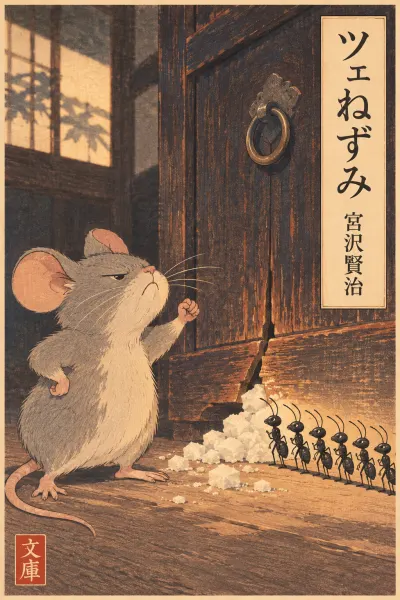
ありたちは、こんぺいとうのまわりにならんで、こわい顔で立っていました。The ants stood in a line around the sugar candy, wearing frightening faces.
「ここに入るな。早く帰れ。」と、偉いありがひくい声で言いました。"Don't come in here. Go home, quick," said an important-looking ant in a low voice.
ツェねずみはふるえながら、自分の家へ逃げて帰りました。Trembling, Tse ran away back to his own home.
でも、だんだん腹が立ってきました。But little by little he began to grow angry.
そこで、いたちの家へ行きました。So he went to the weasel's house.
「いたちさん、ひどいですね。わたしのようなよわいものに、うそを教えるなんて。」"Mr. Weasel, that was cruel of you. Fancy telling a lie to a weak little creature like me!"
「うそじゃないよ。本当にあったんだ。」"It wasn't a lie. It really was there."
「でも、もうありが全部取ってしまいました。つぐなってください。つぐなってください。」"But the ants have already taken it all. Make amends, please. Make amends, please."
「お前が行くのが遅かったんだよ。」"You were just too slow getting there, that's all."
「知りません。つぐなってください。」"I don't care. Make amends, please."
いたちは怒って言いました。The weasel lost his temper and said:
「人の親切を悪く思うなんて、困ったやつだ。じゃあ、おれのこんぺいとうをやろう。持てるだけ持って、どこかへ行け。お前の顔なんか見たくない。」"Thinking badly of somebody who did you a kindness — you're a real nuisance, you are. All right, then, I'll give you my sugar candy. Take as much as you can carry and clear off somewhere. I don't want to see your face."
いたちはこんぺいとうを投げました。The weasel flung the sugar candy away.
ツェねずみはたくさんひろって、頭を下げて、家に帰って食べました。Tse picked up a great deal of it, bowed his head, went home and ate it.
こんなことをするので、ツェねずみはみんなにきらわれて、だれも話をしてくれなくなりました。Because he did things like this, Tse came to be disliked by everyone, and no one would talk to him any more.
そこでツェねずみは、家の道具たちと友達になりました。So Tse made friends with the household things instead.
いちばんなかがよかったのは、はしらでした。The one he got on with best was the pillar.
ある日、はしらが言いました。One day, the pillar said:
「もうすぐ冬だね。今のうちに、寝るためのあたたかい物を用意したほうがいいよ。ぼくの頭の上に、小鳥が春に持って来たやわらかいはねがたくさんあるから、運んで行くといいよ。」"It'll soon be winter, won't it. You'd better get something warm ready to sleep in while you still can. Up on top of my head there are lots of soft feathers that the little birds brought in spring, so why not carry some of them away?"
ツェねずみはすぐに運び始めました。Tse began carrying them at once.
でも、途中に急なさかがあって、三回目に、そこから転んで落ちてしまいました。But there was a steep slope along the way, and on his third trip he tumbled right off it.
「けがはないかい。」と、はしらは心配しました。"Are you hurt?" asked the pillar anxiously.
ツェねずみは痛そうな顔で言いました。Wearing a pained expression, Tse said:
「はしらさん、ひどいですね。よわいものをこんな目にあわせるなんて。つぐなってください。つぐなってください。」"Mr. Pillar, that was cruel of you. Fancy putting a weak little creature through something like this! Make amends, please. Make amends, please."
はしらは何回もあやまりましたが、ツェねずみは許しません。The pillar apologised again and again, but Tse would not forgive him.
はしらは困って、ないてしまいました。The pillar didn't know what to do, and ended up in tears.
それから、はしらはツェねずみと話さなくなりました。After that, the pillar stopped talking to Tse.
またある日、ちりとりはツェねずみに、半分のおかしをあげました。Then another day, the dustpan gave Tse half of its sweets.
次の日、ツェねずみはおなかが痛くなりました。The next day, Tse got a stomach ache.
ツェねずみは「つぐなってください」を百回ぐらい言いました。Tse said "Make amends, please" about a hundred times.
ちりとりもいやになって、もう付き合うのをやめました。The dustpan grew sick of it too, and stopped having anything to do with him.
バケツは「これで毎朝、顔を洗いなさい。」と言って、せっけんを少しあげました。The bucket gave him a little soap, saying, "Wash your face with this every morning."
ツェねずみは毎日それで顔を洗いましたが、そのうちにひげが十本ぐらい抜けてしまいました。Tse washed his face with it every day, but before long about ten of his whiskers fell out.
ツェねずみは「つぐなってください」を二百五十回ぐらい言いました。Tse said "Make amends, please" about two hundred and fifty times.
でも、バケツにはひげがないので、どうすることもできません。But the bucket had no whiskers, so there was nothing at all it could do.
バケツはないてあやまり、それから一度も話しませんでした。The bucket wept and apologised, and after that it never spoke to him again.
こうして、道具たちはみんな、ツェねずみの顔を見ると、横を向くようになりました。And so all the household things took to looking the other way whenever they saw Tse's face.
でも、まだツェねずみと付き合ったことがない道具が、一つだけありました。Yet there was still one thing that had never had dealings with Tse.
はりがねで作ったねずみ捕りです。It was a mousetrap made of wire.
ねずみ捕りは人間のための道具ですが、人間に大切にされたことは一度もありません。The mousetrap was a tool meant for people, but people had never once treated it with any care.
だから、本当は人間よりねずみのほうが好きでした。So, truth be told, it liked mice better than people.
毎晩やさしい声で「おいで。えさだけあげるよ。入り口を閉めたりしないよ。」と呼びますが、ねずみたちはこわがって来ません。Every night it called out in a gentle voice, "Come along. I'll only give you the bait. I won't go shutting the door on you," but the mice were frightened and never came.
朝になると、顔の赤い男が来て、「また入っていない。」と言って、新しいえさに取りかえるのでした。And when morning came, a red-faced man would arrive, say, "Not caught again," and swap the bait for fresh.
ある晩、ねずみ捕りが「今夜はやわらかいはんぺんだよ。」と呼ぶと、ちょうどツェねずみが通りました。One night, just as the mousetrap was calling, "Tonight it's soft fish cake," Tse happened to pass by.
「本当にえさだけくれるんですか。」"Will you really give me only the bait?"
「そうだよ。早くお食べ。」"That's right. Go on, eat up."
ツェねずみは中に入ってはんぺんを食べ、すぐ外に出ました。Tse went inside, ate the fish cake, and came straight back out.
「おいしかった。ありがとう。」"That was delicious. Thank you."
「よかったね。またあしたの晩おいで。」"I'm glad. Come again tomorrow night."
次の朝、男は怒りました。The next morning, the man was angry.
「えさだけ取って行ったな。ずるいねずみだ。でも、中に入ったのはえらい。今日はいわしだ。」"Made off with just the bait, did it? Crafty little mouse. Still, it went inside, I'll give it that. Today it's sardine."
夜、ツェねずみはまた来て、えらそうに言いました。That night Tse came again and said grandly:
「約束どおり、来てあげましたよ。」"I've come, just as I promised, as a favour to you."
ねずみ捕りは少し怒りましたが、がまんして「食べなさい。」とだけ言いました。The mousetrap was a little annoyed, but it held its tongue and said only, "Eat."
ツェねずみは食べると、「じゃあ、あしたも来て食べてあげるからね。」と言いました。When Tse had eaten, he said, "Well then, I'll do you the favour of coming to eat tomorrow too."
次の朝、男はもっと怒りました。The next morning, the man was even angrier.
「毎晩えさだけ取られるのはおかしい。このねずみ捕りは、ねずみから何かもらったんだろう。」"Having just the bait taken night after night — there's something fishy here. This mousetrap must've got some sort of bribe from the mice."
「もらっていない!」とねずみ捕りはさけびましたが、男には聞こえません。"I did not!" shouted the mousetrap, but the man couldn't hear it.
男はくさったはんぺんを付けて行きました。The man put in a rotten fish cake and went off.
ねずみ捕りは一日中怒っていました。The mousetrap stayed angry all day long.
夜、ツェねずみが来て言いました。That night, Tse came and said:
「毎日ここまで来るのは大変だ。ごちそうと言っても、魚の頭ぐらいだ。でも、来たからしかたない。食べてやろう。」"Coming all the way here every day is such a bother. And call it a feast if you like, it's only fish heads and such. But since I've come, there's nothing for it. I'll eat it for you."
ねずみ捕りは怒っていたので、「お食べ。」とだけ言いました。The mousetrap was angry, so it said only, "Eat."
ツェねずみは中に入りましたが、はんぺんがくさっているのを見て、さけびました。Tse went inside, but when he saw that the fish cake was rotten, he cried out:
「ひどい!くさっています。よわいものにうそを言うなんて。つぐなってください。」"How cruel! It's rotten. Fancy lying to a weak little creature! Make amends, please."
ねずみ捕りは、はりがねが鳴るほど怒ってふるえました。The mousetrap shook with such fury that its wires rang.
それがいけませんでした。That was the mistake.
「ピシャッ。」入り口が閉まってしまったのです。Snap! The door had swung shut.
ツェねずみは「ひどい、ひどい。」と言いながら、はりがねをかんだり、ぐるぐる回ったり、ないたりして、大さわぎをしました。Crying "How cruel, how cruel!", Tse made a terrible commotion, biting the wires, running round and round, and weeping.
でも、もう「つぐなってください」と言う力はありませんでした。But he no longer had the strength to say "Make amends, please."
ねずみ捕りも痛くて、腹が立って、一晩中ガタガタふるえていました。The mousetrap was hurting too, and angry, and it rattled and shook all night long.
朝になると、顔の赤い男が来て、大喜びで言いました。When morning came, the red-faced man arrived and spoke in great delight.
「やった、とうとうかかったぞ。性格の悪そうなねずみだな。さあ、出て来い。」"Got it! Caught one at last. Looks like a nasty-natured sort of mouse, too. Come on, out you come."
Vocabulary
| Word | Meaning | JLPT |
|---|---|---|
| てんじょううらてんじょううら | the space above the ceiling, under the roofdictionary form: 天井裏天井 (ceiling) + 裏 (back side); a classic place for mice in old Japanese houses. | — |
| こんぺいとうこんぺいとう | konpeitō: small, star-shaped sugar candydictionary form: 金平糖From Portuguese confeito; translated here as 'sugar candy'. | — |
| 腹が立ってはらがたつ | to get angrydictionary form: 腹が立つLiterally 'one's belly rises'; describes anger building inside. | — |
| つぐなってつぐなう | to make amends, to compensatedictionary form: 償うTse's refrain; a stiff, formal word that sounds comically demanding from a mouse. | — |
| 道具どうぐ | tool, household itemHere the household objects that act as characters. | N4 |
| 用意ようい | preparation; getting something readyUsed as 用意する. | N4 |
| 急なきゅう | steep (of a slope)dictionary form: 急急 also means 'sudden'; with さか it means 'steep'. | N4 |
| 目にあわせるめにあわせる | to put someone through (a bad experience)Usually ひどい目にあわせる; ひどい目にあう = to have a terrible time. | — |
| 付き合うつきあう | to associate with, keep company withAlso means 'to date' in modern usage. | N2 |
| 抜けてぬける | to fall out, come out (hair, whiskers, teeth)dictionary form: 抜けるIntransitive; 抜く = to pull out. | N3 |
| えさえさ | bait; animal fooddictionary form: 餌 | N3 |
| はんぺんはんぺん | a soft, white fish cakeMade from ground fish and yam; translated as 'fish cake'. | — |
| がまんがまん | holding back; putting up withdictionary form: 我慢がまんする = to endure, to control one's feelings. | N3 |
| かかったかかる | to be caught (in a trap)dictionary form: かかるわなにかかる = to get caught in a trap. | N5 |
Grammar
〜なんて N3 expresses shock or criticism: 'Fancy (doing)…!'
Attached to a plain-form verb, なんて shows that the speaker finds the action outrageous. Tse repeats it every time he blames someone, leaving the rest of the sentence unsaid.
わたしのようなよわいものに、うそを教えるなんて。
Fancy telling a lie to a weak little creature like me!
〜(られ)るだけ N3 as much as one can
A potential verb plus だけ means 'to the full extent possible'. 持てるだけ持って means 'carry as much as you are able to carry'.
持てるだけ持って、どこかへ行け。
Take as much as you can carry and clear off somewhere.
〜てくれなくなる N4 people stop doing something for one
〜てくれる marks an action done for the speaker's side, and 〜なくなる means 'come to no longer do'. Together they show that others stopped talking to Tse.
だれも話をしてくれなくなりました。
No one would talk to him any more.
〜ようになる N4 to come to do; a change in habit
A dictionary-form verb plus ようになる describes a gradual change into a new habit. Here, turning away from Tse became the things' usual behaviour.
道具たちはみんな、ツェねずみの顔を見ると、横を向くようになりました。
All the household things took to looking the other way whenever they saw Tse's face.
〜ほど N3 to the extent that…; so … that…
ほど after a clause shows the degree of the main action. The trap was so angry that its wires actually rang.
ねずみ捕りは、はりがねが鳴るほど怒ってふるえました。
The mousetrap shook with such fury that its wires rang.
〜たり〜たりする N4 doing things such as A and B
The たり form lists several example actions, suggesting a mixed series of things being done. Here it paints Tse's frantic struggle.
はりがねをかんだり、ぐるぐる回ったり、ないたりして、大さわぎをしました。
He made a terrible commotion, biting the wires, running round and round, and weeping.