 N5 · easy
Simplified retelling · JLPT N5
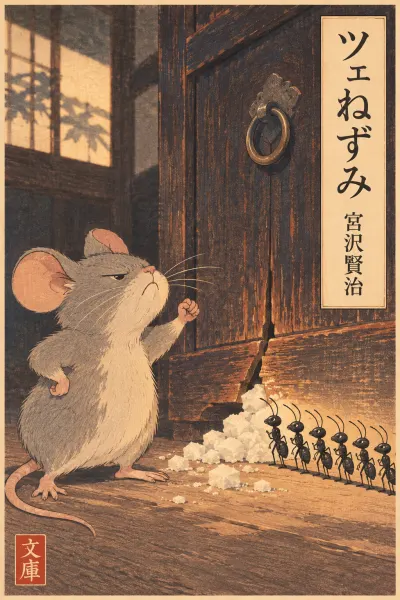
ツェねずみ Tsuenezumi in easy Japanese (N5)
This is our own simplified retelling of Tse the Mouse Wants Amends, written for N5 learners and checked word by word against the N5 vocabulary list. A few story words and grammar patterns go beyond N5; the notes below give each one's level. It keeps the characters, events and ending of the original. When it feels easy, move on to the N4 version or the original text.
The story in brief
Tse the mouse lives in an old house. Whenever things go badly for him, even after the pillar, dustpan and bucket have helped him, he complains that he is weak and demands amends, until everyone stops speaking to him. Then he visits a kind mousetrap every night, eating its bait as if doing it a favour. When the bait turns stale and he complains again, the upset trap rattles, its door snaps shut, and the man finds Tse caught inside.
AI translation · independently checked
ふるいいえの上のくらいところに、ツェというねずみがすんでいました。In a dark place up above in an old house, there lived a mouse called Tse.
あるあさ、ツェねずみがいえの下をあるいていると、いたちが来ました。One morning, as Tse the mouse was walking along under the house, a weasel came by.
「ツェねずみ、だいどころの下に、こんぺいとうがたくさんあるよ。早く行って。」"Hey, Tse! There's loads of sugar candy under the kitchen. Hurry on over there."
ツェねずみは何もいわないで、すぐにはしって行きました。Without saying a word, Tse the mouse ran off at once.
でも、そこにはありがたくさんいました。But a great many ants were already there.
ありはこんぺいとうをじぶんのいえへもって行っていました。The ants were carrying the sugar candy off to their own home.
「ここに入らないでください。早くかえってください。」とありがいいました。"Please don't come in here. Please go home right away," said the ants.
ツェねずみはかえりましたが、とてもいやでした。Tse the mouse went home, but he felt very cross about it.
それで、いたちのいえへ行きました。So he went to the weasel's house.
「いたちさん、あなたはわるい人ですね。わたしはよわいのに。こんぺいとうは、ありがぜんぶとりました。つぐなってください。つぐなってください。」"Mr Weasel, you're a wicked fellow, aren't you? And me so weak, too. The ants took every bit of the sugar candy. Please make amends. Please make amends."
「じゃあ、わたしのこんぺいとうをあげよう。もって行け。もう来るな。」"Fine, then I'll give you my sugar candy. Take it and go. And don't you come back."
ツェねずみはたくさんとって、かえって食べました。Tse the mouse took a great deal of it, went home, and ate it.
それで、みんなはツェねずみがきらいになりました。After that, everyone came to dislike Tse the mouse.
ツェねずみは、はしらやちりとりやバケツと友だちになりました。Tse the mouse made friends with a pillar, a dustpan and a bucket.
あるばん、はしらがいいました。One evening, the pillar spoke.
「もうすぐにふゆだね。わたしの上に、とりがもって来たあたたかいものがあるよ。すこしもって行って、ベッドをつくってください。」"Winter will soon be here. Up on top of me there's some warm stuff a bird brought. Take a little and make yourself a bed."
はじめとつぎは、だいじょうぶでした。The first time and the next time, all went well.
でも、そのつぎに、ツェねずみは高いところからおちました。But the time after that, Tse the mouse fell from the high place.
「わたしはよわいのに。つぐなってください。」ツェねずみはたくさんいいました。"And me so weak, too. Please make amends." Tse the mouse said it over and over.
はしらはとてもこまって、もうツェねずみと話しませんでした。The pillar was quite at a loss, and never spoke to Tse the mouse again.
ちりとりは、ツェねずみにあまい食べものを半ぶんあげました。The dustpan gave Tse the mouse half of its sweet food.
つぎのあさ、ツェねずみはおなかがいたかったです。The next morning, Tse the mouse had a stomach ache.
ツェねずみは「つぐなってください。」を百ぐらいいいました。Tse the mouse said "Please make amends" about a hundred times.
ちりとりも、もう話しませんでした。The dustpan, too, never spoke to him again.
バケツは、せっけんをあげました。The bucket gave him some soap.
「これで毎あさあらってください。」すると、ツェねずみのひげが十本とれました。"Wash with this every morning." And then ten of Tse the mouse's whiskers came off.
ツェねずみは「つぐなってください。」を二百五十ぐらいいいました。Tse the mouse said "Please make amends" about two hundred and fifty times.
バケツもこまって、もう話しませんでした。The bucket was at a loss too, and never spoke to him again.
みんなはツェねずみを見ると、すぐにむこうを見ました。Whenever anyone saw Tse the mouse, they looked the other way at once.
でも、まだツェねずみと話していないものが一つありました。But there was still one thing that had not yet spoken with Tse the mouse.
ねずみとりです。It was the mousetrap.
人はねずみとりを「きたない。」といいます。People call the mousetrap "filthy."
それで、ねずみとりは人がきらいで、ねずみがすきでした。So the mousetrap disliked people and was fond of mice.
毎ばん、ねずみとりはやさしいこえでいいました。Every night, the mousetrap would call out in a gentle voice.
「ねずみさん、来てください。おいしいさかなのあたまがありますよ。ドアはしめません。」でも、ねずみはだれも来ませんでした。"Little mice, do come along. I have a lovely tasty fish head for you. I won't shut my door." But not a single mouse came.
あさになると、男の人が来て、あたらしいえさをつけました。When morning came, the man would come and put on fresh bait.
あるばん、ツェねずみが来ました。One night, Tse the mouse came.
「えさだけ食べてもいいですか。」"Is it all right if I just eat the bait?"
「いいよ。食べてください。」"Of course. Please, eat up."
ツェねずみは中に入って、えさを食べて、外に出ました。Tse the mouse went inside, ate the bait, and came back out.
「おいしかった。どうも。」"That was tasty. Thanks."
つぎのあさ、男の人は「えさだけとったな。わるいねずみだ。」といって、さかなをつけました。The next morning, the man said, "Took just the bait, did it? Rotten mouse," and put on some fish.
そのばんも、ツェねずみは来ました。That night, too, Tse the mouse came.
「今ばんも来てあげましたよ。」ねずみとりはすこしいやでしたが、「食べてください。」とだけいいました。"I've come for you again tonight, you know." The mousetrap felt a little annoyed, but all it said was, "Please, eat."
ツェねずみは食べて、「あしたも来て、食べてあげますよ。」といいました。Tse the mouse ate and said, "I'll do you the favour of coming and eating again tomorrow, too."
つぎのあさ、男の人はいいました。The next morning, the man spoke.
「このねずみとりは、ねずみからお金をとっているな。」ねずみとりは「ちがう。」と大きいこえでいいましたが、男の人には聞こえません。"This mousetrap's taking bribes from the mice, I'll bet." "That's not true!" cried the mousetrap in a loud voice, but the man could not hear it.
男の人は、ふるくてまずいえさをつけました。The man put on some stale, nasty-tasting bait.
よる、ツェねずみが来ました。At night, Tse the mouse came.
「ああ、毎ばん来るのはたいへんだ。でも、食べてあげよう。」"Oh, what a bother it is, coming every night. Still, I'll do you the favour of eating."
ねずみとりは「食べて。」とだけいいました。All the mousetrap said was, "Eat."
ツェねずみは中に入りましたが、えさはふるくてまずかったです。Tse the mouse went inside, but the bait was stale and nasty.
「わたしはよわいのに。つぐなってください。」"And me so weak, too. Please make amends."
ねずみとりはとてもいやになって、からだがガタガタいいました。The mousetrap grew so very upset that its whole body went rattle, rattle.
すると、ドアがしまりました。And then the door snapped shut.
ツェねずみは「出してください。」といって、中ではしりました。"Let me out!" cried Tse the mouse, running about inside.
でも、もう「つぐなってください。」はいえませんでした。But he could no longer say "Please make amends."
あさになりました。Morning came.
男の人が来て、大きいこえでいいました。The man came and said in a loud voice,
「入った、入った。わるいねずみだな。さあ、出て来い。」"Got one, got one! You rotten little mouse. Right, out you come."
Vocabulary
| Word | Meaning | JLPT |
|---|---|---|
| すんでいましたすむ | to live (in a place)dictionary form: 住むUsually used as 〜にすんでいる for where someone lives. | N5 |
| こんぺいとうこんぺいとう | small star-shaped sugar candydictionary form: 金平糖A traditional sweet originally brought to Japan by the Portuguese. | — |
| よわいよわい | weakdictionary form: 弱いOpposite: つよい (strong). | N5 |
| つぐなってつぐなう | to make amends, to compensatedictionary form: 償うTse's refrain; a formal, rather old-fashioned word. | — |
| きらいきらい | disliked; to dislikedictionary form: 嫌いA な-adjective: 〜がきらいになる = come to dislike. | N5 |
| はしらはしら | pillar, postdictionary form: 柱 | N1 |
| ちりとりちりとり | dustpandictionary form: 塵取りLiterally 'dust-taker'. | N1 |
| こまってこまる | to be troubled, to be at a lossdictionary form: 困る | N5 |
| せっけんせっけん | soapdictionary form: 石鹸 | N5 |
| ひげひげ | whiskers; bearddictionary form: 髭Counted with 本 (long thin things). | N4 |
| ねずみとりねずみとり | mousetrapdictionary form: 鼠捕りねずみ (mouse) + とり (catching). | — |
| えさえさ | bait; animal fooddictionary form: 餌 | N3 |
| 聞こえませんきこえる | to be audible, can heardictionary form: 聞こえるThe thing heard takes が/は; compare 聞く (to listen). | N4 |
| ガタガタがたがた | rattle, clatter (sound of shaking)dictionary form: がたがたOnomatopoeia; ガタガタいう = to rattle. | — |
Grammar
〜ていると N4 while doing ~, (something happened)
The て-form plus いる plus と sets up an ongoing action, and the next clause tells what unexpectedly happened during it.
ツェねずみがいえの下をあるいていると、いたちが来ました。
As Tse the mouse was walking under the house, a weasel came.
〜ないで N4 without doing ~
The ない-form plus で links to the next verb and shows that the first action is not done before or while doing the second.
ツェねずみは何もいわないで、すぐにはしって行きました。
Without saying a word, Tse the mouse ran off at once.
〜のに (sentence-final) N4 even though ~ (complaint)
のに normally means 'even though', but at the end of a sentence it leaves the result unsaid and expresses resentment. Tse uses it to say 'I'm weak, so you should not have done this to me.'
わたしはよわいのに。
And me so weak, too.
dictionary form + な N4 don't ~! (blunt prohibition)
Adding な to the dictionary form of a verb makes a rough, direct command not to do something. The irritated weasel uses it here.
もう来るな。
Don't come back.
〜てもいいですか N5 may I ~?
The て-form plus もいいですか asks for permission; the answer いいよ means 'yes, go ahead'.
えさだけ食べてもいいですか。
May I eat just the bait?
〜てあげる N4 to do ~ for someone (as a favour)
The て-form plus あげる shows the speaker does something for another person's benefit. Tse uses it about eating the trap's bait, which sounds rude and self-important.
あしたも来て、食べてあげますよ。
I'll do you the favour of coming and eating again tomorrow, too.