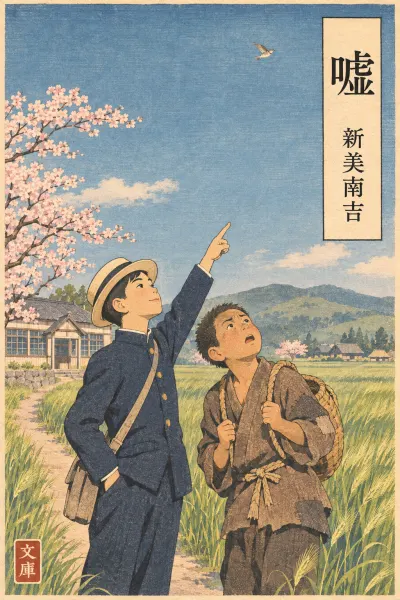
 N4 · easy
Simplified retelling · JLPT N4
嘘 Uso in easy Japanese (N4)
This is our own simplified retelling of The Boy Who Told Fibs, written for N4 learners and checked word by word against the N4 vocabulary list. A few story words and grammar patterns go beyond N4; the notes below give each one's level. It keeps the characters, events and ending of the original. When it feels easy, move on to the original text.
The story in brief
Kyūsuke returns to school after an illness and meets Tarōzaemon, a pale boy from a big town who keeps telling lies to his new friends. One Sunday he tricks the boys into walking all the way to the seaside to see a whale that isn't there, and they break down in tears, far from home. This time, though, Tarōzaemon tells the truth: his aunt's family really does live in Ōno, and they send everyone home by train, which makes Kyūsuke realise that people are the same deep down.
AI translation · independently checked
きゅうすけは病気で、五日間学校を休みました。Kyūsuke was ill, and he missed five days of school.
六日目の朝、学校に行くと、じゅぎょうはもう始まっていました。On the morning of the sixth day, when he went to school, lessons had already begun.
教室に、知らない男の子がいました。In the classroom there was a boy he didn't know.
色が白くて、きれいな洋服を着ていました。He had pale skin and was wearing fine Western clothes.
名前は、たろうざえもんです。His name was Tarōzaemon.
大きな町から来た子でした。He was a boy who had come from a big city.
きゅうすけは、この子が気になりました。Kyūsuke couldn't stop thinking about this boy.
でも、なかなか話せませんでした。But he just couldn't bring himself to talk to him.
ある日、学校から帰る道で、たろうざえもんが話しかけてきました。One day, on the road home from school, Tarōzaemon started talking to him.
「あの赤い花、ぼくのお兄さんが好きだった花だよ。お兄さんはえをかく人だったけど、おととしの秋に死んだんだ。」きゅうすけは、何と答えたらいいか、わかりませんでした。"Those red flowers over there were my elder brother's favourite. He was a painter, but he died the autumn before last." Kyūsuke didn't know what he ought to say.
家の前で、たろうざえもんは小さい物をきゅうすけの手の上においてくれました。In front of his house, Tarōzaemon placed a little something in Kyūsuke's hand.
口に入れると、にがくなったり、あまくなったりします。When he put it in his mouth, it tasted bitter one moment and sweet the next.
家に帰ると、お母さんが「じんたんのにおいがするね」といいました。When he got home, his mother said, "You smell of jintan."
きゅうすけもよく知っている物でした。It was something Kyūsuke knew perfectly well, too.
「へんな子だなあ」と、きゅうすけは思いました。"What an odd boy," Kyūsuke thought.
ある日、きゅうすけはたろうざえもんの家に行きました。One day, Kyūsuke went to Tarōzaemon's house.
古くて、とてもしずかな家でした。It was an old and very quiet house.
へやの中に、色の白いお姉さんがいました。In the room there was a pale-skinned elder sister.
お姉さんはランプに火をつけて、だれもいないのに、だれかと話していました。She had lit a lamp, and although no one was there, she was talking to someone.
きゅうすけはこわくなりました。Kyūsuke grew frightened.
でも、それは学校の会のためのれんしゅうでした。But it was only practice for a school performance.
だんだん、たろうざえもんはみんなと友だちになりました。Little by little, Tarōzaemon became friends with everyone.
でも、よくうそをつきました。But he often told lies.
山で大きなこえを出すと、こだまがいつまでもきえないといいました。He said that if you shouted loudly in the hills, the echo would never fade away.
それはうそでした。That was a lie.
かみなりにうたれた鳥がおちたといいました。He said a bird had been struck by lightning and had fallen to the ground.
友だちがさがしましたが、何もありませんでした。His friends searched for it, but there was nothing there.
ある日、たろうざえもんは丸い物を学校に持って来ました。One day, Tarōzaemon brought a round object to school.
「これをみみにつけると、音楽が聞こえるよ。」みんなは一人ずつ聞きました。"If you hold this to your ear, you can hear music." Everyone took a turn listening, one after another.
きゅうすけも「うん、聞こえる」といいました。Kyūsuke said, "Yeah, I can hear it," too.
でも、あとで家で同じ物を見つけました。But later, at home, he found the very same thing.
お父さんは「これは、たばこのはいざらだよ」と教えてくれました。His father told him, "That's an ashtray."
またうそでした。It was another lie.
きゅうすけは、たろうざえもんのかおをよく見ました。Kyūsuke took a good look at Tarōzaemon's face.
右の目は大きくて、左の目は小さいです。His right eye was large, and his left eye was small.
「この子の中には、二人の人がいるのかもしれない。だから、うそをつくんだ」と、きゅうすけは思いました。"Maybe there are two people inside this boy. That must be why he tells lies," Kyūsuke thought.
五月の日曜日の午後、きゅうすけたち四人は、とてもひまでした。One Sunday afternoon in May, Kyūsuke and three of his friends had nothing at all to do.
そこへ、たろうざえもんが来ました。Just then, Tarōzaemon came along.
「しんまいこの海岸に、大きなくじらが来ているよ。」みんなは、見に行くことにしました。"A big whale has come to the beach at Shinmaiko." Everyone decided to go and see it.
とおい道でしたが、家の人には何もいわないで出かけました。It was a long way, but they set off without telling anyone at home.
山の道を歩いて、みんなはだんだんつかれました。Walking along the mountain road, they gradually grew tired.
海岸に着くと、もう夕方でした。By the time they reached the beach, it was already evening.
くじらはいませんでした。There was no whale.
またうそでした。It was another lie.
でも、みんなはつかれて、「どうやって帰ろう」と思うだけでした。But everyone was so tired that all they could think was, "How are we going to get home?"
一人がなき出しました。One of them burst into tears.
それから、みんな大きなこえでなきました。Then they all cried out loud.
たろうざえもんだけは、なきませんでした。Only Tarōzaemon did not cry.
夜になって、たろうざえもんがいいました。When night had fallen, Tarōzaemon spoke.
「おおのに、ぼくのおばさんの家がある。そこへ行って、電車で送ってもらおう。」みんなは立ちましたが、またうそだろうと思いました。"My aunt has a house in Ōno. Let's go there and have them send us home by train." Everyone got to their feet, but they thought it was probably another lie.
町で、たろうざえもんは道をさがしていました。In the town, Tarōzaemon was searching for the way.
きゅうすけは心配でした。Kyūsuke was worried.
でも、ほんとうに小さい時計の店がありました。But there really was a small watch shop.
そこがおばさんの家でした。That was his aunt's house.
きゅうすけは安心して、その場にすわりました。Kyūsuke felt such relief that he sat right down where he was.
おじさんが、電車でみんなを村まで送ってくれました。His uncle took them all back to the village by train.
電車の中で、だれも何も話しませんでした。On the train, nobody said a word.
その夜、ねる前に、きゅうすけは思いました。That night, before going to sleep, Kyūsuke thought:
「たろうざえもんも、いちばんたいへんなところでは、うそをつかなかった。人はみんなちがうように見えても、心のいちばん下のところでは、同じなんだ。」きゅうすけは安心して、海の音を思い出しながら、ねむりました。"Even Tarōzaemon didn't lie when things were at their very worst. However different people may look, deep down at the very bottom of their hearts they're all the same." Feeling at peace, Kyūsuke fell asleep, remembering the sound of the sea.
Vocabulary
| Word | Meaning | JLPT |
|---|---|---|
| 気になりましたきになる | to be on one's mind; to be curious about, to keep thinking aboutdictionary form: 気になるUsed for something or someone you can't stop noticing, whether out of interest or worry. | — |
| 話しかけてはなしかける | to start talking to someone; to speak todictionary form: 話しかける〜かける here means directing an action at someone. | N2 |
| にがくにがい | bitter (taste)dictionary form: 苦いOpposite of 甘い (あまい, sweet). | N4 |
| じんたんじんたん | Jintan, tiny silver breath-freshening pillsdictionary form: 仁丹A famous Japanese brand of herbal pills sold since 1905. They taste bitter and cool, and many people once carried them. | — |
| うそうそ | a liedictionary form: 嘘To tell a lie is うそをつく, not うそを言う. | N4 |
| こだまこだま | an echo (in the hills or mountains)dictionary form: 木霊Literally 'tree spirit'. Old belief said the voice came back from the spirits of the trees. | — |
| かみなりかみなり | lightning; thunder (here: a lightning strike)dictionary form: 雷かみなりにうたれる = to be struck by lightning (passive of 打つ). | N3 |
| はいざらはいざい | an ashtraydictionary form: 灰皿灰 (ash) + 皿 (plate); さら becomes ざら (rendaku). | N5 |
| ひまひま | free, with nothing to do; having time on one's handsdictionary form: 暇A な-adjective: ひまな日, ひまでした. | N5 |
| 海岸かいがん | beach, seashore, coast | N4 |
| なき出しましたなきだす | to burst into tears, to start cryingdictionary form: 泣き出す〜出す after a verb stem = to suddenly start doing something. | — |
| 送っておくる | to take (someone) home; to see someone offdictionary form: 送るBesides 'to send', 送る also means accompanying a person back home. | N4 |
| 心配しんぱい | worry; worried, anxious | N4 |
| 安心してあんしんする | to feel relieved, to be at easedictionary form: 安心するThe opposite of 心配: 安 (peace) + 心 (heart). | — |
Grammar
〜たらいいか N4 what one should do; how one ought to…
A question word plus a verb in the 〜たら form plus いいか asks what the right action is. Followed by わからない, it means 'didn't know what to do (or say)'.
きゅうすけは、何と答えたらいいか、わかりませんでした。
Kyūsuke didn't know what he ought to say.
〜たり〜たりする N4 doing A and B (by turns); sometimes A, sometimes B
The た-form plus り is added to two verbs or adjectives to list actions or states that change back and forth. With adjectives, くなったり shows the taste keeps switching.
口に入れると、にがくなったり、あまくなったりします。
When he put it in his mouth, it tasted bitter one moment and sweet the next.
〜かもしれない N4 might, maybe
Attached to the plain form, it shows that the speaker thinks something is possible but is not sure. Kyūsuke is guessing why Tarōzaemon lies.
この子の中には、二人の人がいるのかもしれない。
Maybe there are two people inside this boy.
〜ことにする N4 to decide to do
The dictionary form plus ことにする expresses a decision that someone makes. In the past form, ことにしました, it means the group made up their minds to go.
みんなは、見に行くことにしました。
Everyone decided to go and see it.
〜ないで N4 without doing
The ない-form plus で connects to a following verb and shows that the first action was not done. Here the boys left without telling their families.
家の人には何もいわないで出かけました。
They set off without telling anyone at home.
〜てもらおう N4 let's have someone do it (for us)
〜てもらう means receiving a favour from someone else's action. The volitional form もらおう turns it into a suggestion: 'let's get them to send us home'.
そこへ行って、電車で送ってもらおう。
Let's go there and have them send us home by train.