 N4 · easy
Simplified retelling · JLPT N4
病む子の祭 Yamu Ko no Matsuri in easy Japanese (N4)
This is our own simplified retelling of A Festival for the Child in Bed, written for N4 learners and checked word by word against the N4 vocabulary list. A few story words and grammar patterns go beyond N4; the notes below give each one's level. It keeps the characters, events and ending of the original. When it feels easy, move on to the original text.
The story in brief
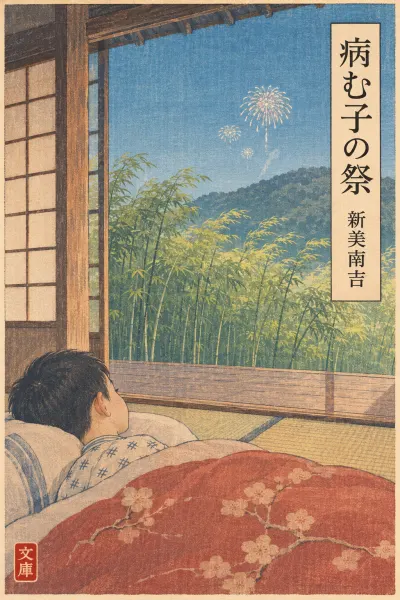
On the day of the village festival, the youngest boy lies sick in bed while his older brother and sister go out to the festival. His sister comes home early and shows him a baby chick and the two seashells they once used to hide a flower. He blows into the joined shells, says he can hear the wind and the flutes, and his voice grows fainter as cherry blossoms fall on him.
AI translation · independently checked
今日は、むらのおまつりです。Today is the village festival.
小さい家で、お母さんが子どもたちに新しい着物を出しました。In a small house, a mother took out new kimonos for her children.
とおくで花火の音や、ふえとたいこの音が聞こえます。Far away, the sound of fireworks and of flutes and drums can be heard.
いちばん下の弟は病気で、ずっとねています。The youngest brother is ill and has been in bed for a long time.
お母さんは「弟が起きないように、しずかにね」と言いました。The mother said, "Be quiet now, so your brother doesn't wake up."
弟も、みんなと外であそびたいのです。The little brother wants to play outside with everyone too.
学校にも行きたいのです。He wants to go to school as well.
でも、病気だから行けません。But he is ill, so he cannot go.
二ばん目の兄は、くつにあなをあけてしまいました。The second brother went and made a hole in his shoe.
兄は「友だちが悪いんだ」と言いました。He said, "It's my friend's fault."
お母さんはしかりました。His mother scolded him.
「悪いことをして、ほかの人が悪いと言うのは、もっと悪いですよ。」兄は「ごめんなさい」とあやまりました。"When you do something wrong and then say it's someone else's fault, that's even worse." The brother apologised, saying, "I'm sorry."
すると、弟が起きました。Just then, the little brother woke up.
「お兄さん、どこへ行くの。」お母さんは「学校に用事があるのよ」と言いました。"Where are you going, brother?" The mother said, "He has something to do at school."
でも、弟はわかっていました。But the little brother knew.
「うそだ。おまつりに行くんでしょう。ぼく、今ゆめを見たよ。去年のさるが、赤ちゃんのさるといっしょに来たんだ。ぼくも行きたい。」"That's a lie. He's going to the festival, isn't he? I just had a dream. The monkey from last year came, together with a baby monkey. I want to go too."
でも、お医者さんは、ねていなければだめだと言いました。But the doctor had said he must stay in bed.
兄が弟のくつをはいて行こうとすると、弟はとてもおこりました。When the older brother tried to put on the little brother's shoes and go, the little brother got very angry.
それで、兄はじぶんのくつをはいて出かけました。So the older brother put on his own shoes and went out.
姉が出かけようとすると、弟は「お姉さん、行っちゃいやだ」となきました。When his sister tried to go out, the little brother cried, "Sister, don't go!"
でも、お母さんに言われて、姉も出て行きました。But because her mother told her to, the sister went out too.
弟は言いました。The little brother said,
「ぼくも、おまつりの着物が着たいよ。」お母さんは着物を出して、てつだいました。"I want to wear my festival kimono too." His mother took out the kimono and helped him put it on.
弟は聞きました。The little brother asked,
「子どもは本当に大人になるの。」「なりますよ。お母さんも、はじめは赤ちゃんだったのよ。」弟はじぶんのほそい手を見て、言いました。"Do children really grow up?" "Yes, they do. Even I was a baby at first." The little brother looked at his own thin hands and said,
「ぼくは、大人にならないような気がする。」"I feel like I won't ever grow up."
そこへ、姉がだまって帰ってきました。Just then, his sister came home without a word.
「なぜか、急に帰りたくなったの。」お母さんは、くすりをもらいに、医者の家へ行きました。"Somehow I suddenly wanted to come home." The mother went to the doctor's house to get some medicine.
姉は、はこからひよこを出しました。The sister took a baby chick out of a box.
弟はひよこを手にのせて、長い間見ていました。The little brother held the chick on his hand and looked at it for a long time.
「かるいなあ。」それから、しずかに姉にかえしました。"It's so light." Then he quietly gave it back to his sister.
ふえとたいこの音が近くまで来て、また、とおくへ行きました。The sound of the flutes and drums came close, then went far away again.
「まだ聞こえるね。」「もう聞こえないわよ。」「まだ聞こえるよ。」"I can still hear it." "You can't hear it anymore." "I can still hear it."
弟は言いました。The little brother said,
「前に、お姉さんと花をかくしてあそんだね。」病気になる前に、弟はかいがらで花をかくしたのです。"Before, you and I played at hiding flowers, didn't we?" Before he fell ill, he had hidden a flower under a seashell.
姉は外へ出て、木の下でかいがらを見つけました。The sister went outside and found the shell under a tree.
中の花は、もう古くなっていました。The flower inside had already grown old.
姉は、もう一つのかいがらも持ってきました。The sister brought the other shell, too.
二つは、よく合いました。The two fitted together well.
弟はそれを口に入れて、ふきました。The little brother put them to his mouth and blew.
音はなりません。No sound came.
でも、弟は言いました。But the little brother said,
「聞こえるよ。風の音や、ふえの音がするよ。……ぼく、かるくなった。ぼくもとんで行くよ。」"I can hear it. I hear the wind, and the flutes... I've become light. I'm going to fly away too."
姉はこわくなりました。The sister became frightened.
「お母さんをよんでくるわ。待っていてね。」姉は走って出て行きました。"I'll go and call Mother. Wait for me." The sister ran out.
「お母さん……ぼく、とおいの……。」弟のこえは、だんだん小さくなりました。"Mother... I'm far away..." The little brother's voice grew fainter and fainter.
風が強くなって、さくらの花が、弟の上にしずかにおちました。The wind grew stronger, and cherry blossoms fell quietly on the little brother.
Vocabulary
| Word | Meaning | JLPT |
|---|---|---|
| 着物きもの | kimono; traditional Japanese clothesLiterally 'a thing to wear'. New kimonos were worn for festivals. | N4 |
| 花火はなび | fireworks花 'flower' + 火 'fire': flowers of fire. | N2 |
| 病気びょうき | illness; ill | N5 |
| しかりましたしかる | to scolddictionary form: 叱るUsed for a parent or teacher scolding a child. | N3 |
| あやまりましたあやまる | to apologisedictionary form: 謝る | N4 |
| 用事ようじ | something to do; an errand〜に用事がある: to have something to do at/with ~. | N4 |
| うそうそ | lie; that's not truedictionary form: 嘘 | N4 |
| おこりましたおこる | to get angrydictionary form: 怒る | N4 |
| はいてはく | to put on (shoes)dictionary form: 履くはく is used for shoes and trousers; 着る for kimonos and shirts. | N5 |
| だまってだまる | to be silent; (だまって) without saying anythingdictionary form: 黙る | N3 |
| ひよこひよこ | baby chick | — |
| かいがらかいがら | seashelldictionary form: 貝殻貝 'shellfish' + 殻 'shell'; から becomes がら. | N1 |
| ふきましたふく | to blow (with the mouth); (of wind) to blowdictionary form: 吹く | N5 |
| だんだんだんだん | gradually; little by littledictionary form: 段々Often used with 〜なる: だんだん小さくなる 'grow smaller and smaller'. | N1 |
Grammar
〜ないように N4 so that ... doesn't ...
The negative form + ように gives the purpose of an action, here what should not happen. The children must be quiet so that the brother is not woken.
弟が起きないように、しずかにね
Be quiet now, so your brother doesn't wake up.
〜てしまう N4 to end up doing; to do something regrettable
The te-form + しまう shows that something is finished, often with a feeling of regret. Here it shows that the hole in the shoe was a mistake.
くつにあなをあけてしまいました
He had gone and made a hole in his shoe.
〜なければだめ N4 must ...; have to ...
The negative conditional なければ + だめ literally means 'if you don't ..., it's no good'. It is a conversational way of saying something is necessary.
お医者さんは、ねていなければだめだと言いました
The doctor had said he must stay in bed.
〜ようとする N3 to try to ...; to be about to ...
The volitional form + とする shows someone attempting or about to do something. With 〜と, it sets up what happens at that moment.
兄が弟のくつをはいて行こうとすると、弟はとてもおこりました
When the older brother tried to put on the little brother's shoes and go, the little brother got very angry.
Passive 〜られる (言われる) N4 to be told (by someone)
言われて is the passive te-form of 言う. The person who gives the order is marked with に, so the sister went out because her mother told her to.
お母さんに言われて、姉も出て行きました
Because her mother told her to, the sister went out too.
〜ような気がする N3 to have a feeling that ...
A plain-form clause + ような気がする expresses a vague, personal feeling. The boy has a feeling that he will never become an adult.
ぼくは、大人にならないような気がする。
I feel like I won't ever grow up.