Intermediate · JLPT N3
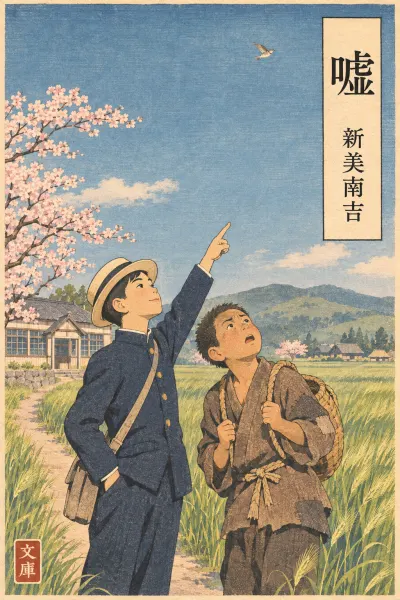
嘘Uso — The Boy Who Told Fibs
- JLPT N3
- 13,960 characters
- 10 parts
- about 116 minutes
- 2 easier versions
This is a school story set in the country village of Yanabe on the Chita Peninsula, told in the third person and staying close to the thoughts of a fifth-year boy, Kyūsuke. A pale, well-spoken boy named Tarōzaemon transfers to his class from Yokohama, and Kyūsuke is drawn to him, puzzled by him, and slowly shaken by him. Tarōzaemon soon gets a reputation as a liar: there is an echo that never dies away, a skylark struck by lightning, an ivory disc that plays music. Finally, on a dull Sunday in late May, a group of boys follows one of his tales on a long walk to the sea, and the trip goes badly wrong. The tone is gently humorous, and it takes seriously how children wonder about other people, misjudge them and embarrass themselves. Learners will find plain written narration with many long, thought-tracing sentences. The main challenge is the dialogue: the village boys speak rural Chita dialect, while Tarōzaemon and his sister speak polished standard Japanese. That contrast is part of what the story is about.
Contents
Easier versions
This story is also retold in simpler Japanese. Reading an easier version first makes the original much more approachable.
Before you read
- Learn to recognise the Chita dialect in the village boys' speech before you start. だげな means roughly 'they say / apparently' (standard だそうだ), ほんとけ means ほんとうか, and forms like きこえやしんげや are rural negatives (roughly きこえないじゃないか). Tarōzaemon's standard speech will feel easier by comparison. Notice that Kyūsuke himself trips between the two styles in Part 3.
- The narration often ends sentences with 〜のである / 〜のであった. Read these as explanatory emphasis ('the fact was…'), not as new information. Similarly, 〜のではないか usually marks Kyūsuke's suspicions and half-formed theories, such as the idea that Tarōzaemon might be Egawa Tarōzaemon grown young again.
- Watch for patterns describing repeated or ongoing change, especially in the Jintan scene and the long walk. 〜ては (repeated action), 〜たり〜たりする, 〜ているうちに ('while…, before he knew it') and 〜ば〜ほど ('the more…, the more…') carry much of the narrative movement.
- Keep the names straight. Tarōzaemon is also called Tarō at home and by Mr Yamaguchi, and Kyūsuke is Kyū to his mother. The name Tarōzaemon also links to the historical gunnery expert Egawa Tarōzaemon and his furnace at Nirayama in Izu, which Kyūsuke daydreams about in Part 2.
- Useful words to learn early: 嘘 (lie), 転校生 (transfer pupil), 鯨 (whale), 峠 (mountain pass), and 電車 (electric train). They come up at the turning points of the plot.
Words to know
The most useful words from the notes across the story.
| Word | Meaning | JLPT |
|---|---|---|
| 学芸会がくげいかい | school performance day (plays, recitals) | — |
| 一ぱいくわされたいっぱいくわす | to trick, take someone indictionary form: 一杯食わすIdiom; the passive 一杯食わされる means 'to be fooled'. | — |
| ぼっしようぼっする | to sink, to go down (of the sun)dictionary form: 没するLiterary word; 日没 (にちぼつ) means sunset. | — |
| あがってあがる | to get nervous or flustereddictionary form: 上がるTypically used for stage fright, or for being nervous in front of people. | N4 |
| 君くん | suffix added to a boy's name (friendly but respectful)Kept as "-kun" here because the story contrasts the polite form "Tarō-kun" with the blunt full name; English has no exact equivalent. | N4 |
| えんりょなくえんりょ | without holding back, without ceremonydictionary form: 遠慮遠慮なく is a set adverb: freely, without hesitation. | N4 |
| きこえやしんげやきこえる | to be audible, can be heard (here in a dialect negative form: 'can't hear a thing')dictionary form: 聞こえるChita dialect, roughly standard 聞こえやしないよ. | N4 |
| 都会とかい | city, big townContrasts with いなか (the countryside). 都会ふう means 'city-style'. | N3 |
| 招かれてまねく | to invite, to beckondictionary form: 招くHere in the passive: 招かれる 'to be invited'. | N3 |
| 尊敬そんけい | respect, looking up to someoneUsed as a verb with する: 尊敬する. | N3 |
| うわさうわさ | rumourdictionary form: 噂うわさがたつ: a rumour starts going around. | N3 |
| 伝記でんき | biography, life story | N2 |
| へだてられていたへだてる | to separate, to partitiondictionary form: 隔てるPassive + ている describes a state: 'was separated'. | N2 |
| 下品げひん | vulgar, coarseOpposite: 上品 (じょうひん), refined. | N2 |
| もたれてもたれる | to lean againstdictionary form: もたれるTakes に: まどにもたれる. | N2 |
Plot summary
Show the full summary (contains spoilers)
Kyūsuke returns to school after the mumps and finds a new pupil, Tarōzaemon, a refined boy from Yokohama. Kyūsuke is fascinated by him. Tarōzaemon tells him that his painter brother killed himself and gives him a tiny pellet, which Kyūsuke later realises was ordinary Jintan. At Tarōzaemon's gloomy house he sees the boy's pale sister rehearsing a school play by lamplight. The other boys lose interest in Tarōzaemon as his tall tales about echoes, skylarks and a music-playing disc prove false. On a Sunday in late May he tells four boys, including Kyūsuke, that a whale is on show at Shinmaiko. They walk there over the pass and arrive at sunset to find nothing. Far from home, they all cry except Tarōzaemon. He says his relatives in Ōno can help. To everyone's surprise this is true, and the boys are taken home by electric train. In bed, Kyūsuke concludes that even Tarōzaemon did not lie when it mattered, and that people can understand one another.
About the author
Niimi Nankichi was a Japanese writer of children's stories, poems and songs from Handa in Aichi Prefecture. The countryside of that area is widely thought to lie behind the village and hills of Gongitsune. He began writing as a young man. Gongitsune appeared in the children's magazine Akai Tori (The Red Bird), edited by Suzuki Miekichi. Niimi later worked as a teacher at a girls' school while continuing to write. His health was poor, and he died of tuberculosis while still in his twenties. Many of his works were published and became widely known only after his death. Besides Gongitsune, he is especially remembered for Tebukuro wo Kai ni (Buying Mittens).