 N5 · easy
Simplified retelling · JLPT N5
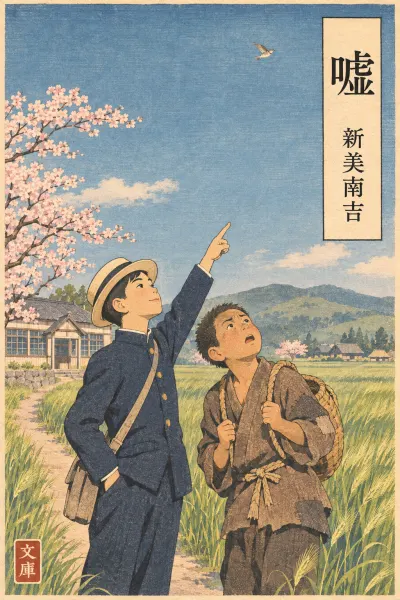
嘘 Uso in easy Japanese (N5)
This is our own simplified retelling of The Boy Who Told Fibs, written for N5 learners and checked word by word against the N5 vocabulary list. A few story words and grammar patterns go beyond N5; the notes below give each one's level. It keeps the characters, events and ending of the original. When it feels easy, move on to the N4 version or the original text.
The story in brief
Kyūsuke returns to school after being ill and meets Tarōzaemon, a pale new boy from Yokohama who often tells lies. One Sunday Tarōzaemon leads four bored boys on a long walk to the sea at Shinmaiko to see a whale that isn't there. When they are stranded and crying, he gets them safely home through his relatives in Ōno, and that night Kyūsuke realises that Tarōzaemon did not lie when it mattered most.
AI translation · independently checked
きゅうすけはびょうきで、五日学校を休みました。Kyūsuke was ill, and he stayed home from school for five days.
六日めのあさ、学校へ行くと、きょうしつに知らない男の子がいました。On the morning of the sixth day, when he went to school, there was a boy he didn't know in the classroom.
いろが白くて、きれいなようふくをきていました。He had pale skin and was wearing nice Western clothes.
友だちが教えました。A friend told him about the boy.
「あの人はよこはまから来たよ。名前はたろうざえもんだよ。」"That one came from Yokohama. His name's Tarōzaemon."
「おじいさんの名前だね。」と、きゅうすけはいいました。"That's a granddad's name," said Kyūsuke.
ある午後、学校からかえるみちで、たろうざえもんがきゅうすけに小さい白いものをあげました。One afternoon, on the way home from school, Tarōzaemon gave Kyūsuke a small white thing.
くちに入れると、くちの中がとてもすずしくなりました。When Kyūsuke put it in his mouth, the inside of his mouth became very cool.
いえにかえると、お母さんが「それはにんたんだね。」といいました。When he got home, his mother said, "That's a breath mint, isn't it."
なんだ、にんたんか。Oh, so it was just a breath mint.
きゅうすけもよく知っているものでした。It was something Kyūsuke knew very well too.
たろうざえもんは、へんな人です。Tarōzaemon is a strange boy.
だんだん、みんなはたろうざえもんと友だちになりました。Little by little, everyone became friends with Tarōzaemon.
でも、たろうざえもんはよくうそをいいました。But Tarōzaemon often told lies.
ある午後、たろうざえもんはまるい白いものを学校へもって来ました。One afternoon, Tarōzaemon brought a round white thing to school.
「これをみみにつけると、おんがくを聞くことができるよ。」みんなで聞きました。"If you put this to your ear, you can hear music." They all listened to it together.
きゅうすけも「うん、すこしあるよ。」といいました。Kyūsuke said too, "Yeah, there's a bit of it."
でも、あとできゅうすけのいえでもおなじものが出て来ました。But later the very same thing turned up at Kyūsuke's house as well.
お父さんは「それははいざらだよ。」といいました。His father said, "That's an ashtray."
また、うそでした。It was a lie again.
にちようびの午後、四人の男の子はひまで、つまらなかったです。One Sunday afternoon, four boys had nothing to do and were bored.
そこへたろうざえもんが来て、いいました。Just then Tarōzaemon came along and said:
「しんまいこのうみで、大きなくじらを見せているよ。十メートルもあるよ。」"At the sea at Shinmaiko they're showing a huge whale. It's a whole ten metres long."
みんなは、すぐに出かけました。Everyone set off at once.
いえの人には何もいいませんでした。They didn't say anything to their families.
しんまいこは、とてもとおいです。Shinmaiko is very far away.
山のみちをたくさんあるきました。They walked a long way along mountain roads.
みんなはだんだんつかれて、話さなくなりました。Little by little they all got tired and stopped talking.
うみについたのは、もうゆうがたでした。By the time they reached the sea, it was already evening.
くじらは、いませんでした。There was no whale.
また、うそでした。It was a lie again.
もう、あるくことができません。They couldn't walk any more.
どうやってかえりますか。How were they going to get home?
一人が大きな声でなきました。One of them burst out crying loudly.
ほかの三人もなきました。The other three cried too.
きゅうすけもなきました。Kyūsuke cried too.
でも、たろうざえもんはなきませんでした。But Tarōzaemon didn't cry.
下を見て、何もいいませんでした。He looked down and said nothing.
そらがくらくなりました。The sky grew dark.
たろうざえもんがいいました。Tarōzaemon spoke.
「おおのに、ぼくのしんせきがいるよ。そこへ行って、電車でかえろう。」"I have relatives in Ōno. Let's go there and take the train home."
みんなはたちました。Everyone stood up.
でも、たろうざえもんの話です。But this was Tarōzaemon talking.
「ほんとう?」と、何かいも聞きました。"Honest?" they asked again and again.
きゅうすけも、また、うそだろうと、いいました。Kyūsuke too said it was probably another lie.
でも、とけいの小さい店につくと、そこはほんとうにたろうざえもんのしんせきのいえでした。But when they reached a small watch shop, it really was the home of Tarōzaemon's relatives.
おばさんは、みんなを見て、「あなたたちは……」といいました。The aunt looked at them all and said, "You children..."
きゅうすけは、もうだいじょうぶだと分かって、げんかんにすわりました。Kyūsuke understood that they were safe now, and he sat down in the entryway.
それから五人は、おじさんといっしょに電車でむらへかえりました。After that, the five boys went back to the village by train with the uncle.
電車の中で、だれも話しませんでした。On the train, nobody spoke.
よる、ねる前に、きゅうすけは分かりました。That night, before going to sleep, Kyūsuke understood.
たろうざえもんは、いちばんたいへんなところで、うそをいいませんでした。At the very worst moment, Tarōzaemon had not told a lie.
人はみんなちがいます。People are all different.
でも、いちばんたいせつなところでは、みんなおなじです。But in the place that matters most, they are all the same.
そして、きゅうすけはしずかにねました。And then Kyūsuke went quietly to sleep.
Vocabulary
| Word | Meaning | JLPT |
|---|---|---|
| びょうきびょうき | illness; being sickdictionary form: 病気〜で here means "because of": びょうきで = because he was ill. | N5 |
| 休みましたやすむ | to be absent (from school); to restdictionary form: 休む学校を休む = to miss school. | N5 |
| ようふくようふく | Western-style clothesdictionary form: 洋服洋 = Western, 服 = clothes; in older times a sign of a city child. | N5 |
| にんたんじんたん | Jintan, a brand of small silver breath-freshening pillsdictionary form: 仁丹Usually pronounced じんたん; にんたん is a local or childish way of saying it. | — |
| うそうそ | a liedictionary form: 嘘うそをいう / うそをつく = to tell a lie. The key word of the story. | N4 |
| はいざらはいざら | ashtraydictionary form: 灰皿灰 (ash) + 皿 (plate); さら becomes ざら (rendaku). | N5 |
| ひまひま | free time; having nothing to dodictionary form: 暇 | N5 |
| つまらなかったつまらない | boring; dulldictionary form: つまらないPast form of an い-adjective: 〜い → 〜かった. | N5 |
| くじらくじら | whaledictionary form: 鯨 | — |
| つかれてつかれる | to get tireddictionary form: 疲れる | N5 |
| ゆうがたゆうがた | evening; late afternoondictionary form: 夕方 | N5 |
| しんせきしんせき | relativesdictionary form: 親戚 | N3 |
| げんかんげんかん | entryway of a housedictionary form: 玄関The lower area inside the front door where shoes are taken off. | N5 |
| たいせつたいせつ | important; preciousdictionary form: 大切A な-adjective: たいせつなところ = the important part. | N5 |
Grammar
〜と (when / whenever) N4 when ~; as soon as ~
A plain verb + と shows that the second event follows naturally right after the first. In a story it often means "when he did X, Y happened".
くちに入れると、くちの中がとてもすずしくなりました。
When Kyūsuke put it in his mouth, the inside of his mouth became very cool.
〜ことができる N4 can ~; be able to ~
Dictionary form of a verb + ことができる expresses ability or possibility. The negative ことができません means "cannot".
これをみみにつけると、おんがくを聞くことができるよ。
If you put this to your ear, you can hear music.
〜なくなる N4 to stop doing ~; to no longer ~
The ない-form of a verb with い changed to く, plus なる, shows a change into not doing something. 話さなくなりました = they came to not talk any more.
みんなはだんだんつかれて、話さなくなりました。
Little by little they all got tired and stopped talking.
Volitional 〜う / 〜よう (let's ~) N4 let's ~
The volitional form is the casual version of 〜ましょう. かえる → かえろう means "let's go home".
そこへ行って、電車でかえろう。
Let's go there and take the train home.
〜だろう N4 probably ~; I bet ~
だろう is the plain form of でしょう and shows a guess. Here it is followed by と to quote what Kyūsuke said.
きゅうすけも、また、うそだろうと、いいました。
Kyūsuke too said it was probably another lie.
〜前に N5 before ~
Dictionary form of a verb + 前に means "before doing". The verb stays in dictionary form even when the sentence is in the past.
よる、ねる前に、きゅうすけは分かりました。
That night, before going to sleep, Kyūsuke understood.