Part 1 of 7 · JLPT N3
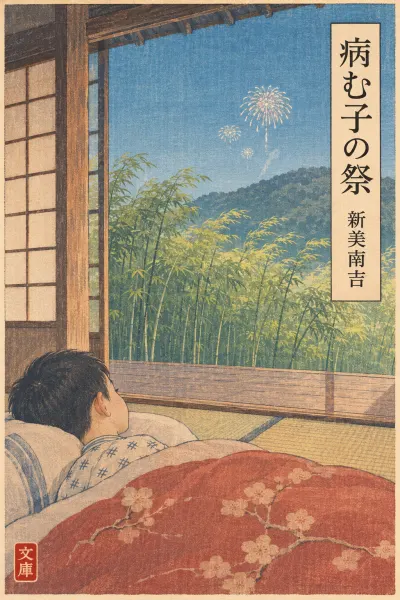
病む子の祭 Yamu Ko no Matsuri, part 1: Dressing Up for the Festival
In this part
On a festival day, a mother dresses her children in their best kimono while the sick little boy Yoshibō sleeps. The children talk about how Yoshibō wants to do everything they do, even go to school despite San-chan (Santa), the sake-shop boy who bullies him, and how thin he has become. Ayako then picks out the camellia-patterned crepe kimono she wore at their father's funeral.
AI translation · independently checked
母MOTHER
長男ELDEST SON
長女ELDEST DAUGHTER
次男SECOND SON
三男(病気の子)THIRD SON (the sick child)
岡のふもとの竹やぶにかこまれた小さい家。A small house surrounded by a bamboo grove at the foot of a hill.
母親が子どもたちに祭の晴着をきせている。The mother is dressing the children in their festival best.
花火の音。The sound of fireworks.
笛、太鼓のゆるやかな、かすかなはやし。The slow, faint music of flutes and drums.
母 よごすんじゃないよ。MOTHER: Don't get them dirty, now.
いつもの着物とちがうんだからね、土塀にもたれたり、土いじりしちゃいけないんだよ。These aren't your everyday clothes, you know, so you mustn't lean against the mud walls or play in the dirt.
それから、袖ではなをふいたりしないでね。And don't go wiping your noses on your sleeves.
ふところから鼻紙を出してはなをかむんだよ。Take the tissue paper out of the front of your kimono and blow your nose with that.
長男 ごわごわするなあ、この着物。ELDEST SON: It's so stiff, this kimono.
母 いい着物だからさ。MOTHER: That's because it's a good one.
ほらいいにおいがするでしょう。There, doesn't it smell nice?
長男 薄荷みたいにすうっとするね。ELDEST SON: It's cool and fresh, like peppermint.
ぼくなんだか、心が軽くなったみたいだ。Somehow it feels as if my heart has got lighter.
わくわくするなあ、さあ早くいこうよ。I'm so excited! Come on, let's hurry up and go.
母 そんな大きな声をたてるんじゃないよ、よし坊が目をさますから。MOTHER: Don't raise your voice like that, you'll wake Yoshibō.
よし坊が目をさましたら、またつれてってくれってきかないから。If Yoshibō wakes up, he'll be begging to be taken along again, and he won't take no for an answer.
長女 おっかさん、よし坊がなにかいってますよ。ELDEST DAUGHTER: Mother, Yoshibō is saying something.
むにゃむにゃって、目をつむったまま、いってますよ。He's mumbling away with his eyes still shut.
母 目をさましたのかしら。MOTHER: I wonder if he's woken up.
そうじゃないわ。No, he hasn't.
なにか夢でもみたのよ。He must be dreaming or something.
長女 なんの夢、みたんでしょう。ELDEST DAUGHTER: I wonder what he's dreaming about.
病気がなおって、たこをあげてる夢かしら。Maybe he's dreaming that he's better and flying a kite.
よし坊は、しょっちゅう、たこをあげたいっていってたから。Yoshibō was always saying he wanted to fly a kite.
長男 それからね、こまもまわしたいって、いってたよ。ELDEST SON: And he said he wanted to spin a top, too.
次男 きのうぼくに、竹馬にのりたいって、いってたよ。SECOND SON: Yesterday he told me he wanted to walk on stilts.
長男 ぼくたちがすること、よし坊は、なんでもしたいんですよ。ELDEST SON: Whatever we do, Yoshibō wants to do it too.
病気のくせしてね。Even though he's sick.
かあさん。Mother.
母 よし坊は、みんなといっしょに、なんでもしたいんですよ。MOTHER: Yoshibō wants to do everything together with all of you.
長女 そうよ、かあさん。ELDEST DAUGHTER: That's right, Mother.
学校へもいきたいんだって。He says he wants to go to school, too.
よし坊をよくいじめた酒屋の三ちゃんがいてもいいのってきいたらね、三ちゃんがいても、学校へいきたいって。I asked him whether it would be all right even if San-chan from the sake shop, the one who used to bully him so much, was there, and he said he'd want to go to school even if San-chan was there.
もう三ちゃんは、よし坊をいじめやしないってさ。He says San-chan won't bully him anymore.
次男 そんなことあるもんかい。SECOND SON: Fat chance of that!
三太はだれでもいじめるんだよ。Santa bullies everybody.
ぼくたちは同級だからいじめないけど、年下のものならだれでもなかすんだ。He doesn't bully us because we're in the same class, but anyone younger than him, he makes them cry.
帽子をとりあげたり、堤の根方におしつけたり、するんだよ。He snatches their caps and shoves them up against the foot of the embankment.
長女 でもね、よし坊は栗の実をポケットにいっぱい持ってって、三ちゃんに、もういじめないでねって、あやまるんだってさ。ELDEST DAUGHTER: But you know, Yoshibō says he'll take a pocketful of chestnuts to San-chan and apologize, saying, 'Please don't bully me anymore.'
よし坊はとても外に出たがるのね。Yoshibō really longs to go outside, doesn't he?
母 そう、外でみんなと遊びたいのさ。MOTHER: Yes, he wants to play outside with everyone.
でも病気だからいけないのですよ。But he's ill, so he can't.
病気がこの子にとりついていて、いかせないんですよ。The illness has taken hold of him and won't let him go.
病気ってどうしてこんな罪もない子にとりつくのでしょう。Why must illness take hold of an innocent child like this, I wonder?
長女 おかあさん、よし坊はずいぶんやせたね。ELDEST DAUGHTER: Mother, Yoshibō has got awfully thin.
手なんかむぎわらみたいね。His hands are like wheat straws.
長男 頭もあや子のゴムまりくらいだ。ELDEST SON: And his head's only about the size of Ayako's rubber ball.
次男 きのう、帽子がかぶりたいっていったからね、ぼくが柱からはずしてきてかぶせてやったら、すこすこしてたよ。SECOND SON: Yesterday he said he wanted to wear his cap, so I took it down off the pillar and put it on him, and it was all loose.
目までかぶさっちゃって、とてもおかしいんだよ。It slid right down over his eyes. It was ever so funny.
母 さあ、たあちゃんはもうこれでいいのよ。MOTHER: There, Tā-chan, you're all done.
こんどは、あや子。Now it's Ayako's turn.
あや子にはどの着物がいいかね。Which kimono would suit Ayako, I wonder?
(たんすをあける)(She opens the chest of drawers.)
長女 あたしは、唐ちりめんがいいわ。ELDEST DAUGHTER: I'd like the Chinese crepe one.
ほら、つばきの花の。You know, the one with the camellias.
母 つばきの花のって?MOTHER: The one with the camellias?
長女 おとうさんのお葬式んとききたのよ。ELDEST DAUGHTER: The one I wore at Father's funeral.
あたしよくおぼえててよ、こっちの肩のとこに、つばきの花がふたつかさなってたわ。I remember it well, you see: right here on this shoulder there were two camellia flowers, one over the other.
こうするとよく見えるのよ。If I do this, I can see them nicely.
花のにおいがかげるくらいのそばに。Close enough to smell the flowers.
母 ああ、これだね、まだきられるかしら。MOTHER: Ah, this is the one. I wonder if you can still wear it.
Vocabulary
| Word | Meaning | JLPT |
|---|---|---|
| ふもとふもと | foot (of a hill or mountain)dictionary form: 麓Usually written in kana or as 麓; 岡のふもと = at the foot of the hill. | N2 |
| 晴着はれぎ | one's best clothes, festival or holiday clothesdictionary form: 晴れ着From 晴れ, the special 'festive' as opposed to everyday, plus 着 'wear'. | — |
| 土塀どべい | mud or earthen wallA wall of packed earth, common around old village houses. | — |
| 鼻紙はながみ | tissue paper for blowing one's noseTraditionally tucked into the ふところ, the fold at the front of a kimono. | — |
| ごわごわごわごわ | stiff, rough (of cloth)Onomatopoeic word for new or starched fabric that does not drape softly. | — |
| 薄荷はっか | peppermintすうっとする describes the cool, refreshing feeling mint gives. | — |
| 竹馬たけうま | stiltsLiterally 'bamboo horse'; a traditional children's toy. | — |
| 年下としした | younger (than oneself)Opposite: 年上 (としうえ), older. | — |
| 根方ねかた | base, foot (of a slope or tree)Somewhat old-fashioned word. | — |
| とりついてとりつく | to take hold of, to possess (of illness or a spirit)dictionary form: 取り付くSuggests something clinging to a person and refusing to let go. | — |
| 罪つみ | sin, guilt罪もない子 = an innocent child who has done nothing wrong. | N3 |
| すこすこすこすこ | loose, too big (of something worn)Rare expressive word; standard Japanese would say ぶかぶか. | — |
| 唐ちりめんとうちりめん | Chinese-style crepe (a soft wool crepe fabric)dictionary form: 唐縮緬ちりめん is a crinkled crepe cloth often used for kimono. | — |
| お葬式そうしき | funeraldictionary form: 葬式んとき is a casual contraction of のとき. | N2 |
Grammar
〜んじゃない N3 don't …! (firm prohibition)
A plain verb plus んじゃない(よ) is a colloquial command not to do something, used by parents to children. It sounds like a warning rather than a question.
よごすんじゃないよ。
Don't get them dirty, now.
〜たり〜たりする N4 do things such as … and …
The たり form lists representative actions without claiming the list is complete. With しちゃいけない it forbids this kind of behaviour in general.
土塀にもたれたり、土いじりしちゃいけないんだよ。
You mustn't lean against the mud walls or play in the dirt.
〜のくせして N3 even though; despite being …
A colloquial variant of のくせに, expressing that someone acts in a way that does not fit their situation. Here it carries more pity than criticism.
病気のくせしてね。
Even though he's sick.
〜もんかい N2 as if …!; no way …
もんか (from ものか) after a plain form strongly denies something; the added い makes it rougher, typical of boys' speech.
そんなことあるもんかい。
Fat chance of that!
〜たがる N4 (someone else) wants to …
たい describes one's own desire; to describe a third person's visible wish, the stem takes たがる, conjugated like a godan verb.
よし坊はとても外に出たがるのね。
Yoshibō really longs to go outside, doesn't he?
〜てよ (feminine) N3 sentence-final emphasis in old-fashioned girls' speech
The te-form plus よ (てよ) is a soft, slightly emphatic sentence ending used mainly by girls and women in older speech. おぼえててよ is おぼえている contracted to おぼえてて plus よ, meaning 'I do remember, you know.'
あたしよくおぼえててよ
I remember it well, you see.