Intermediate · JLPT N3
病む子の祭Yamu Ko no Matsuri — A Festival for the Child in Bed
- JLPT N3
- 9,647 characters
- 7 parts
- about 80 minutes
- 2 easier versions
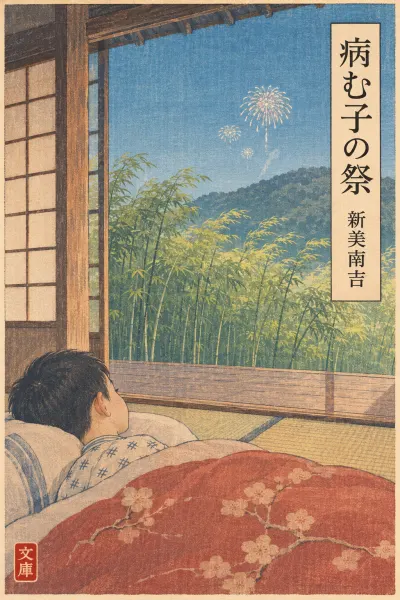
病む子の祭 is a short one-act play by Niimi Nankichi, the author of the well-known children's story ごんぎつね ("Gon, the Little Fox"). It is set on a spring festival day in a small house surrounded by bamboo at the foot of a hill. A mother is getting her children ready to go out to the festival, while the youngest son, Yoshibō, lies sick in bed. The older children chat, tease each other and get scolded. A girl finds a forgotten seed in an old kimono, and a boy has already burned a hole in his new shoe. Then Yoshibō wakes up and wants to go too. On the surface the play is full of ordinary family talk and small jokes, but underneath there is a quiet, growing sadness. Fireworks, drums and flutes from the festival are always in the background. For learners, the play format helps: lines are short, and most of the text is spoken Japanese. The challenge is the children's casual, clipped speech and the girl's old-fashioned feminine endings. You also need to keep track of who is speaking in a lively family scene.
Contents
Easier versions
This story is also retold in simpler Japanese. Reading an easier version first makes the original much more approachable.
Before you read
- This is a play script. Each line starts with the speaker's name, and the stage directions are written in plain narrative Japanese. Read the stage directions carefully, because they tell you who comes in, who leaves, and how Yoshibō's condition changes.
- The boys use casual, clipped speech: わからあ (わかる), いってら (いっている), びっくら (びっくり). They also use rough endings like ~もんかい ("as if…!") and ~やしない ("won't / doesn't at all"). Say these forms aloud and the standard form usually becomes clear.
- Ayako uses old-fashioned feminine endings such as ~てよ and ~ことよ. These are mostly softeners or emphasis, not commands. Read them as a gentle "you know" or "I tell you."
- Notice the children's patterns for complaining and giving reasons: ~んだもの ("but it's because…"), ~のくせして ("even though you're…"), ~ちゃいけない ("you mustn't"), and ~たがる (Yoshibō "wants to" do everything the others do). These carry much of the family's back-and-forth.
- Learn a few festival and household words before you start, such as 祭, 花火, 着物, 靴, 小遣い, 薬, 小鳥, 貝 and 笛. The sounds of the festival outside (fireworks, drums, flutes) come back again and again and set the mood of the last scenes.
Words to know
The most useful words from the notes across the story.
| Word | Meaning | JLPT |
|---|---|---|
| 罪つみ | sin, guilt罪もない子 = an innocent child who has done nothing wrong. | N3 |
| お葬式そうしき | funeraldictionary form: 葬式んとき is a casual contraction of のとき. | N2 |
| あきれたあきれる | to be amazed or exasperateddictionary form: 呆れるあきれた子 is a mild, affectionate scolding. | N2 |
| 衰えるおとろえる | to weaken, to decline | N1 |
| 晴着はれぎ | one's best clothes, festival or holiday clothesdictionary form: 晴れ着From 晴れ, the special 'festive' as opposed to everyday, plus 着 'wear'. | — |
| 枕もとまくらもと | bedside (by the pillow)dictionary form: 枕元 | — |
| 品物しなもの | things, goods, articles | N4 |
| びっくらびっくり | being startled, frighteneddictionary form: びっくりびっくら is a colloquial or dialect variant of びっくり. | N4 |
| お嫁さんよめ | bride, wifedictionary form: 嫁お嫁さんにもらう: to take someone as a bride. | N3 |
| 正直しょうじき | honestly, truthfullyUsed here with に as an adverb: 正直に言う 'to tell honestly'. | N3 |
| まずしいまずしい | poordictionary form: 貧しいA more formal word than お金がない. | N3 |
| 額ひたい | foreheadRead がく it means a framed picture or a sum of money. | N3 |
| 餌え | food for an animal, feedえさ is the more common reading today. 餌をやる means 'to feed (an animal)'. | N3 |
| とりあげられとりあげる | to take away, confiscatedictionary form: 取り上げるThis is the passive form: 'to have something taken away'. | N3 |
| かあいそうかわいそう | pitiful; poor thingdictionary form: 可哀想かあいそう is an old colloquial spelling of かわいそう. | N3 |
Plot summary
Show the full summary (contains spoilers)
On a festival day, a mother dresses her children while the sick youngest son, Yoshibō, sleeps. Ayako tries on the kimono she wore at their father's funeral, and Jirō admits he burned a hole in his new shoe with a lens. Yoshibō wakes up, sees through his mother's excuses and demands to go too. He throws a tantrum when Jirō puts on his shoes. The others leave, but Ayako soon comes back without knowing why. While the mother goes to fetch medicine, Yoshibō, growing weaker, quarrels with Ayako over her baby bird. In the end he holds it gently and gives it back. Ayako digs up a shell he once hid. It fits together with another shell, and he blows into it, saying he can hear the wind and the flutes and is floating away. Terrified, she runs for their mother as cherry petals fall on him.
About the author
Niimi Nankichi was a Japanese writer of children's stories, poems and songs from Handa in Aichi Prefecture. The countryside of that area is widely thought to lie behind the village and hills of Gongitsune. He began writing as a young man. Gongitsune appeared in the children's magazine Akai Tori (The Red Bird), edited by Suzuki Miekichi. Niimi later worked as a teacher at a girls' school while continuing to write. His health was poor, and he died of tuberculosis while still in his twenties. Many of his works were published and became widely known only after his death. Besides Gongitsune, he is especially remembered for Tebukuro wo Kai ni (Buying Mittens).