 N5 · easy
Simplified retelling · JLPT N5
I can speak Aikyansupīku in easy Japanese (N5)
This is our own simplified retelling of A Voice Across the Lane, written for N5 learners and checked word by word against the N5 vocabulary list. A few story words and grammar patterns go beyond N5; the notes below give each one's level. It keeps the characters, events and ending of the original. When it feels easy, move on to the N4 version or the original text.
The story in brief
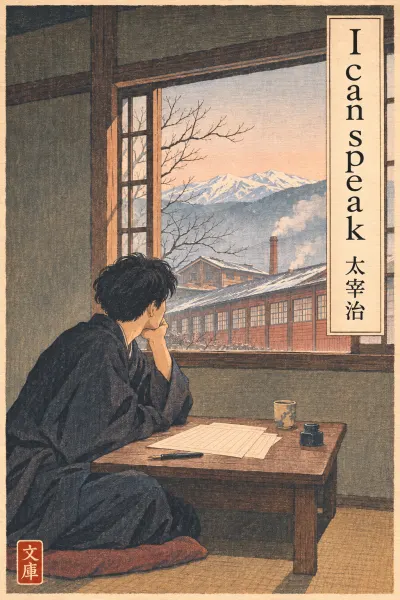
A writer whose song has fallen silent rents a room in a small shop on a mountain to write a long novel, but the cold drives him down to the town of Kōfu. There he loves the voice of a young woman singing at the factory in front of his house, though he never speaks to her. One February night he hears a drunk young man in a white coat talk to his older sister at the factory window, saying "I can speak English", and those words bring a little of his lost song back to him.
AI translation · independently checked
わたしは本を書く男です。I am a man who writes books.
前は、うたを書いていました。Once, I used to write songs.
でも、わたしのうたは、なくなりました。But my songs were lost.
とうきょうで、わたしは長い間、何もしませんでした。In Tokyo, for a long while, I did nothing at all.
それから、少しずつ小さなぶんしょうを書きました。Then, little by little, I wrote short pieces of prose.
だんだん、じぶんの書く物がわかりました。Little by little, I came to understand the kind of thing I write.
そして、長いしょうせつを書きたくなりました。And I came to want to write a long novel.
きょねんの九月、わたしは山の上の小さなみせに行きました。In September of last year, I went to a small shop on top of a mountain.
そこでへやをかりて、しょうせつを書きました。There I rented a room and wrote my novel.
百ページぐらい書きました。I wrote about a hundred pages.
読みました。I read them over.
わるくありませんでした。They were not bad.
わたしはじぶんに言いました。I said to myself:
「このしょうせつがおわるまで、とうきょうにかえりません。」"Until this novel is finished, I will not go back to Tokyo."
でも、それはよくありませんでした。But that was not a good idea.
十月、十一月、山はとてもさむくなりました。In October and November, the mountain grew very cold.
よるは長くて、くらかったです。The nights were long and dark.
とうきょうにかえりたかったです。I wanted to go back to Tokyo.
でも、じぶんに言った言ばがありました。But there were the words I had spoken to myself.
わたしはとてもこまりました。I was at a complete loss.
それで、わたしは山をおりて、こうふというまちに行きました。And so I came down the mountain and went to a town called Kōfu.
こうふは、とうきょうよりあたたかいです。Kōfu is warmer than Tokyo.
わたしはふるい家で、あかるいへやをかりました。In an old house, I rented a bright room.
からだもよくなりました。My health grew better, too.
わたしはまたつくえの前にすわって、少しずつ書きました。Once more I sat down before my desk and wrote, little by little.
ひるごろ、外からわかい女の人たちのうたを聞きました。Around noon, I heard young women singing outside.
家のすぐ前に、こうじょうがありました。Just in front of the house there stood a mill.
そこではたらく女の人たちが、しごとをしながら、うたっていました。The women who worked there were singing as they worked.
その中に一人、とてもいいこえの人がいました。Among them was one with a very fine voice.
その人が、いつも先にうたいました。It was always she who began each song.
わたしはペンをおいて、そのうたを聞きました。I would lay down my pen and listen to that song.
いいこえだなあ。What a lovely voice.
わたしはその人に、おれいを言いたかったです。I wanted to thank her.
その人を、一ど見たかったです。I wanted to see her, just once.
わたしはてがみを書きたかったです。I wanted to write her a letter.
「ここに一人の男がいます。あなたのうたがあるから、わたしは毎日書きます。あなたは、それをしりません。」そのてがみを、こうじょうのまどから入れたかったです。"Here there is a man. Because of your songs, he writes every day. You do not know it." I wanted to slip that letter in through the window of the mill.
でも、てがみを読んで、その人がもううたわなくなったら、こまります。But if she read the letter and then stopped singing, that would be terrible.
わたしは何もしませんでした。I did nothing.
わたしは、そのこえが大すきでした。I loved that voice dearly.
二月の、さむくて、しずかなよるでした。It was a cold, quiet night in February.
外で、おさけをのんだ男が、大きなこえで話していました。Outside, a man who had been drinking was talking in a loud voice.
わたしは、よく聞きました。I listened closely.
「どうしてわらうんだ。ときどき、おさけをのむだけだ。アイ・キャン・スピーク・イングリッシュ。"Whatcha laughin' for? I just have a drink now 'n' then, that's all. I can speak English.
おれは、よるの学校に行っているんだ。おねえさん、しらないだろう。お母さんにも言わないで、行っているんだ。I'm goin' to night school, see. Bet you didn't know that, Sis. Goin' without tellin' Mom, even.
おれは、もうすぐせんそうに行くんだ。それは本とうじゃない。まだわからない。でも、アイ・キャン・スピーク・イングリッシュ。I'm off to the war real soon. Nah, that ain't true. Dunno yet. But, I can speak English.
えいごはいいなあ。おねえさん、おれはいいおとうとだろう?お母さんは、何もわからないんだ。」English is great, huh. Sis, I'm a good little brother, ain't I? Mom, she don't get nothin'."
わたしはまどを少しあけて、下を見ました。I opened the window a little and looked down.
白いはな?A white flower?
いいえ、ちがいました。No, it was not.
それは、おとうとの白いコートでした。It was the younger brother's white coat.
おとうとは、うすい白いコートをきて、さむい中、こうじょうの前にたっていました。The brother, in a thin white coat, was standing in the cold before the mill.
上のこうじょうのまどから、女の人が一人、からだを出して、おとうとを見ていました。From a mill window above, a woman was leaning out and looking down at him.
その人が、おねえさんでした。She was the older sister.
外はくらくて、二人のかおは、よくわかりませんでした。It was dark outside, and I could not clearly make out either of their faces.
おねえさんのまるいかおは白くて、わらっていました。The sister's round face was pale, and she was smiling.
おとうとのかおはくろくて、まだとてもわかかったです。The brother's face was dark, and he was still very young.
アイ・キャン・スピーク。I can speak.
その言ばは、わたしの中に、つよく入りました。Those words went deep into me.
わすれていたうたが、わたしの中に、少しかえってきました。The song I had forgotten came back to me, just a little.
小さな話です。It is a small story.
でも、わたしはあのよるをわすれません。Yet I shall not forget that night.
あの女の人は、あのいいこえの人でしたか。Was that woman the one with the lovely voice?
わたしはしりません。I do not know.
たぶん、ちがう人でしょうね。Most likely she was someone else.
Vocabulary
| Word | Meaning | JLPT |
|---|---|---|
| ぶんしょうぶんしょう | piece of writing, prosedictionary form: 文章Any written text. Here it means short prose pieces, as opposed to songs or poems. | N5 |
| だんだんだんだん | gradually, little by littleUsed for slow change over time. | N1 |
| しょうせつしょうせつ | novel, storydictionary form: 小説Kanji: 小 (small) + 説 (explain, tale). | N4 |
| かりてかりる | to rent, to borrowdictionary form: 借りるThe opposite is 貸す (かす), 'to lend'. | N5 |
| こまりましたこまる | to be troubled, to be at a lossdictionary form: 困るAlso used to say something would be bad or inconvenient, as in こまります. | N5 |
| おりておりる | to come down (a mountain)dictionary form: 下りるAlso used for getting off a train or bus (降りる). | N5 |
| こうじょうこうじょう | factory, milldictionary form: 工場In this story it is a silk mill where young women work. | N4 |
| はたらくはたらく | to work (at a job)dictionary form: 働く | N5 |
| おれいおれい | thanks, gratitudedictionary form: お礼おれいを言う means 'to say thank you'. | N4 |
| せんそうせんそう | wardictionary form: 戦争せんそうに行く means 'to go off to war'. The story was written in the late 1930s. | N4 |
| うすいうすい | thindictionary form: 薄いThe opposite is あつい (厚い), 'thick'. A thin coat on a cold night. | N5 |
| 言ばことば | word(s)dictionary form: 言葉Read ことば, not げんば. Usually written 言葉. | N5 |
| わすれていたわすれる | to forgetdictionary form: 忘れるわすれていた means 'which I had forgotten'. | N5 |
Grammar
〜ながら N4 while doing ~
Attach ながら to the verb stem (し-) to show two actions happening at the same time. The main action, singing, comes at the end.
そこではたらく女の人たちが、しごとをしながら、うたっていました。
The women who worked there were singing as they worked.
〜たかった N5 wanted to ~
Verb stem + たい means 'want to'. It changes like an i-adjective, so the past tense is たかった.
わたしはその人に、おれいを言いたかったです。
I wanted to thank her.
〜まで N5 until ~
Dictionary-form verb + まで marks the point when something stops. The narrator will not go back until the novel is finished.
このしょうせつがおわるまで、とうきょうにかえりません。
Until this novel is finished, I will not go back to Tokyo.
〜なくなる / 〜たら N4 stop doing ~ / if ~
Negative ない + なる means 'come to not do', that is, to stop doing something. The past form + ら (なくなったら) makes an 'if' clause: if she stopped singing.
てがみを読んで、その人がもううたわなくなったら、こまります。
If she read the letter and then stopped singing, that would be terrible.
〜んだ N4 explaining or emphasizing
Plain form + んだ is a casual, spoken way to explain or stress something. The drunk brother keeps using it to insist on what he says.
おれは、よるの学校に行っているんだ。
I'm goin' to night school, see.
〜でしょう N5 probably ~
でしょう shows a guess. Together with たぶん and the soft ね, it gives a gentle, uncertain ending.
たぶん、ちがう人でしょうね。
Most likely she was someone else.