Part 2 of 7 · JLPT N2
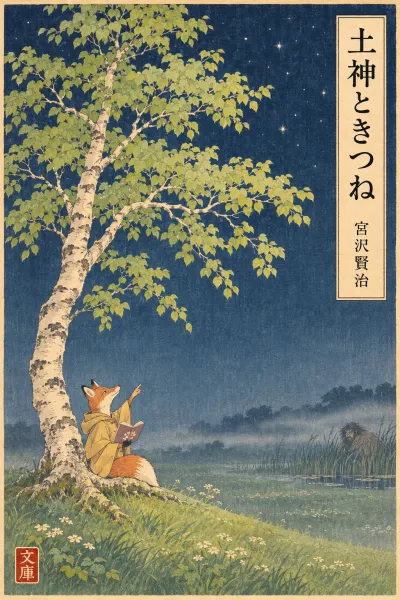
土神ときつね Dojin to Kitsune, part 2: A Lie Under the Stars, a God at Dawn
In this part
To please the birch tree, the fox falsely claims he has ordered a telescope from Germany, then privately regrets having lied to her again. He lends her a book of Heine's poems, which she reads all night by starlight. The next morning the Earth God arrives and begins musing gruffly about why plants that grow from dark soil, even seedless autumn mushrooms, come in so many colours.
AI translation · independently checked
「まあ、あたしいつか見たいわ。魚の口の形の星だなんてまあどんなに立派でしょう。」"Oh, I'd love to see it some day. A star shaped like a fish's mouth—how splendid it must be!"
「それは立派ですよ。僕水沢の天文台で見ましたがね。」"It is splendid indeed. I saw it at the observatory in Mizusawa, you know."
「まあ、あたしも見たいわ。」"Oh, I want to see it too."
「見せてあげましょう。僕実は望遠鏡を独乙のツァイスに注文してあるんです。来年の春までには来ますから来たらすぐ見せてあげましょう。」狐は思わず斯う云ってしまいました。"I'll show it to you. As a matter of fact, I've ordered a telescope from Zeiss in Germany. It will arrive by next spring, and as soon as it comes I'll show it to you." The fox said this before he could stop himself.
そしてすぐ考えたのです。And at once he began to think.
ああ僕はたった一人のお友達にまたつい偽を云ってしまった。Oh, I've gone and told a lie again, without meaning to, to my one and only friend.
ああ僕はほんとうにだめなやつだ。Oh, I really am a hopeless fellow.
けれども決して悪い気で云ったんじゃない。But I certainly didn't say it out of ill will.
よろこばせようと思って云ったんだ。I said it because I wanted to make her happy.
あとですっかり本当のことを云ってしまおう、狐はしばらくしんとしながら斯う考えていたのでした。Later I'll tell her the whole truth—so the fox thought, falling quiet for a while.
樺の木はそんなことも知らないでよろこんで言いました。The birch tree, knowing nothing of this, spoke with delight.
「まあうれしい。あなた本当にいつでも親切だわ。」"Oh, how wonderful. You really are always so kind."
狐は少し悄気ながら答えました。The fox answered, a little crestfallen.
「ええ、そして僕はあなたの為ならばほかのどんなことでもやりますよ。この詩集、ごらんなさいませんか。ハイネという人のですよ。翻訳ですけれども仲々よくできてるんです。」"Yes, and for your sake I would do anything else at all. Would you care to look at this book of poems? They're by a man called Heine. It's a translation, but quite a well-made one."
「まあ、お借りしていいんでしょうかしら。」"Oh, may I really borrow it, I wonder?"
「構いませんとも。どうかゆっくりごらんなすって。じゃ僕もう失礼します。はてな、何か云い残したことがあるようだ。」"By all means. Please take your time with it. Well, I must be going now. Hmm, I feel there's something I've left unsaid."
「お星さまのいろのことですわ。」"It's about the colours of the stars."
「ああそうそう、だけどそれは今度にしましょう。僕あんまり永くお邪魔しちゃいけないから。」"Ah yes, yes—but let's leave that for next time. I mustn't impose on you too long."
「あら、いいんですよ。」"Oh, but it's quite all right."
「僕又来ますから、じゃさよなら。本はあげてきます。じゃ、さよなら。」狐はいそがしく帰って行きました。"I'll come again, so goodbye for now. I'll leave the book with you. Well, goodbye." And the fox hurried off home.
そして樺の木はその時吹いて来た南風にざわざわ葉を鳴らしながら狐の置いて行った詩集をとりあげて天の川やそらいちめんの星から来る微かなあかりにすかして頁を繰りました。Then the birch tree, rustling her leaves in the south wind that had just begun to blow, took up the book of poems the fox had left behind and turned its pages, holding them up to the faint light that came from the Milky Way and the stars that filled the whole sky.
そのハイネの詩集にはロウレライやさまざま美しい歌がいっぱいにあったのです。That book of Heine's was full of the Lorelei and all sorts of other beautiful songs.
そして樺の木は一晩中よみ続けました。And the birch tree went on reading all night long.
ただその野原の三時すぎ東から金牛宮ののぼるころ少しとろとろしただけでした。Only once, a little past three in the meadow, when Taurus was rising in the east, did she doze off for a short while.
夜があけました。The night ended.
太陽がのぼりました。The sun rose.
草には露がきらめき花はみな力いっぱい咲きました。Dew glittered on the grass, and every flower bloomed with all its might.
その東北の方から熔けた銅の汁をからだ中に被ったように朝日をいっぱいに浴びて土神がゆっくりゆっくりやって来ました。From the north-east, bathed in morning sunlight as though he had poured molten copper all over his body, the Earth God came slowly, slowly along.
いかにも分別くさそうに腕を拱きながらゆっくりゆっくりやって来たのでした。He came slowly, slowly, with his arms folded, looking ever so wise and thoughtful.
樺の木は何だか少し困ったように思いながらそれでも青い葉をきらきらと動かして土神の来る方を向きました。The birch tree felt somehow a little troubled, yet she still set her green leaves glittering and turned towards the way the Earth God was coming.
その影は草に落ちてちらちらちらちらゆれました。Her shadow fell on the grass and flickered and trembled there.
土神はしずかにやって来て樺の木の前に立ちました。The Earth God came quietly up and stood in front of the birch tree.
「樺の木さん。お早う。」"Birch tree. Good morning."
「お早うございます。」"Good morning to you, sir."
「わしはね、どうも考えて見るとわからんことが沢山ある、なかなかわからんことが多いもんだね。」"I tell ye, when I think it over, there's a great deal I can't make out. A great many things are mighty hard to understand."
「まあ、どんなことでございますの。」"Oh, what sort of things might those be, sir?"
「たとえばだね、草というものは黒い土から出るのだがなぜこう青いもんだろう。黄や白の花さえ咲くんだ。どうもわからんねえ。」"Take this, for instance. Grass comes up out of black earth, so why is it so green? Why, it even grows yellow and white flowers. I can't make it out at all."
「それは草の種子が青や白をもっているためではないでございましょうか。」"Might it not be because the seeds of the grass hold the green and the white within them, sir?"
「そうだ。まあそう云えばそうだがそれでもやっぱりわからんな。たとえば秋のきのこのようなものは種子もなし全く土の中からばかり出て行くもんだ、それにもやっぱり赤や黄いろやいろいろある、わからんねえ。」"Aye. Well, put that way, so it is, but still I can't make it out. Take the mushrooms of autumn, say—they have no seeds, they just come up out of the earth and nothing else, and yet they too are red and yellow and all manner of colours. I can't make it out."
Vocabulary
| Word | Meaning | JLPT |
|---|---|---|
| 天文台てんもんだい | astronomical observatory天文 = astronomy, 台 = platform/station. | — |
| 望遠鏡ぼうえんきょう | telescopeLiterally 'far-gazing mirror/lens'. | N2 |
| 思わずおもわず | without thinking; before one could stop oneselfOften paired with 〜てしまう for an unintended action. | N3 |
| 偽うそ | lie, falsehood (normally written 嘘; 偽 read うそ is the author's spelling)Normally written 嘘 today; 偽 is usually read にせ/いつわり. Older texts often use unusual kanji for common words. | — |
| ついつい | inadvertently, without meaning toExpresses regret at doing something out of habit or impulse. | — |
| 悄気しょげる | to be dejected, crestfallendictionary form: 悄気るUsually written in kana today. | — |
| 詩集ししゅう | collection of poems, poetry book | — |
| 仲々なかなか | quite, rather (well)dictionary form: なかなかOld spelling of なかなか; with a negative it means 'not easily'. | N4 |
| 邪魔じゃま | hindrance; お邪魔する = to impose on someone, to visitPolite set phrase when visiting or taking up someone's time. | N4 |
| すかしてすかす | to hold up to the light to see throughdictionary form: 透かす〜にすかす = look at something against a light source. | — |
| 繰りましたくる | to turn (pages)dictionary form: 繰る頁を繰る is a set literary expression. | — |
| とろとろとろとろ | dozing lightlyMimetic word; とろとろする = to doze off. | — |
| 分別くさそうふんべつくさい | looking (affectedly) wise and sensibledictionary form: 分別くさい〜くさい adds 'smacking of'; slightly ironic. Read ふんべつ here, not ぶんべつ (= sorting waste). | — |
| 拱きこまねく | to fold one's armsdictionary form: 拱く腕を拱く: folding arms in thought, or standing idle. Also こまぬく. | — |
Grammar
〜てしまう N4 to end up doing (regrettably)
Attached to the te-form, it shows an action is done and cannot be undone, often with regret. With つい it stresses that the fox lied without meaning to.
ああ僕はたった一人のお友達にまたつい偽を云ってしまった。
Oh, I've gone and told a lie again, without meaning to, to my one and only friend.
〜てある N4 has been done (and the result remains)
A transitive verb in te-form plus ある describes a completed action whose result is still in place. The fox claims the order has already been placed and is pending.
僕実は望遠鏡を独乙のツァイスに注文してあるんです。
As a matter of fact, I've ordered a telescope from Zeiss in Germany.
〜ようと思う N4 to intend to do
The volitional form plus と思う expresses intention. Here it combines with the causative よろこばせる: 'I meant to make her happy'.
よろこばせようと思って云ったんだ。
I said it because I wanted to make her happy.
〜ないで N4 without doing; while not doing
The negative ない plus で describes the state in which the next action happens. The birch speaks happily while not knowing the fox's thoughts.
樺の木はそんなことも知らないでよろこんで言いました。
The birch tree, knowing nothing of this, spoke with delight.
〜とも N2 of course, certainly
Sentence-final とも after a statement adds strong assurance. 構いませんとも means 'it's no trouble at all, by all means'.
構いませんとも。
By all means.
〜ん (negative) N2 colloquial negative of 〜ない
〜ん is a colloquial contraction of the negative (from older ぬ): わからん = わからない. It is common in western dialects and in older, gruff-sounding speech, and here it helps mark the Earth God's old-fashioned manner of talking.
わしはね、どうも考えて見るとわからんことが沢山ある
I tell ye, when I think it over, there's a great deal I can't make out.