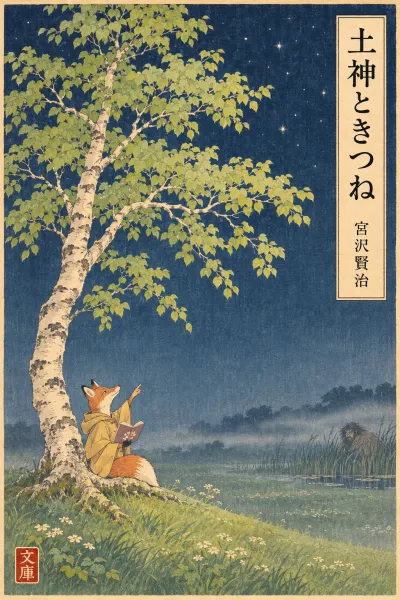
Part 3 of 7 · JLPT N2
土神ときつね Dojin to Kitsune, part 3: The Earth God's Jealous Rage
In this part
The birch tree innocently suggests asking the fox, and the Earth God flies into a jealous fury, cursing the fox and then the humans who neglect his festival. He storms back to his gloomy, rust-stained marsh, where he frightens a passing bird and, on glimpsing the birch in the distance, tears at his hair. A woodcutter passes the marsh nervously, unable to see the god.
AI translation · independently checked
「狐さんにでも聞いて見ましたらいかがでございましょう。」"Perhaps you might try asking Mr. Fox?"
樺の木はうっとり昨夜の星のはなしをおもっていましたのでつい斯う云ってしまいました。The birch tree had been dreamily recalling last night's talk about the stars, and so she said this without thinking.
この語を聞いて土神は俄かに顔いろを変えました。When he heard these words, the Earth God's face suddenly changed colour.
そしてこぶしを握りました。And he clenched his fists.
「何だ。狐? 狐が何を云い居った。」"What's that? The fox? What has the fox been saying?"
樺の木はおろおろ声になりました。The birch tree's voice began to tremble.
「何も仰っしゃったんではございませんがちょっとしたらご存知かと思いましたので。」"He didn't say anything at all, sir, but I just thought he might possibly know."
「狐なんぞに神が物を教わるとは一体何たることだ。えい。」"A god being taught things by the likes of a fox — what in the world is that supposed to mean? Bah!"
樺の木はもうすっかり恐くなってぷりぷりぷりぷりゆれました。The birch tree was now thoroughly frightened, and she shook and shook and shook.
土神は歯をきしきし噛みながら高く腕を組んでそこらをあるきまわりました。Grinding his teeth, the Earth God folded his arms high on his chest and paced all around.
その影はまっ黒に草に落ち草も恐れて顫えたのです。His shadow fell pitch-black across the grass, and even the grass shivered in fear.
「狐の如きは実に世の害悪だ。ただ一言もまことはなく卑怯で臆病でそれに非常に妬み深いのだ。うぬ、畜生の分際として。」"A creature like the fox is truly a plague upon the world. There's not one word of truth in him; he's sneaky and cowardly, and terribly jealous besides. Curse him, a mere beast like that!"
樺の木はやっと気をとり直して云いました。At last the birch tree pulled herself together and spoke.
「もうあなたの方のお祭も近づきましたね。」"Your festival will soon be here, won't it?"
土神は少し顔色を和げました。The Earth God's expression softened a little.
「そうじゃ。今日は五月三日、あと六日だ。」"That's right. Today is the third of May — six more days to go."
土神はしばらく考えていましたが俄かに又声を暴らげました。The Earth God thought for a while, but then suddenly raised his voice again.
「しかしながら人間どもは不届だ。近頃はわしの祭にも供物一つ持って来ん、おのれ、今度わしの領分に最初に足を入れたものはきっと泥の底に引き擦り込んでやろう。」土神はまたきりきり歯噛みしました。"And yet those humans are insolent. These days they don't bring a single offering even to my festival. Damn them! The next one to set foot in my domain, I'll drag him down to the bottom of the mud, see if I don't!" And the Earth God ground his teeth again.
樺の木は折角なだめようと思って云ったことが又もや却ってこんなことになったのでもうどうしたらいいかわからなくなりただちらちらとその葉を風にゆすっていました。The birch tree had meant to soothe him, yet once again her words had only made things worse, and now she no longer knew what to do; she could only let her leaves flutter and flicker in the wind.
土神は日光を受けてまるで燃えるようになりながら高く腕を組みキリキリ歯噛みをしてその辺をうろうろしていましたが考えれば考えるほど何もかもしゃくにさわって来るらしいのでした。The Earth God, catching the sunlight until he seemed almost to be on fire, wandered about with his arms folded high, grinding his teeth, and it seemed that the more he thought, the more everything enraged him.
そしてとうとうこらえ切れなくなって、吠えるようにうなって荒々しく自分の谷地に帰って行ったのでした。And at last, unable to bear it any longer, he gave a howling growl and stormed off back to his own marsh.
(三)(Three)
土神の棲んでいる所は小さな競馬場ぐらいある、冷たい湿地で苔やからくさやみじかい蘆などが生えていましたが又所々にはあざみやせいの低いひどくねじれた楊などもありました。The place where the Earth God lived was a cold wetland about the size of a small racecourse, where moss, sedge and short reeds grew, and here and there were thistles and low, badly twisted willows.
水がじめじめしてその表面にはあちこち赤い鉄の渋が湧きあがり見るからどろどろで気味も悪いのでした。The water was soggy, red iron scum welled up on its surface in places, and it looked so muddy that it was eerie just to see.
そのまん中の小さな島のようになった所に丸太で拵えた高さ一間ばかりの土神の祠があったのです。In the middle of it, in a spot like a small island, stood the Earth God's shrine, built of logs and about six feet high.
土神はその島に帰って来て祠の横に長々と寝そべりました。The Earth God came back to that island and stretched out full length beside the shrine.
そして黒い瘠せた脚をがりがり掻きました。Then he scratched and scratched at his thin black legs.
土神は一羽の鳥が自分の頭の上をまっすぐに翔けて行くのを見ました。The Earth God saw a bird flying straight over his head.
すぐ土神は起き直って「しっ」と叫びました。At once he sat up and shouted, "Shh!"
鳥はびっくりしてよろよろっと落ちそうになりそれからまるではねも何もしびれたようにだんだん低く落ちながら向うへ遁げて行きました。The bird was so startled that it reeled and nearly fell, and then, as though its wings and everything else had gone numb, it fled into the distance, sinking lower and lower.
土神は少し笑って起きあがりました。The Earth God laughed a little and got to his feet.
けれども又すぐ向うの樺の木の立っている高みの方を見るとはっと顔色を変えて棒立ちになりました。But as soon as he looked toward the rise in the distance where the birch tree stood, his face suddenly changed colour and he froze stock-still.
それからいかにもむしゃくしゃするという風にそのぼろぼろの髪毛を両手で掻きむしっていました。Then, looking thoroughly irritated, he tore at his ragged hair with both hands.
その時谷地の南の方から一人の木樵がやって来ました。Just then a woodcutter came along from the south side of the marsh.
三つ森山の方へ稼ぎに出るらしく谷地のふちに沿った細い路を大股に行くのでしたがやっぱり土神のことは知っていたと見えて時々気づかわしそうに土神の祠の方を見ていました。He seemed to be heading off to work toward Mitsumoriyama, striding along the narrow path that ran beside the edge of the marsh, but it appeared he knew about the Earth God after all, for every now and then he glanced anxiously toward the god's shrine.
けれども木樵には土神の形は見えなかったのです。The woodcutter, however, could not see the Earth God's form.
Vocabulary
| Word | Meaning | JLPT |
|---|---|---|
| うっとりうっとり | dreamily, entrancedDescribes being lost in a pleasant feeling or memory. | — |
| 俄かににわか | suddenly, abruptlydictionary form: 俄かLiterary; everyday speech would use 急に. | N2 |
| おろおろおろおろ | flustered, trembling with nervousnessおろおろ声 is a voice shaky with fear or confusion. | — |
| 卑怯ひきょう | sneaky, cowardly, underhanded | N2 |
| 妬み深いねたみぶかい | deeply jealous, envious by nature妬み (envy) + 深い; ironic, since the god himself is the jealous one. | — |
| 分際ぶんざい | one's (lowly) station〜の分際で/として scolds someone for acting above their place. | — |
| 供物くもつ | offering (to a god or spirit) | — |
| 領分りょうぶん | territory, domain | — |
| 歯噛みはがみ | grinding one's teeth (in anger or frustration) | — |
| なだめようなだめる | to soothe, to calm someone downdictionary form: 宥める | — |
| しゃくにさわってしゃくにさわる | to irritate, to get on one's nervesdictionary form: 癪に障る | — |
| 谷地やち | marsh, boggy lowlandRegional word common in northern Japan. | — |
| 祠ほこら | small wayside shrine | — |
| 木樵きこり | woodcutter | — |
Grammar
〜たらいかがでございましょう N2 how about doing ~? (very polite suggestion)
A very polite way to suggest doing something ('How about ~?'). It is 〜たらどうですか made more formal: いかが replaces どう, and でございましょう (the polite でございます form) replaces でしょう. The birch uses it to offer advice deferentially to the god.
狐さんにでも聞いて見ましたらいかがでございましょう。
Perhaps you might try asking Mr. Fox?
つい〜てしまう N3 to do something without meaning to
つい marks an unintended, reflexive action, and てしまう adds regret or the sense that it cannot be undone.
つい斯う云ってしまいました。
she said this without thinking.
〜とは一体何たることだ N1 what on earth is the meaning of ~! (indignation)
〜とは picks out a situation as shocking, and 何たること is a stiff, old-fashioned exclamation of outrage, fitting the god's archaic speech.
狐なんぞに神が物を教わるとは一体何たることだ。
A god being taught things by the likes of a fox — what in the world is that supposed to mean?
〜の如き N1 the likes of ~, such as ~
A literary form of 〜のような. Here it carries contempt, lumping the fox into a despised category.
狐の如きは実に世の害悪だ。
A creature like the fox is truly a plague upon the world.
〜ば〜ほど N3 the more ~, the more ~
The verb is repeated in conditional form and then plain form plus ほど, showing that one thing increases along with another.
考えれば考えるほど何もかもしゃくにさわって来るらしいのでした。
it seemed that the more he thought, the more everything enraged him.
〜と見えて N1 it appears that ~, apparently ~
Draws a conclusion from visible evidence: the woodcutter's anxious glances show that he knew about the god.
やっぱり土神のことは知っていたと見えて時々気づかわしそうに土神の祠の方を見ていました。
it appeared he knew about the Earth God after all, for every now and then he glanced anxiously toward the god's shrine.