Advanced · JLPT N1
悟浄歎異Gojōtanni — Gojō Looks On in Wonder
- JLPT N1
- 12,427 characters
- 7 parts
- about 104 minutes
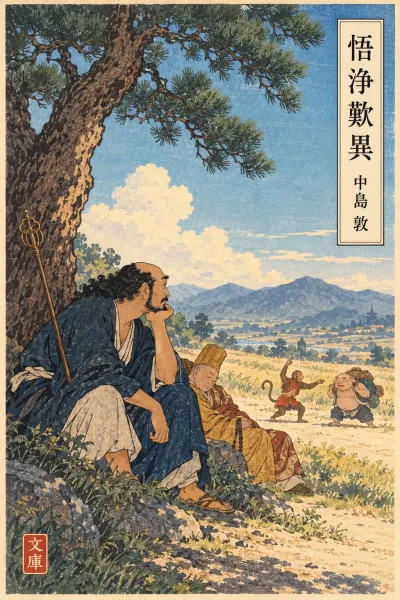
悟浄歎異 is Nakajima Atsushi's retelling of characters from the Chinese classic Journey to the West (西遊記). It is written as the private notes of Gojō, the most thoughtful of Sanzō's three disciples. Very little happens in the present. There is an afternoon rest by the roadside, a transformation lesson that goes badly wrong for Hakkai, and a night under a great tree. Most of the text is Gojō watching his companions and trying to understand them: Gokū's fiery genius, Hakkai's talent for pleasure, and the puzzling strength of their weak master. Gojō also recalls Gokū's legendary battles, including the duel with the Bull Demon King and the trap of the golden cymbal. The tone is essayistic, wry and quietly self-critical. For learners, the attraction is the ideas: what genius is, why book learning can feel poor, and what real courage is. The difficulty is the language. Rated N1, the narration uses dense abstract vocabulary and literary grammar, and the battle chronicle switches into terse kanbun-style diction. If you already know the basic Journey to the West story, the episodes will be much easier to follow.
Contents
Before you read
- Learn the cast and their alternate names before you start. Gokū also appears as 孫行者 and 斉天大聖, Hakkai as 猪悟能八戒, and Sanzō as 三蔵法師. Many demon, deity and mountain names, such as 牛魔大王, 黄眉老仏 and 五行山, appear only once, so treat them as labels rather than vocabulary to memorize.
- Gojō's reasoning moves through a few literary patterns again and again. Expect 〜には違いない (surely), 〜というよりは、むしろ〜 (rather than X, actually Y), 〜ないではいられない (cannot help but), 〜ないではない (it isn't that…not), 〜のごとき (like) and 〜がゆえに (because). Once you recognise these, his long analytical sentences become much easier to break apart.
- In part 2, the Bull Demon King battle record, and in part 4, the Buddha episode, the style switches to classical kanbun-like phrasing: 曰く, sentence endings in 〜たり and 〜す, and short clipped clauses. Read these as a formal chronicle where each clause is one action. Don't try to parse them as modern Japanese.
- Expect abstract Sino-Japanese vocabulary about character and thought, such as 天才, 自信, 意志, 必然, 肯定 and 愛憐. These words carry the essay's argument, so learning them first will help more than the battle vocabulary.
- Notice the shifts in voice. Gojō narrates in plain だ/である with 俺, and occasionally 私. Gokū and Hakkai talk in blunt, casual male speech, while Sanzō uses an old man's わし. These differences help you tell who is speaking when the dialogue tags are short.
Words to know
The most useful words from the notes across the story.
| Word | Meaning | JLPT |
|---|---|---|
| 驚嘆きょうたん | amazement, wonder, admiration | — |
| 変化へんげ | magical transformation, shape-shiftingRead へんげ in this supernatural sense, not へんか (change). | N3 |
| 覚悟かくご | resolve, readiness (for the worst)死ぬ覚悟 = being prepared to die. | N3 |
| 納得なっとく | being convinced; accepting something as reasonable納得できる = to be able to accept or agree with something. | N3 |
| 吸収きゅうしゅう | absorption; taking in吸 'suck in' + 収 'gather'. | N3 |
| 機嫌きげん | mood, temper機嫌が悪い = in a bad mood; ご機嫌 = good mood. | N3 |
| 焦がすこがす | to scorch, to singeIntransitive partner: 焦げる (to get burnt). | N2 |
| 心得ているこころえる | to know well, understand thoroughlydictionary form: 心得るImplies practical, working knowledge. | N2 |
| てんでてんで | (not) at allColloquial; used with negatives. | N1 |
| 促すうながす | to urge, to prompt, to spur on | N1 |
| 点火てんか | ignition, setting fire to点火する = to light, ignite (fuses, engines). | N1 |
| 愧じるはじる | to be ashamed ofUsually written 恥じる; 愧 is a rarer literary kanji. | N1 |
| 茫然ぼうぜん | dazed, stunnedUsually 茫然として or 茫然と; also written 呆然. | N1 |
| 退治するたいじ | to exterminate, subdue (monsters, pests)dictionary form: 退治Classic word for slaying demons in folk tales. | N1 |
| 権威けんい | authority; prestige | N1 |
Plot summary
Show the full summary (contains spoilers)
While Sanzō naps, Gokū coaches Hakkai in transforming into a dragon. Hakkai fails, and Gokū explains that transformation depends on pure concentration of will. Gojō reflects on Gokū's genius: his delight in the world, his beauty in battle, his practical wisdom despite being illiterate, and his indifference to death. He recalls the fight on Mount Suiun, the escape from Kōbi Rōbutsu's cymbal, and Gokū's humbling by the Buddha, which ended in five hundred years under Mount Gogyō and lifelong gratitude to Sanzō. Gojō concludes that the frail Sanzō is strong in a different way. He sees clearly how pitiful and precious life is, yet calmly affirms it. Turning to Hakkai and finally to himself, Gojō admits that he has learned nothing and resolves to get close to Gokū. Lying awake that night, he feels lonely, grasps the compassion in Sanzō's eyes, and feels a small, warm light kindled in his heart.
About the author
Nakajima Atsushi was born in Tokyo into a family of scholars of the Chinese classics, a background that shows clearly in his style. After studying Japanese literature at Tokyo Imperial University, he taught at a girls' school in Yokohama. He later went to Palau, then under Japanese administration, to prepare Japanese-language textbooks for the South Seas Bureau. His small body of work includes several stories drawn from Chinese history and legend, among them Meijinden and Riryō.